Question: Please! I need help with this question, answer the question of the first image in reference to the other images , I would greatly appreciate
Please! I need help with this question, answer the question of the first image in reference to the other images, I would greatly appreciate it. The answer has to be based on what the documents of the other images say. For more ease, read the subtitles and guide yourself from there to know which parts are necessary to read and take away a little work. Thanks!!!
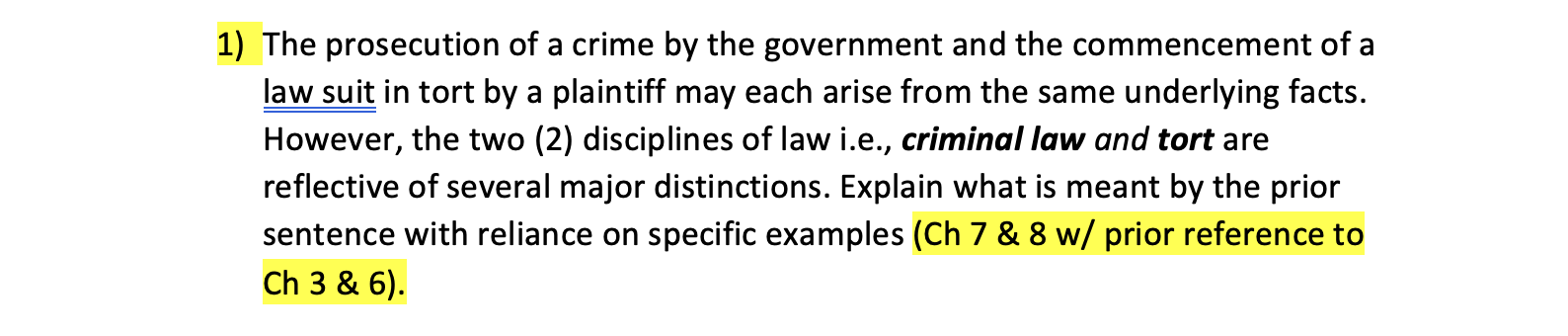
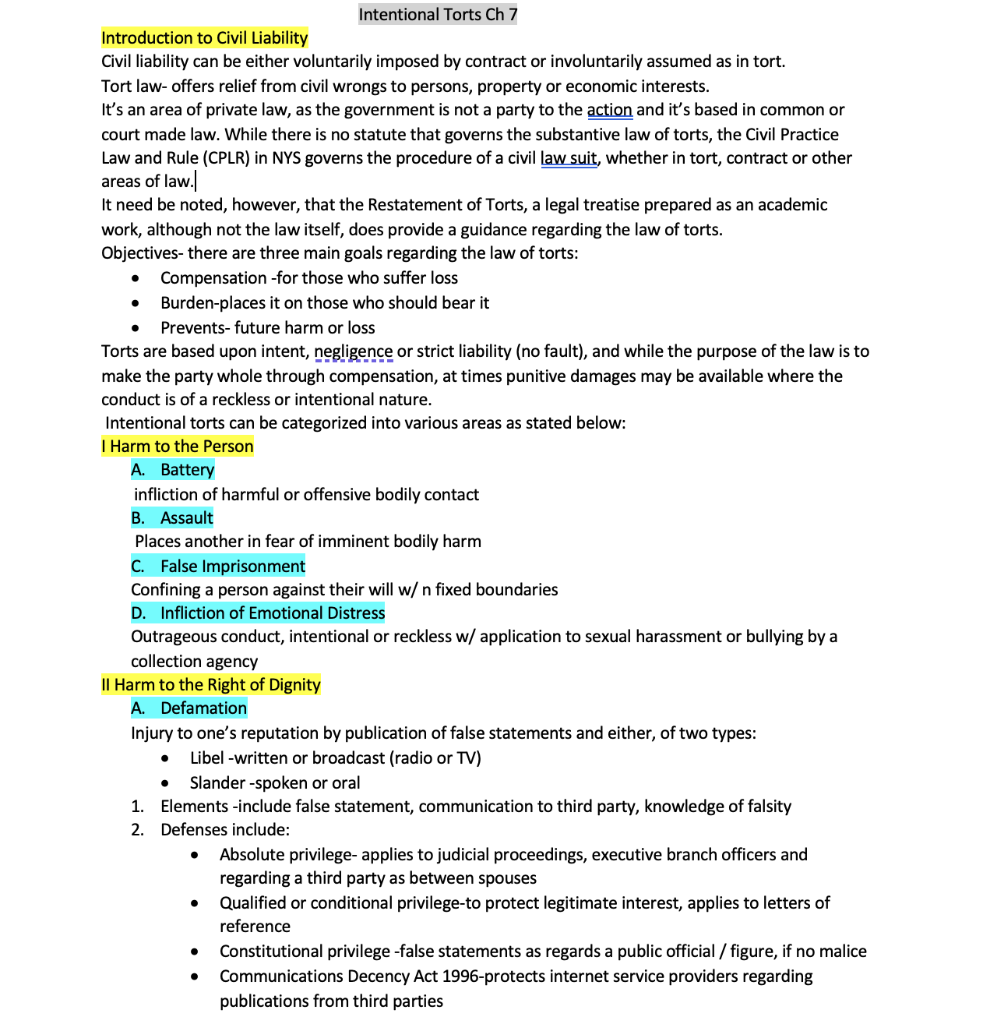
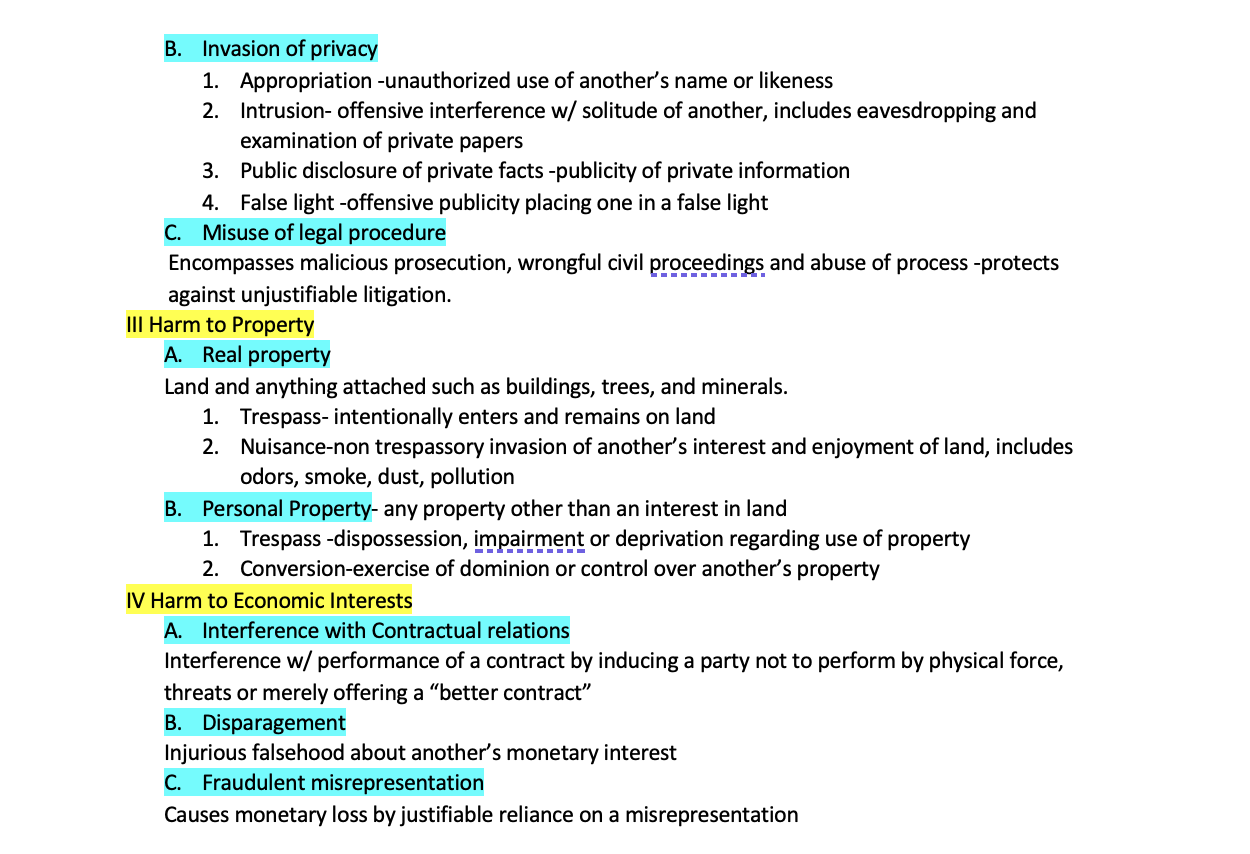
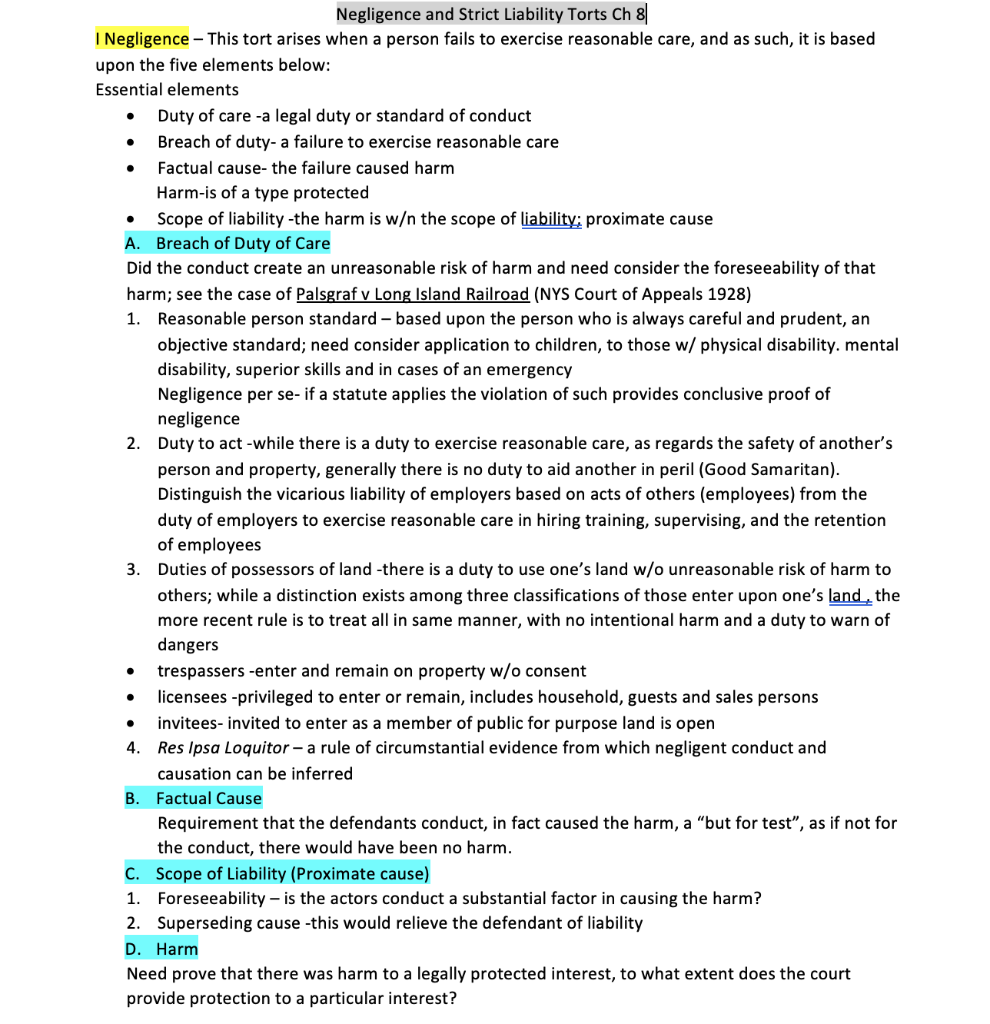
1) The prosecution of a crime by the government and the commencement of a law suit in tort by a plaintiff may each arise from the same underlying facts. However, the two (2) disciplines of law i.e., criminal law and tort are reflective of several major distinctions. Explain what is meant by the prior sentence with reliance on specific examples (Ch 7 & 8 w/ prior reference to Ch 3 & 6). Intentional Torts Ch 7 Introduction to Civil Liability Civil liability can be either voluntarily imposed by contract or involuntarily assumed as in tort. Tort law- offers relief from civil wrongs to persons, property or economic interests. It's an area of private law, as the government is not a party to the action and it's based in common or court made law. While there is no statute that governs the substantive law of torts, the Civil Practice Law and Rule (CPLR) in NYS governs the procedure of a civil law suit, whether in tort, contract or other areas of law. It need be noted, however, that the Restatement of Torts, a legal treatise prepared as an academic work, although not the law itself, does provide a guidance regarding the law of torts. Objectives- there are three main goals regarding the law of torts: Compensation -for those who suffer loss Burden-places it on those who should bear it Prevents- future harm or loss Torts are based upon intent, negligence or strict liability (no fault), and while the purpose of the law is to make the party whole through compensation, at times punitive damages may be available where the conduct is of a reckless or intentional nature. Intentional torts can be categorized into various areas as stated below: I Harm to the Person A. Battery infliction of harmful or offensive bodily contact B. Assault Places another in fear of imminent bodily harm C. False Imprisonment Confining a person against their will w/ n fixed boundaries D. Infliction of Emotional Distress Outrageous conduct, intentional or reckless w/ application to sexual harassment or bullying by a collection agency II Harm to the Right of Dignity A. Defamation Injury to one's reputation by publication of false statements and either, of two types: Libel-written or broadcast (radio or TV) Slander -spoken or oral 1. Elements -include false statement, communication to third party, knowledge of falsity 2. Defenses include: Absolute privilege- applies to judicial proceedings, executive branch officers and regarding a third party as between spouses Qualified or conditional privilege-to protect legitimate interest, applies to letters of reference Constitutional privilege -false statements as regards a public official/figure, if no malice Communications Decency Act 1996-protects internet service providers regarding publications from third parties B. Invasion of privacy 1. Appropriation -unauthorized use of another's name or likeness 2. Intrusion-offensive interference w/ solitude of another, includes eavesdropping and examination of private papers 3. Public disclosure of private facts -publicity of private information 4. False light -offensive publicity placing one in a false light C. Misuse of legal procedure Encompasses malicious prosecution, wrongful civil proceedings and abuse of process -protects against unjustifiable litigation. III Harm to Property A. Real property Land and anything attached such as buildings, trees, and minerals. 1. Trespass-intentionally enters and remains on land 2. Nuisance-non trespassory invasion of another's interest and enjoyment of land, includes odors, smoke, dust, pollution B. Personal Property- any property other than an interest in land 1. Trespass -dispossession, impairment or deprivation regarding use of property 2. Conversion-exercise of dominion or control over another's property IV Harm to Economic Interests A. Interference with Contractual relations Interference w/ performance of a contract by inducing a party not to perform by physical force, threats or merely offering a "better contract" B. Disparagement Injurious falsehood about another's monetary interest C. Fraudulent misrepresentation Causes monetary loss by justifiable reliance on a misrepresentation Negligence and Strict Liability Torts Ch 8 I Negligence - This tort arises when a person fails to exercise reasonable care, and as such, it is based upon the five elements below: Essential elements Duty of care -a legal duty or standard of conduct Breach of duty- a failure to exercise reasonable care Factual cause- the failure caused harm Harm-is of a type protected Scope of liability -the harm is w the scope of liability; proximate cause A. Breach of Duty of Care Did the conduct create an unreasonable risk of harm and need consider the foreseeability of that harm; see the case of Palsgraf v Long Island Railroad (NYS Court of Appeals 1928) 1. Reasonable person standard - based upon the person who is always careful and prudent, an objective standard; need consider application to children, to those w/ physical disability. mental disability, superior skills and in cases of an emergency Negligence per se- if a statute applies the violation of such provides conclusive proof of negligence 2. Duty to act -while there is a duty to exercise reasonable care, as regards the safety of another's person and property, generally there is no duty to aid another in peril (Good Samaritan). Distinguish the vicarious liability of employers based on acts of others (employees) from the duty of employers to exercise reasonable care in hiring training, supervising, and the retention of employees 3. Duties of possessors of land -there is a duty to use one's land w/o unreasonable risk of harm to others; while a distinction exists among three classifications of those enter upon one's land, the more recent rule is to treat all in same manner, with no intentional harm and a duty to warn of dangers trespassers -enter and remain on property w/o consent . licensees -privileged to enter or remain, includes household, guests and sales persons invitees- invited to enter as a member of public for purpose land is open 4. Res Ipsa Loquitor- a rule of circumstantial evidence from which negligent conduct and causation can be inferred B. Factual Cause Requirement that the defendants conduct, in fact caused the harm, a "but for test", as if not for the conduct, there would have been no harm. C. Scope of (Proximate cause) 1. Foreseeability is the actors conduct a substantial factor in causing the harm? 2. Superseding cause this would relieve the defendant of liability D. Harm Need prove that there was harm to a legally protected interest, to what extent does the court provide protection to a particular interest? E. Defenses to negligence There are a number of defenses that may be raised in response to a complaint of negligence, in addition to those applicable to intentional torts. 1. Contributory negligence -failure of plaintiff to use reasonable care, but if defendant had the last clear chance to avoid the injury, then plaintiff's negligence will not bar recovery 2. Comparative negligence -damages allocated among parties in proportion to the degree of fault 3. Assumption of the risk -plaintiff expressly agrees to assume the risk of harm Il Strict Liability This third classification of tort liability encompasses dangerous activities, animals both wild and domestic, and the area of products liability, whereby certain goods are rendered dangerous to a user, due to some defect. A. Activities for Strict Liability 1. Abnormally dangerous activities This tort is based upon the idea that the activity creates a foreseeable risk of harm, even with reasonable care, and the activity is not of common usage, such as collecting water and sewage, storage of flammables and explosives, blasting, crop dusting, etc. 2. Animals Trespassing-domestic animals except for dogs and cats, which makes the owner responsible for physical harm to the property of another Non trespassing - Wild animals - liability for animals not generally domesticated and likely to cause personal injury unless restrained such as bears. lions, monkeys, tigers, etc. Domestic animals - those in service of human kind and considered safe such as dogs, cats, horses, cattle and sheep Owner strictly liable if knows of dangerous tendencies B. Defenses Include comparative, but not contributory negligence and assumption of the risk 3. Product liability - this area, which is a subject beyond the content of the course, constitutes an area, whereby strict liability is based upon a defective condition which renders the product abnormally dangerous to the user. Strict liability is but one of several causes of action or legal theories that can serve as a basis for a product liability law suit, Other causes of action include negligence and breach of warranty. Civil Dispute Resolution Ch 3 The objectives of procedural law are twofold: To be fair and impartial To operate efficiently I The Courts Thee are two distinct judicial systems as set forth below: A. Federal Court System US District Courts- general trial courts US Circuit Courts of Appeal-intermediate appellate courts w/ power to reverse, modify, remand (return to trial court) or affirm US Supreme Court-ultimate appellate court by right or by writ of certiorari Special Courts -include Court of Claims, Tax Court, etc. B. State Courts Inferior trial- NYC Civil Court, Criminal Court, Family Court, Small Claims Trial courts -county, district, superior, circuit, NYS State Supreme Court Appellate Courts -NYS Appellate Division -intermediate appellate court NYS Court of Appeals -ultimate appellate court II Jurisdiction Jurisdiction is the power of a court to hear a case, it requires both subject matter jurisdiction and jurisdiction over the parties - this is satisfied when one brings suit (Plaintiff), or when one has minimum contacts w/ the state (defendant). Due process requires reasonable notification and an opportunity to be heard. A. Subject matter jurisdiction This jurisdiction is the authority of a court to hear a particular kind of case 1. Federal jurisdiction Exclusive jurisdiction-is based on federal criminal prosecutions, bankruptcy, anti-trust, intellectual property. Concurrent jurisdiction -it shares jurisdiction with the state courts when there is diversity of citizenship i.e. citizens of two different states and an amount in controversy that exceeds $ 75,000. 2. Exclusive state jurisdiction -exists in all other cases including property, torts, contracts, agency, commercial transactions and most criminal matters 3. Stare decisis relates to the use of decisions that have come before as precedent B. Jurisdiction over the parties Can be based upon any one of three mechanisms: 1. In personam jurisdiction-process is served on defendant who is in- state or via reasonable notices out of state by use of a long arm statute 2. In rem jurisdiction-based on claims against property w state 3. Attachment jurisdiction -quasi in rem jurisdiction over property not subject to claims against it 4. Venue- as opposed to jurisdiction, venue is the geographic location where a court w/ jurisdiction hears a case III Civil Dispute resolution -the process Disputes across the legal system are heard in various forums and with the use of different procedures. Judicial- civil and criminal courts with each having different levels of courts that hear major cases and minor cases. Administrative hearings -that address cases that arise under the jurisdiction of a multitude of federal, state and local administrative and regulatory agencies. Alternative Dispute Resolution (ADR) - these resolve disputes by use of neutral third parties outside of the government system. A. Civil procedure The following is typical of the order undertaken in a civil matter: 1. Pleadings-plaintiff serves a summons and complaint on the defendant with an opportunity for the latter to respond with motions or legal requests to dismiss, or answer with denials, defenses and counterclaims; if no response, then the defendant defaults and automatically loses the case 2. Pretrial procedure- includes discovery to learn more what the other party has by use of procedures such as depositions, interrogatories, etc., attempts at settlement, conferences before the judge, and again motions to have the court rule in a party's favor without a trial 3. Trial - the order of trial follows the steps below with the judge deciding the law and the jury the facts, unless there is no jury, which in such cases, the judge fulfills that function Voir, dire-jury selection with each side having the ability to exclude certain prospective jurors by use of challenges (peremptory and for cause) Opening statements -plaintiff first and then defendant Direct examination-plaintiff witnesses testify first, and defense cross examines Then direct examination continues with defense witnesses and plaintiff crosses Motions-both before and after closing arguments to have court rule in its favor, all based on the argument that the other side has an insufficient case in some manner Closing arguments -plaintiff first, then defendant Jury instructions-court charges the jury on the applicable law Verdict -formal decision by the jury based on a fair preponderance of the credible evidence; majority rules (i.e. 4 out of 6 jurors agree) Motions-see above Appeal-based on prejudicial error of law w/ reliance on written briefs and oral arguments Enforcement -use of writs of execution, garnishments, etc. B. Alternative dispute resolution ("ADR") Note while much of ADR offers a non-gov mental alternati to civil litigation, at times the judi system seeks to provide an arbitration or mediation option to litigants While litigation is often complex, time consuming, expensive w/ little room for compromise, has but limited remedies and can cause animosity, ADR offers an alternative Among those procedures are: 1. Arbitration reliance on a neutral third party who issues a binding award based on an informal hearing type process w/ little room, however, for appeal 2. Conciliation- non binding process w/ attempts at compromise 3. Mediation-similar to above process 4. Mini trial-discovery and evidence presented with subsequent attempt at settlement 5. Summary jury trial-in effect a mock trial 6. Negotiation - no third party involved in attempt at resolution, just the two parties interact C. Administrative hearings Quasi-judicial procedures conducted by administrative bodies at all levels of government to resolve the impact of rules and regulations on the public. See material regarding Ch. 5 for more on Administrative Law! Criminal Law Ch 6 Criminal Law The criminal law establishes duties, the violation of which is a societal wrong against the whole community. While it's a form of public law, as the government is always a party to the action, it as well is an area of statutory law. Note that the law of torts in contrast is a form of private law, the source of which is found in the common law. I The Nature of Crimes A. Crime- An act or omission of an act forbidden by public law in the interest of protecting society, and made punishable by the government in a judicial proceeding. Among the sanctions available are fines, incarceration, probation, and capital punishment. B. Essential elements 1. Elements needed to constitute a criminal act Actus reus-which is the act Mens rea-which is the required mental state, which can fall w one of three classifications > Subjective fault-purposeful or w/intent; knowingly or recklessly > Objective fault-carelessness or w/ negligence Liability w/o fault-no fault or strict liability II Classification An act may be classified as follows: Mala in se- morally wrong unto itself, ex murder Mala prohibitg- not morally wrong ex driving on the wrong side of the road Crimes are also classified as felonies (punishable by imprisonment in excess of one year), or misdemeanors based on the degree of seriousness and the possible punishment A. Vicarious liability The refers to the liability of one person for the acts of another, such as the liability of an employer for the acts of their employees, if the employer directed, participated or approved; there also may be liability under a no fault statute. B. Liability of corporation Liability of a corporation may be based upon a no-fault statute or the acts of corporate directors and officers. 1. Federal sentencing guidelines -allow for mitigation and reduction of sentences if effective corporate compliance and ethics programs exist 2. Among the elements are as follows: Standards and procedures Responsibility at all levels Personnel screening Training Auditing, monitoring Non retaliatory internal reporting Incentives and discipline Steps to respond and prevent III White Collar crimes Encompasses nonviolent crimes regarding deceit, corruption, reflected in bribery, product safety and health violations, false advertising and antitrust activities. Sarbanes Oxley-federal statute addresses need for increased corporate responsibility, financial disclosure w/ a focus on securities fraud. A. Computer crime Cybercrimes include those activities, whereby the computer was the instrument (money laundering) or the intended target (destruction of data). B. Racketeer Influenced and Corrupt Organization Act (RICO) Targets elimination of organized crime involvement in legitimate businesses; crimes such as murder, extortion, mail fraud and bribery carry severe penalties. IV Crimes against Business A. Larceny Trespassory taking of another's goods with intent to deprive B. Embezzlement Taking the property of one's employers C. False pretenses Involves materially false representations w/ knowledge of falsity ad intent to defraud D. Robbery Larceny from a person by force E. Burglary Entry into a building w/ intent to commit a crime F. Extortion and bribery Threats to obtain property and offers of money to influence decision of government cf. commercial bribery G. Forgery Intentional falsification of a document to defraud H. Bad checks Writing a check when not enough money in the account V Defenses to Crimes A. Defense of person and property May use reasonable force to protect life or property B. Duress Coercion by threat of serious bodily injury C. Mistake of fact Reasonable belief conduct is not criminal D. Entrapment Law enforcement causes one to commit a crime when would not have otherwise done so VI Criminal Procedure A. Steps in criminal prosecution While the trial of criminal matter may often appear similar to that of a civil trial involving perhaps a tort or contract action, there are specific procedures and processes. Among them are: Arrest, booking, arraignment, preliminary hearing, grand jury, complaint, information, indictment, and guilt as opposed to a finding of liability. The jury in a criminal matter may be six (misdemeanor) or 12 (felony) and the verdict must be unanimous based upon proof beyond a reasonable doubt, while an attorney represents the defendant, the state is represented by the district attorney, the Attorney general or the US Attorney dependent the level of the prosecution. The Penal Law (PL) in NYS is the statute the addresses the substantive criminal law, while the Criminal Procedure Law (CPL) in NYS deals w/ the legal process. Many of the important protections found in the criminal law may be found in the US Constitution Below are some of those: B. Fourth Amendment Offers protection regarding unreasonable search and seizure by the government cf. not apply to such actions by a private entity. C. Fifth Amendment Protects against self-incrimination, double jeopardy and provides for a number of due process safeguards. D. Sixth Amendment Provides for speedy trial and the right to counsel E. Eighth Amendment Prohibits excessive bail and cruel and unusual punishment









 Study Help