







Question: 27. Another term for portfolio strategy is: A. modulation model B. formula model C. allocation model D. equity model 28. When the Fed increases
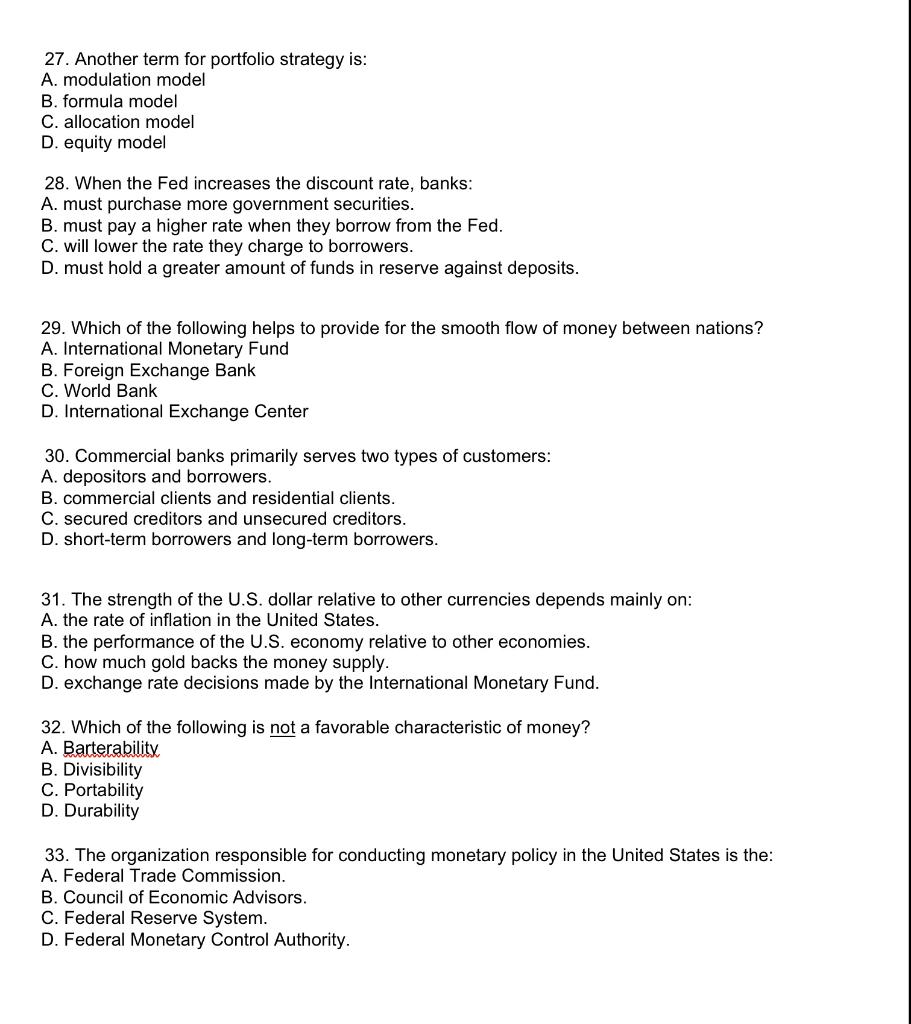
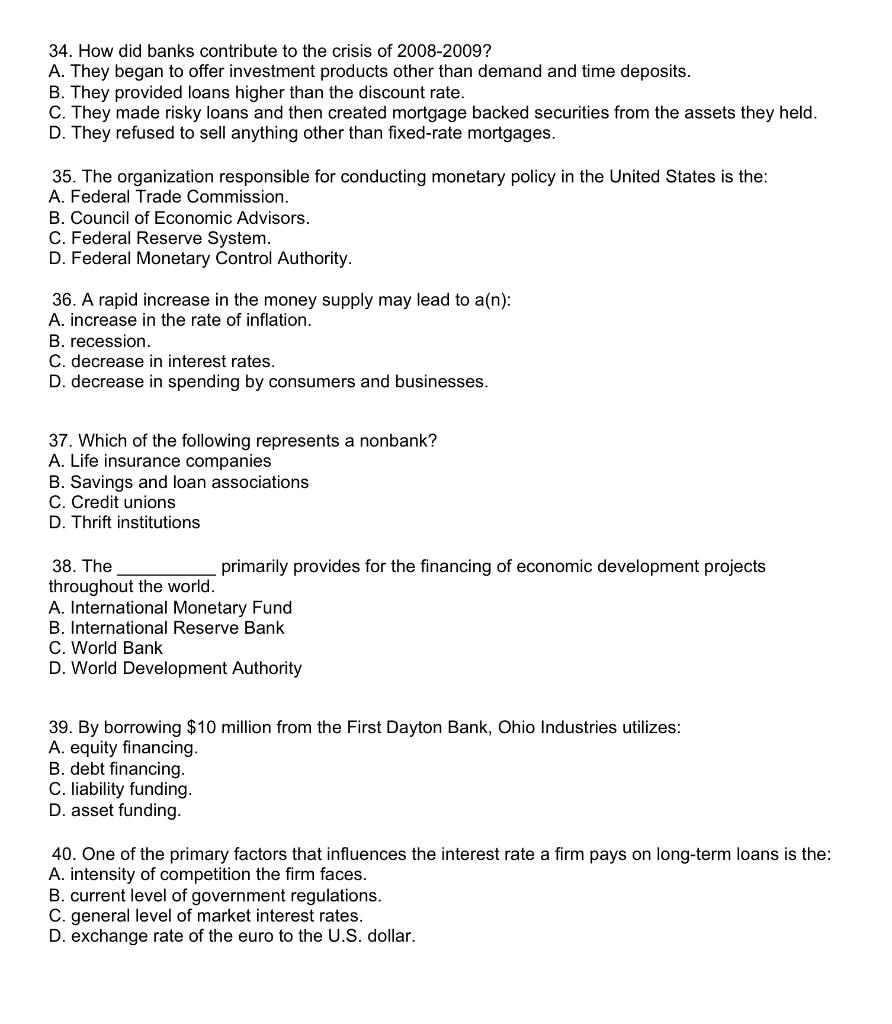
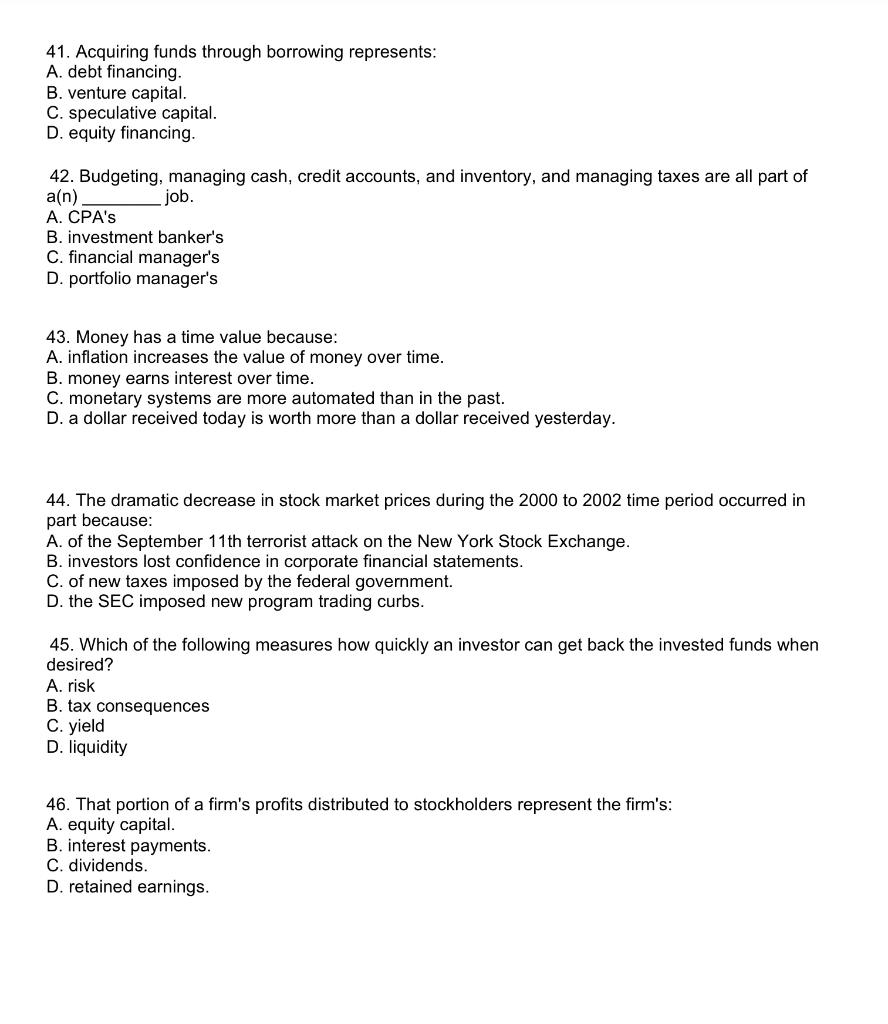
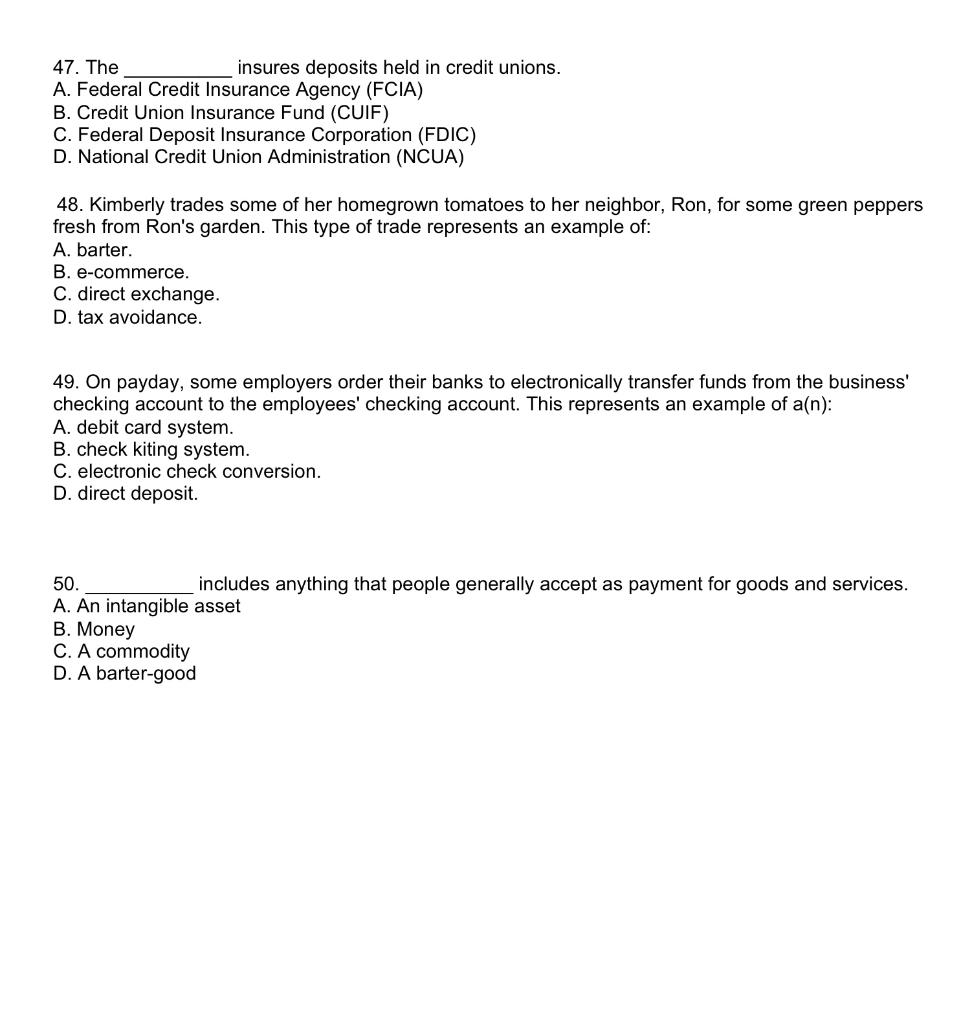
27. Another term for portfolio strategy is: A. modulation model B. formula model C. allocation model D. equity model 28. When the Fed increases the discount rate, banks: A. must purchase more government securities. B. must pay a higher rate when they borrow from the Fed. C. will lower the rate they charge to borrowers. D. must hold a greater amount of funds in reserve against deposits. 29. Which of the following helps to provide for the smooth flow of money between nations? A. International Monetary Fund B. Foreign Exchange Bank C. World Bank D. International Exchange Center 30. Commercial banks primarily serves two types of customers: A. depositors and borrowers. B. commercial clients and residential clients. C. secured creditors and unsecured creditors. D. short-term borrowers and long-term borrowers. 31. The strength of the U.S. dollar relative to other currencies depends mainly on: A. the rate of inflation in the United States. B. the performance of the U.S. economy relative to other economies. C. how much gold backs the money supply. D. exchange rate decisions made by the International Monetary Fund. 32. Which of the following is not a favorable characteristic of money? A. Barterability B. Divisibility C. Portability D. Durability 33. The organization responsible for conducting monetary policy in the United States is the: A. Federal Trade Commission. B. Council of Economic Advisors. C. Federal Reserve System. D. Federal Monetary Control Authority. 34. How did banks contribute to the crisis of 2008-2009? A. They began to offer investment products other than demand and time deposits. B. They provided loans higher than the discount rate. C. They made risky loans and then created mortgage backed securities from the assets they held. D. They refused to sell anything other than fixed-rate mortgages. 35. The organization responsible for conducting monetary policy in the United States is the: A. Federal Trade Commission. B. Council of Economic Advisors. C. Federal Reserve System. D. Federal Monetary Control Authority. 36. A rapid increase in the money supply may lead to a(n): A. increase in the rate of inflation. B. recession. C. decrease in interest rates. D. decrease in spending by consumers and businesses. 37. Which of the following represents a nonbank? A. Life insurance ompanies B. Savings and loan associations C. Credit unions D. Thrift institutions 38. The throughout the world. primarily provides for the financing of economic development projects A. International Monetary Fund B. International Reserve Bank C. World Bank D. World Development Authority 39. By borrowing $10 million from the First Dayton Bank, Ohio Industries utilizes: A. equity financing. B. debt financing. C. liability funding. D. asset funding. 40. One of the primary factors that influences the interest rate a firm pays on long-term loans is the: A. intensity of competition the firm B. current level of government regulations. C. general level of market interest rates. D. exchange rate of the euro to the U.S. dollar. 41. Acquiring funds through borrowing represents: A. debt financing. B. venture capital. C. speculative capital. D. equity financing. 42. Budgeting, managing cash, credit accounts, and inventory, and managing taxes are all part of a(n) job. A. CPA's B. investment banker's C. financial manager's D. portfolio manager's 43. Money has a time value because: A. inflation increases the value of money over time. B. money earns interest over time. C. monetary systems are more automated than in the past. D. a dollar received today is worth more than a dollar received yesterday. 44. The dramatic decrease in stock market prices during the 2000 to 2002 time period occurred in part because: A. of the September 11th terrorist attack on the New York Stock Exchange. B. investors lost confidence in corporate financial statements. C. of new taxes imposed by the federal government. D. the SEC imposed new program trading curbs. 45. Which of the following measures how quickly an investor can get back the invested funds when desired? A. risk B. tax consequences C. yield D. liquidity 46. That portion of a firm's profits distributed to stockholders represent the firm's: A. equity capital. B. interest payments. C. dividends. D. retained earnings. 47. The A. Federal Credit Insurance Agency (FCIA) B. Credit Union Insurance Fund (CUIF) C. Federal Deposit Insurance Corporation (FDIC) D. National Credit Union Administration (NCUA) insures deposits held in credit unions. 48. Kimberly trades some of her homegrown tomatoes to her neighbor, Ron, for some green peppers fresh from Ron's garden. This type of trade represents an example of: A. barter. B. e-commerce. C. direct exchange. D. tax avoidance. 49. On payday, some employers order their banks to electronically transfer funds from the business' checking account to the employees' checking account. This represents an example of a(n): A. debit card system. B. check kiting system. C. electronic check conversion. D. direct deposit. 50. A. An intangible asset B. Money C. A commodity D. A barter-good includes anything that people generally accept as payment for goods and services.
Step by Step Solution
3.58 Rating (158 Votes )
There are 3 Steps involved in it
The detailed answer for the above question is provided below Name Instructors Name Institution Course Date QUESTION 27 Answer C allocation ... View full answer

Get step-by-step solutions from verified subject matter experts
 Study Help