







Question: ---------------------------------------------------------------------Please only answer the highlighted questions ----------------------------------------------------------- Background info for the prac. WHERE DOES THIS PRACTICAL FIT IN?: This experiment relates to the synthetic organic
---------------------------------------------------------------------Please only answer the highlighted questions -----------------------------------------------------------
Background info for the prac.
WHERE DOES THIS PRACTICAL FIT IN?: This experiment relates to the synthetic organic chemistry section of your lectures. You will get the opportunity to synthesise and purify a sample of acetylsalicylic acid (aspirin). You will be able to build experience in synthetic methods and practise the techniques of recrystallisation and melting point determination.
SCIENTIFIC OBJECTIVES
| PART 1 Synthesis of acetylsalicylic acid (aspirin) | In this part of the practical, acetic anhydride reacts with salicylic acid to produce acetylsalicylic acid and acetic acid; sulfuric acid is used as a catalyst. The excess acetic anhydride is then decomposed with water to form acetic acid. Acetylsalicylic acid is not very soluble in water (~ 0.25 g/100 mL). Consequently it can be isolated by diluting the reaction mixture with water and filtering off the solid product. |
| PART 2 Recrystallisation of crude aspirin | In this part of the experiment, you will purify the crude aspirin that you synthesised in Part 1. The recrystallisation technique you will use is a variation of the one used in Experiment 4. |
| PART 3 Melting point analysis of purity | In this part of the experiment you will investigate the purity of your synthesised aspirin using melting points and compare your value to the literature value. |
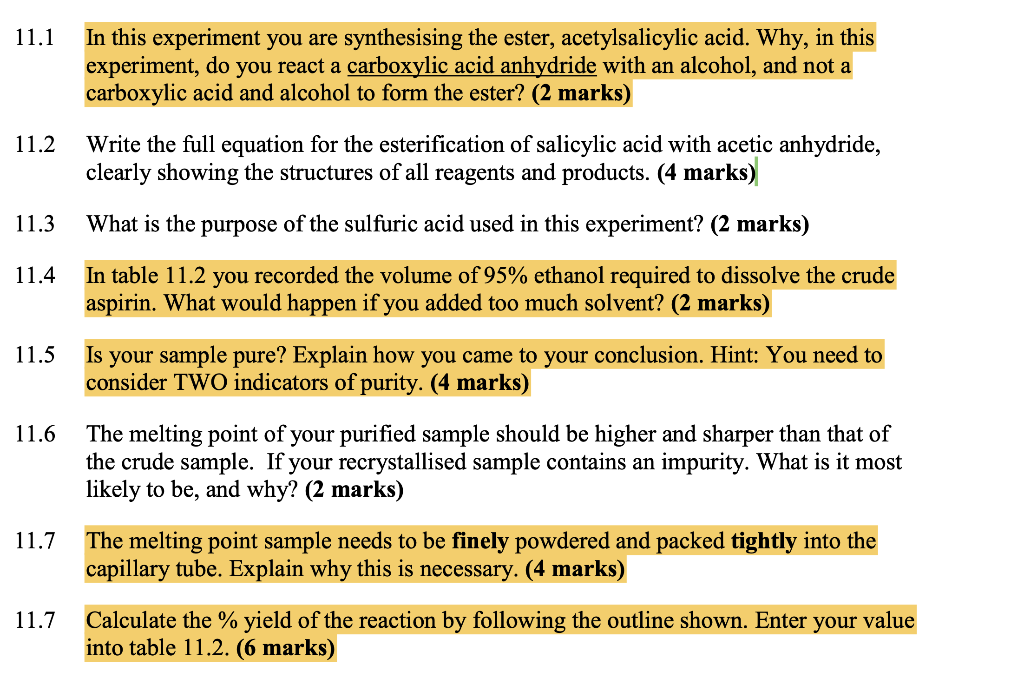
1 In this experiment you are synthesising the ester, acetylsalicylic acid. Why, in this experiment, do you react a carboxylic acid anhydride with an alcohol, and not a carboxylic acid and alcohol to form the ester? (2 marks) 2 Write the full equation for the esterification of salicylic acid with acetic anhydride, clearly showing the structures of all reagents and products. (4 marks) 3 What is the purpose of the sulfuric acid used in this experiment? (2 marks) 4 In table 11.2 you recorded the volume of 95% ethanol required to dissolve the crude aspirin. What would happen if you added too much solvent? (2 marks) 5 Is your sample pure? Explain how you came to your conclusion. Hint: You need to consider TWO indicators of purity. (4 marks) 6 The melting point of your purified sample should be higher and sharper than that of the crude sample. If your recrystallised sample contains an impurity. What is it most likely to be, and why? (2 marks) 7 The melting point sample needs to be finely powdered and packed tightly into the capillary tube. Explain why this is necessary. (4 marks) 7 Calculate the \% yield of the reaction by following the outline shown. Enter your value into table 11.2. (6 marks)
Step by Step Solution
There are 3 Steps involved in it

Get step-by-step solutions from verified subject matter experts
 Study Help