







Question: Please only do part b. 2. Consider an individual with quasilinear preferences and indirect utility function vi(p, m) = m - a;log(yip), where a; and
Please only do part b.
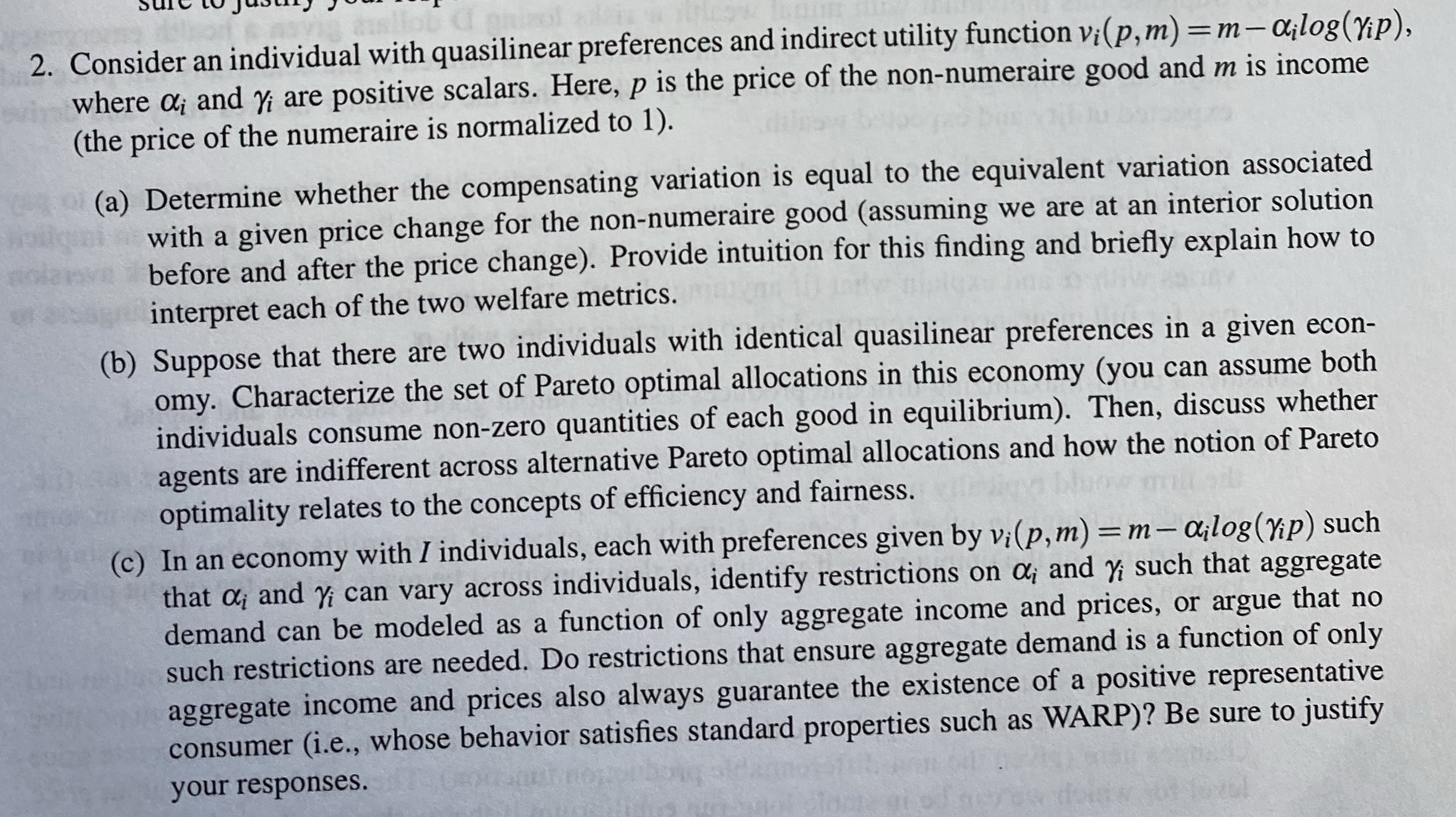
2. Consider an individual with quasilinear preferences and indirect utility function vi(p, m) = m - a;log(yip), where a; and yi are positive scalars. Here, p is the price of the non-numeraire good and m is income (the price of the numeraire is normalized to 1). (a) Determine whether the compensating variation is equal to the equivalent variation associated with a given price change for the non-numeraire good (assuming we are at an interior solution before and after the price change). Provide intuition for this finding and briefly explain how to interpret each of the two welfare metrics. (b) Suppose that there are two individuals with identical quasilinear preferences in a given econ- omy. Characterize the set of Pareto optimal allocations in this economy (you can assume both individuals consume non-zero quantities of each good in equilibrium). Then, discuss whether agents are indifferent across alternative Pareto optimal allocations and how the notion of Pareto optimality relates to the concepts of efficiency and fairness. (c) In an economy with / individuals, each with preferences given by vi(p, m) = m- dilog (Yip) such that a; and yi can vary across individuals, identify restrictions on a; and yi such that aggregate demand can be modeled as a function of only aggregate income and prices, or argue that no such restrictions are needed. Do restrictions that ensure aggregate demand is a function of only aggregate income and prices also always guarantee the existence of a positive representative consumer (i.e., whose behavior satisfies standard properties such as WARP)? Be sure to justify your responses
Step by Step Solution
There are 3 Steps involved in it

Get step-by-step solutions from verified subject matter experts
 Study Help