Question: Please read above case study and answer the following questions... How did Basil's ex-wife know about his condition before she did? What right did Ms.
Please read above case study and answer the following questions...
- How did Basil's ex-wife know about his condition before she did?
- What right did Ms. Jenson have to share this information with Basil's ex-wife before she even knew it?
- Just how bad was the situation?
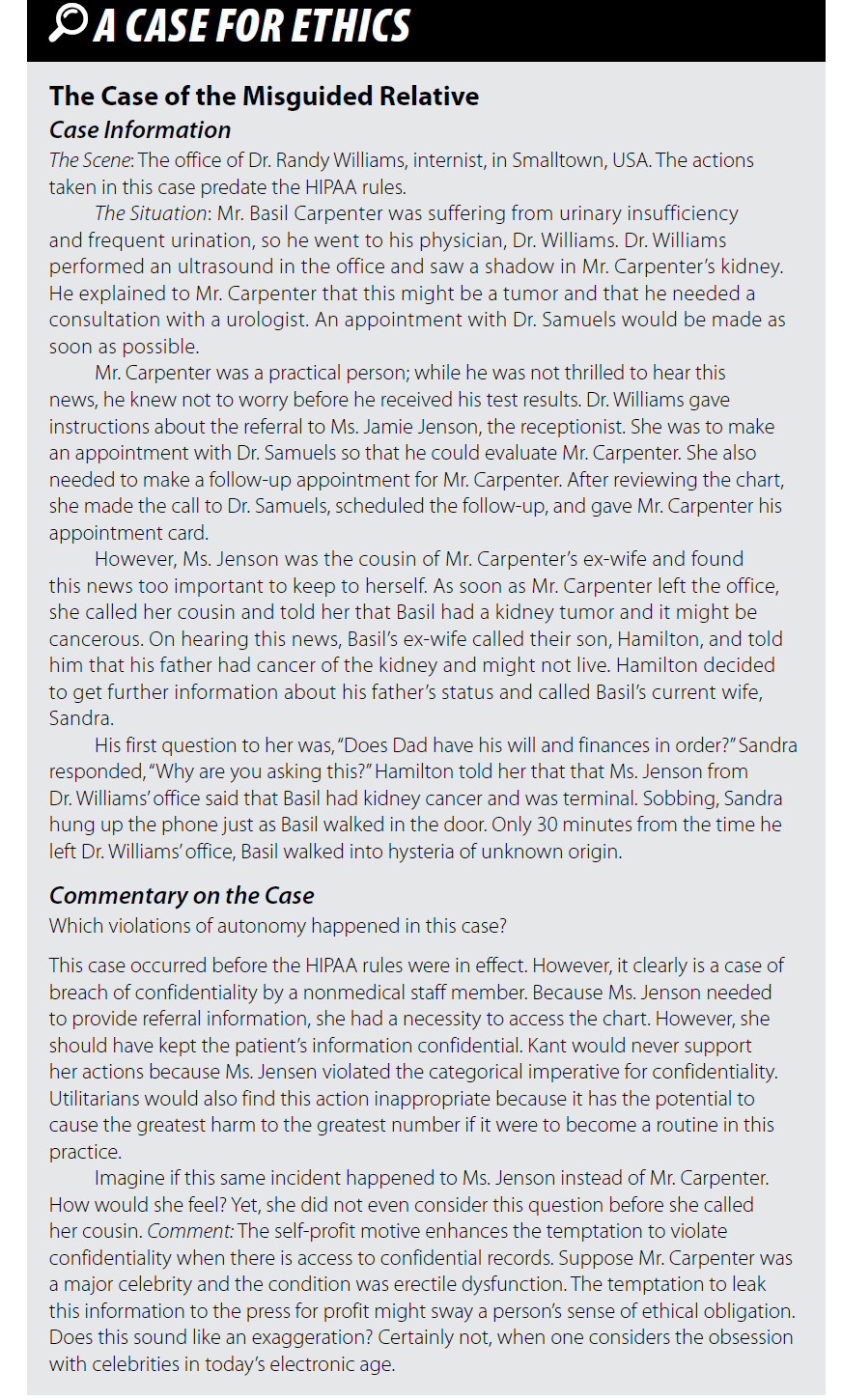
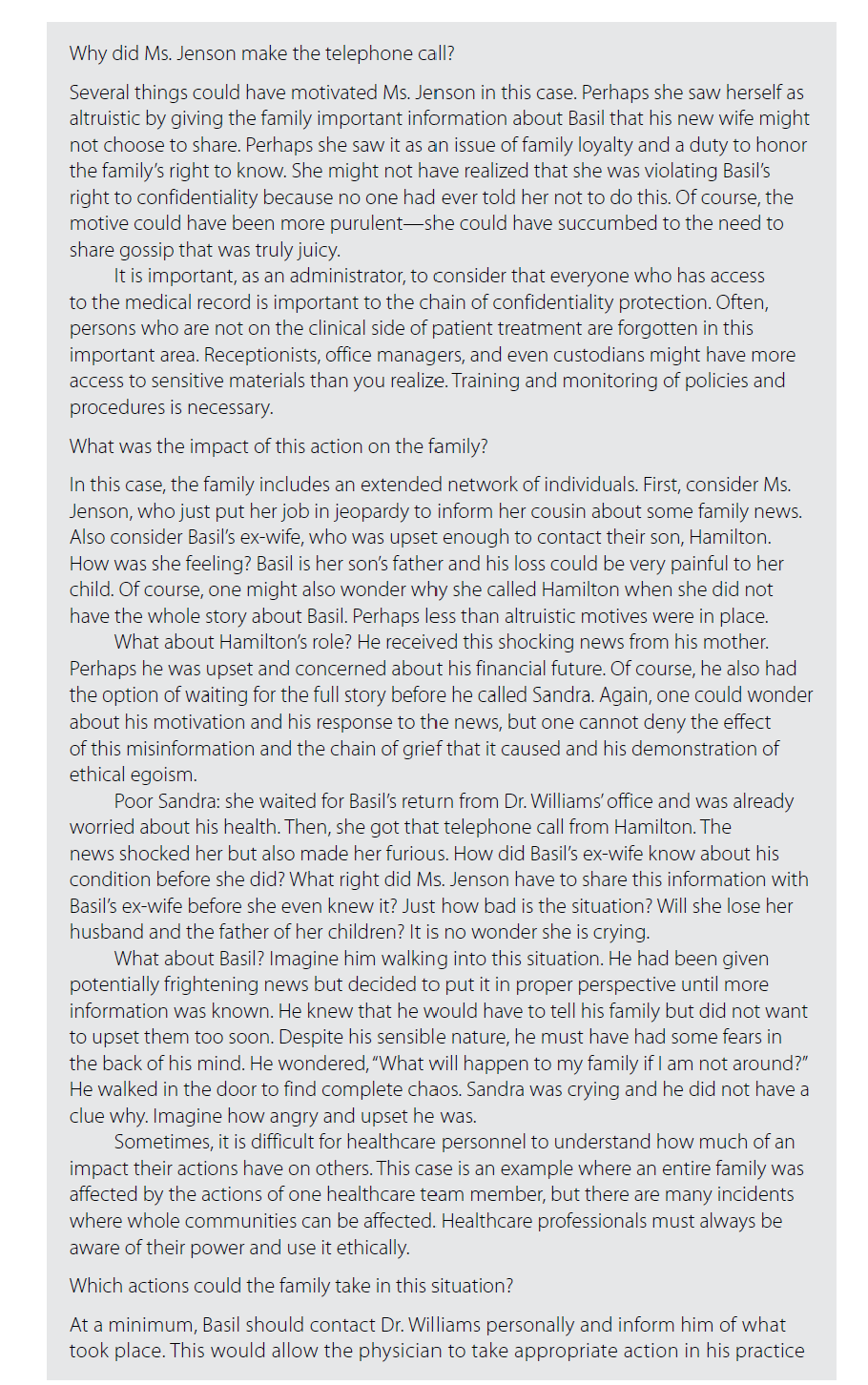
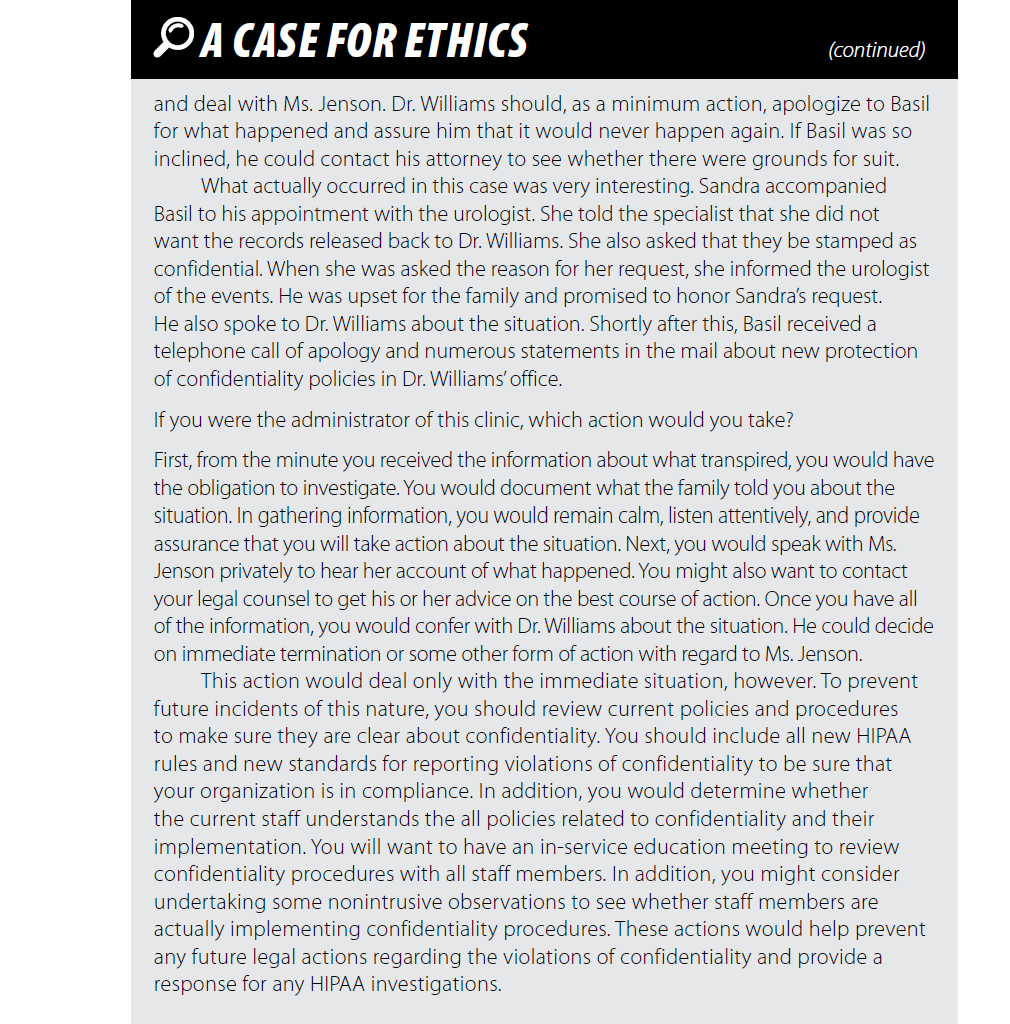
DA CASE FOR ETHICS The Case of the Misguided Relative Case Information The Scene: The office of Dr. Randy Williams, internist, in Smalltown, USA. The actions taken in this case predate the HIPAA rules. The Situation: Mr. Basil Carpenter was suffering from urinary insufficiency and frequent urination, so he went to his physician, Dr. Williams. Dr. Williams performed an ultrasound in the office and saw a shadow in Mr. Carpenter's kidney. He explained to Mr. Carpenter that this might be a tumor and that he needed a consultation with a urologist. An appointment with Dr. Samuels would be made as soon as possible. Mr. Carpenter was a practical person; while he was not thrilled to hear this news, he knew not to worry before he received his test results. Dr. Williams gave instructions about the referral to Ms. Jamie Jenson, the receptionist. She was to make an appointment with Dr. Samuels so that he could evaluate Mr. Carpenter. She also needed to make a follow-up appointment for Mr. Carpenter. After reviewing the chart, she made the call to Dr. Samuels, scheduled the follow-up, and gave Mr. Carpenter his appointment card. However, Ms. Jenson was the cousin of Mr. Carpenter's ex-wife and found this news too important to keep to herself. As soon as Mr. Carpenter left the office, she called her cousin and told her that Basil had a kidney tumor and it might be cancerous. On hearing this news, Basil's ex-wife called their son, Hamilton, and told him that his father had cancer of the kidney and might not live. Hamilton decided to get further information about his father's status and called Basil's current wife, Sandra. His first question to her was, "Does Dad have his will and finances in order?" Sandra responded, "Why are you asking this?" Hamilton told her that that Ms. Jenson from Dr. Williams'office said that Basil had kidney cancer and was terminal. Sobbing, Sandra hung up the phone just as Basil walked in the door. Only 30 minutes from the time he left Dr. Williams' office, Basil walked into hysteria of unknown origin. Commentary on the Case Which violations of autonomy happened in this case? This case occurred before the HIPAA rules were in effect. However, it clearly is a case of breach of confidentiality by a nonmedical staff member. Because Ms. Jenson needed to provide referral information, she had a necessity to access the chart. However, she should have kept the patient's information confidential. Kant would never support her actions because Ms. Jensen violated the categorical imperative for confidentiality. Utilitarians would also find this action inappropriate because it has the potential to cause the greatest harm to the greatest number if it were to become a routine in this practice. Imagine if this same incident happened to Ms. Jenson instead of Mr. Carpenter. How would she feel? Yet, she did not even consider this question before she called her cousin. Comment: The self-profit motive enhances the temptation to violate confidentiality when there is access to confidential records. Suppose Mr. Carpenter was a major celebrity and the condition was erectile dysfunction. The temptation to leak this information to the press for profit might sway a person's sense of ethical obligation. Does this sound like an exaggeration? Certainly not, when one considers the obsession with celebrities in today's electronic age. Why did Ms. Jenson make the telephone call? Several things could have motivated Ms. Jenson in this case. Perhaps she saw herself as altruistic by giving the family important information about Basil that his new wife might not choose to share. Perhaps she saw it as an issue of family loyalty and a duty to honor the family's right to know. She might not have realized that she was violating Basil's right to confidentiality because no one had ever told her not to do this. Of course, the motive could have been more purulentshe could have succumbed to the need to share gossip that was truly juicy. It is important, as an administrator, to consider that everyone who has access to the medical record is important to the chain of confidentiality protection. Often, persons who are not on the clinical side of patient treatment are forgotten in this important area. Receptionists, office managers, and even custodians might have more access to sensitive materials than you realize. Training and monitoring of policies and procedures is necessary. What was the impact of this action on the family? In this case, the family includes an extended network of individuals. First, consider Ms. Jenson, who just put her job in jeopardy to inform her cousin about some family news. Also consider Basil's ex-wife, who was upset enough to contact their son, Hamilton. How was she feeling? Basil is her son's father and his loss could be very painful to her child. Of course, one might also wonder why she called Hamilton when she did not have the whole story about Basil. Perhaps less than altruistic motives were in place. What about Hamilton's role? He received this shocking news from his mother. Perhaps he was upset and concerned about his financial future. Of course, he also had the option of waiting for the full story before he called Sandra. Again, one could wonder about his motivation and his response to the news, but one cannot deny the effect of this misinformation and the chain of grief that it caused and his demonstration of ethical egoism. Poor Sandra: she waited for Basil's return from Dr. Williams' office and was already worried about his health. Then, she got that telephone call from Hamilton. The news shocked her but also made her furious. How did Basil's ex-wife know about his condition before she did? What right did Ms. Jenson have to share this information with Basil's ex-wife before she even knew it? Just how bad is the situation? Will she lose her husband and the father of her children? It is no wonder she is crying. What about Basil? Imagine him walking into this situation. He had been given potentially frightening news but decided to put it in proper perspective until more information was known. He knew that he would have to tell his family but did not want to upset them too soon. Despite his sensible nature, he must have had some fears in the back of his mind. He wondered, "What will happen to my family if I am not around?" He walked in the door to find complete chaos. Sandra was crying and he did not have a clue why. Imagine how angry and upset he was. Sometimes, it is difficult for healthcare personnel to understand how much of an impact their actions have on others. This case is an example where an entire family was affected by the actions of one healthcare team member, but there are many incidents where whole communities can be affected. Healthcare professionals must always be aware of their power and use it ethically. Which actions could the family take in this situation? At a minimum, Basil should contact Dr. Williams personally and inform him of what took place. This would allow the physician to take appropriate action in his practice DA CASE FOR ETHICS (continued) and deal with Ms. Jenson. Dr. Williams should, as a minimum action, apologize to Basil for what happened and assure him that it would never happen again. If Basil was so inclined, he could contact his attorney to see whether there were grounds for suit. What actually occurred in this case was very interesting. Sandra accompanied Basil to his appointment with the urologist. She told the specialist that she did not want the records released back to Dr. Williams. She also asked that they be stamped as confidential. When she was asked the reason for her request, she informed the urologist of the events. He was upset for the family and promised to honor Sandra's request. He also spoke to Dr. Williams about the situation. Shortly after this, Basil received a telephone call of apology and numerous statements in the mail about new protection of confidentiality policies in Dr. Williams'office. If you were the administrator of this clinic, which action would you take? First, from the minute you received the information about what transpired, you would have the obligation to investigate. You would document what the family told you about the situation. In gathering information, you would remain calm, listen attentively, and provide assurance that you will take action about the situation. Next, you would speak with Ms. Jenson privately to hear her account of what happened. You might also want to contact your legal counsel to get his or her advice on the best course of action. Once you have all of the information, you would confer with Dr. Williams about the situation. He could decide on immediate termination or some other form of action with regard to Ms. Jenson. This action would deal only with the immediate situation, however. To prevent future incidents of this nature, you should review current policies and procedures to make sure they are clear about confidentiality. You should include all new HIPAA rules and new standards for reporting violations of confidentiality to be sure that your organization is in compliance. In addition, you would determine whether the current staff understands the all policies related to confidentiality and their implementation. You will want to have an in-service education meeting to review conf entiality procedures with all staff members. In addition, you might consider undertaking some nonintrusive observations to see whether staff members are actually implementing confidentiality procedures. These actions would help prevent any future legal actions regarding the violations of confidentiality and provide a response for any HIPAA investigations









 Study Help