Question: Please read all instructions before responding. Also, do not copy paste your answer, I am looking for guidance, not a thoughtless word dump like the
Please read all instructions before
responding. Also, do not copy paste your answer, I am looking for guidance, not a thoughtless word dump like the previous expert.
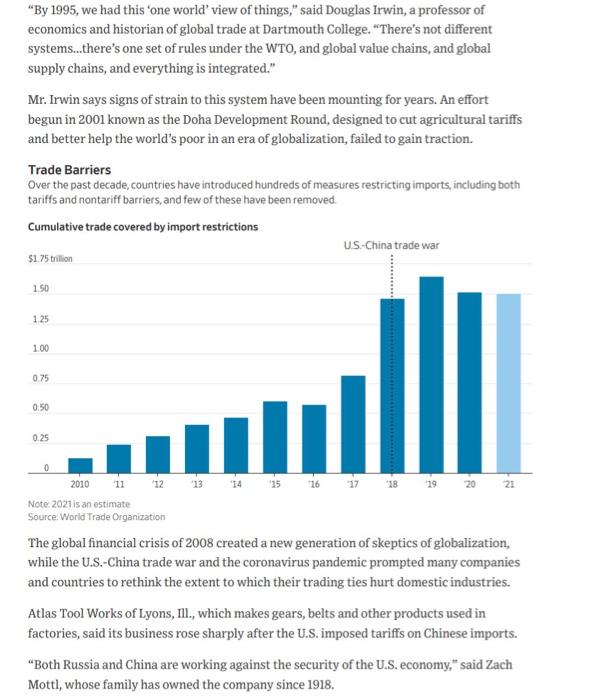
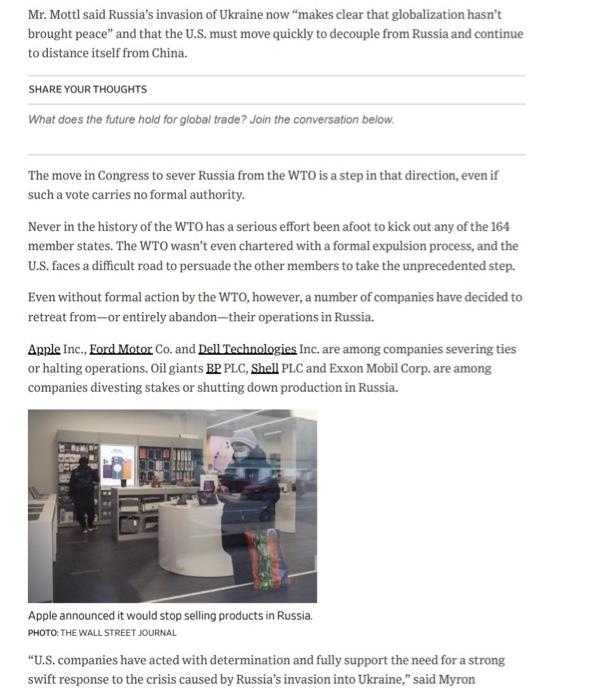
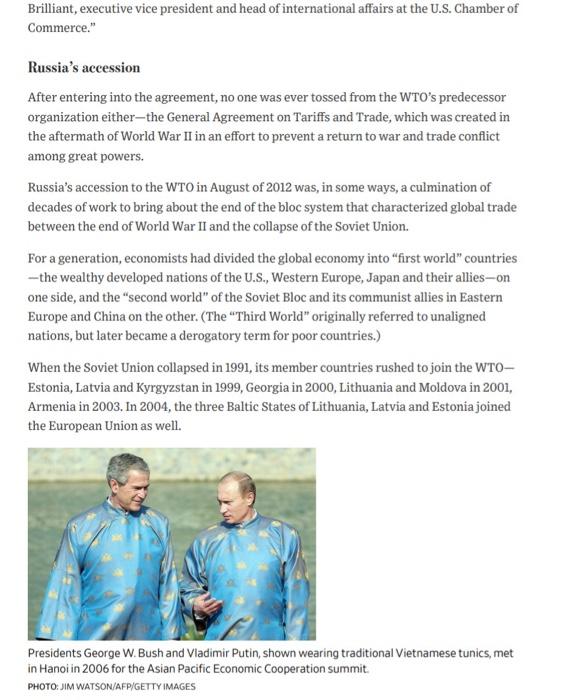
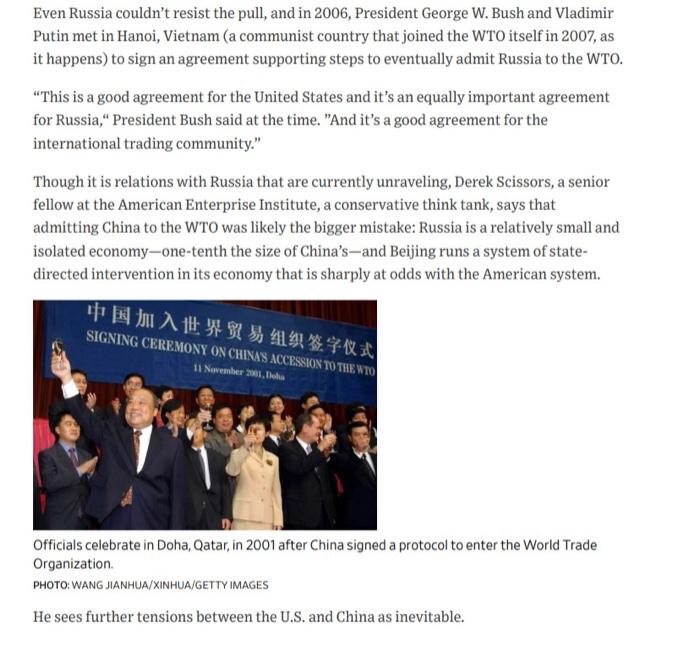
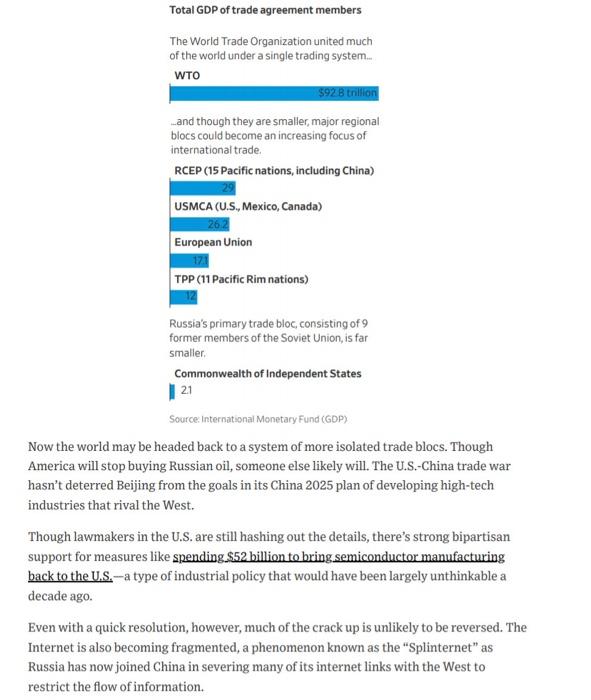
**Note Chegg Expert** I only need help explaining the article's relevance to Supply Chain Management in more than one sentence. I will use the answer to generate more of a thoughtful response to that portion. Any help is appreciated. Obviously economic restrictions pose threats to the efficiency of the global supply chain network. Let me know in the comment portion if you have any questions before answering, thank you! Please review the article below and post a one page (300- 350 words) summary of the article to include: Why you chose this article Relevance to the course Article Summary Brief Takeaways - agree or disagree or not sure and recommendations ECONOMY Economic Blacklist of Russia Marks New Blow for Globalization Postwar vision of harmonious world trade was already under pressure; invasion of Ukraine risks further economic fragmentation By Josh Zumbrun March 10, 2022 2:20 pm ET WASHINGTON- The U.S.-led effort to expel Russia from international commerce marks another fracture in the free-trade vision that guided American policy for nearly 30 years, signaling a future where nations and companies shift away from trading with adversaries and focus more on like-minded partners. The actions taken by the U.S. and Western European allies since Russia invaded Ukraine have been swift and punishing-including banning or scaling back purchases of Russian oil, gas and coal to pressure Russian President Vladimir Putin to call off his troops. The West has also moved to oust Russian banks from international financial networks, while a bipartisan coalition of U.S. lawmakers has introduced legislation calling on the U.S. to press for Russia's suspension from the World Trade Organization-an action that would have no precedent in WTO history. "The trading system as we've known it with the World Trade Organization at its core and with a basic set of rules that everyone traded under, is coming apart," said Jennifer Hillman, a trade lawyer and former jurist on the WTO's trade court who now teaches international law at Georgetown University, Global trade reached its apex before the financial crisis, and hasn't fully recovered amid the great recession, the U.S-China trade war and the Covid-19 pandemic Exports of goods and services as a share of global GDP 40% RECESSION 30 20 wer 10 0 1971 75 80 85 90 95 2000 05 10 15 20 Source: World Bank The concept of globalization-nations trading with few barriers, focusing on the industries and services they do best-has been under pressure for years, driven by economic rivalries, factory closings in wealthy countries and those who say open commercial borders aren't in the best national interest, especially in times of emergency. Former President Donald Trump stoked the trend by launching a trade war against China in 2018. The Covid-19 pandemic added momentum by exposing U.S. dependence on foreign-made items such as personal protective gear and computer chips. Ms. Hillman sees the future of global trade agreements could be in large regional pacts where the participants share more common interests, such as the U.S.-Canada-Mexico Agreement signed in 2020. "I think we're going to see increasingly blocs, where there are coalitions of the like- minded, Ms. Hillman said. "Whether it gets to formal clubs that trade with each other and not others or not, that's hard to know." Supporters of globalization note that benefits of free trade have been far-reaching, opening new markets for businesses and making a variety of consumer goods more affordable. Shifting more production domestically will inevitably add to the inflation that is already on the rise Bill Reinsch, a senior adviser at the Center for Strategic and International Studies, a Washington think tank focused on U.S. national security, says the technologies of transportation and communication still make global trade compelling for businesses and allows them to offer the most competitive products. Moves to isolate Russia are "very satisfying in the short run, because the Russians are doing a very bad thing," said Mr. Reinsch. "But nobody wants to talk about the long-term consequences of weakening international institutions." Destroyed Russian vehicles litter the road connecting Kyiv to western Ukraine. PHOTO CHRISTOPHER OCCHICONE FOR THE WALL STREET JOURNAL Despite the benefits of globalization, the world has been heading in the other direction for a decade or more. By one measure, the high-water mark for globalization came in 2008, when world exports reached 31% of global gross domestic product. By 2020, that had dropped to 26%. Nations including the U.S. have also been raising tariffs on imports, in another brake on global trade. Since 2010, the amount of trade covered by tariffs and other trade barriers has climbed to $1.5 trillion from $126 billion, according to WTO data. Post-Cold War optimism The WTO came into existence in 1995 amid a surge of post-Cold War optimism about a world united behind ideals of free trade, market-opening, and increasing global democracy. Signatories commit to offering the same set of trading conditions to all other WTO members without discrimination. "By 1995, we had this one world' view of things," said Douglas Irwin, a professor of economics and historian of global trade at Dartmouth College. "There's not different systems...there's one set of rules under the WTO, and global value chains, and global supply chains, and everything is integrated." Mr. Irwin says signs of strain to this system have been mounting for years. An effort begun in 2001 known as the Doha Development Round designed to cut agricultural tariffs and better help the world's poor in an era of globalization, failed to gain traction. Trade Barriers Over the past decade, countries have introduced hundreds of measures restricting imports, including both tariffs and nontariff barriers, and few of these have been removed. Cumulative trade covered by import restrictions US-China trade war $1.75 trilion 150 1.25 1.00 0.75 0.50 0.25 II 0 11 12 2010 '13 *14 15 16 17 18 19 20 21 Note: 2021 is an estimate Source: World Trade Organization The global financial crisis of 2008 created a new generation of skeptics of globalization, while the U.S.-China trade war and the coronavirus pandemic prompted many companies and countries to rethink the extent to which their trading ties hurt domestic industries. Atlas Tool Works of Lyons, Ill., which makes gears, belts and other products used in factories, said its business rose sharply after the U.S. imposed tariffs on Chinese imports. "Both Russia and China are working against the security of the U.S. economy," said Zach Mottl, whose family has owned the company since 1918. Mr. Mottl said Russia's invasion of Ukraine now "makes clear that globalization hasn't brought peace" and that the U.S. must move quickly to decouple from Russia and continue to distance itself from China. SHARE YOUR THOUGHTS What does the future hold for global trade? Join the conversation below. The move in Congress to sever Russia from the WTO is a step in that direction, even if such a vote carries no formal authority. Never in the history of the WTO has a serious effort been afoot to kick out any of the 164 member states. The WTO wasn't even chartered with a formal expulsion process, and the U.S. faces a difficult road to persuade the other members to take the unprecedented step. Even without formal action by the WTO, however, a number of companies have decided to retreat from-or entirely abandon-their operations in Russia. Apple Inc., Ford Motor Co. and Dell Technologies Inc. are among companies severing ties or halting operations. Oil giants BP PLC, Shell PLC and Exxon Mobil Corp. are among companies divesting stakes or shutting down production in Russia. Apple announced it would stop selling products in Russia. PHOTO: THE WALL STREET JOURNAL U.S. companies have acted with determination and fully support the need for a strong swift response to the crisis caused by Russia's invasion into Ukraine," said Myron Brilliant, executive vice president and head of international affairs at the U.S. Chamber of Commerce." Russia's accession After entering into the agreement, no one was ever tossed from the WTO's predecessor organization either-the General Agreement on Tariffs and Trade, which was created in the aftermath of World War II in an effort to prevent a return to war and trade conflict among great powers. Russia's accession to the WTO in August of 2012 was, in some ways, a culmination of decades of work to bring about the end of the bloc system that characterized global trade between the end of World War II and the collapse of the Soviet Union. For a generation, economists had divided the global economy into "first world" countries --the wealthy developed nations of the U.S., Western Europe, Japan and their allies-on one side, and the second world" of the Soviet Bloc and its communist allies in Eastern Europe and China on the other. (The "Third World" originally referred to unaligned nations, but later became a derogatory term for poor countries.) When the Soviet Union collapsed in 1991, its member countries rushed to join the WTO- Estonia, Latvia and Kyrgyzstan in 1999, Georgia in 2000, Lithuania and Moldova in 2001, Armenia in 2003. In 2004, the three Baltic States of Lithuania, Latvia and Estonia joined the European Union as well. Presidents George W. Bush and Vladimir Putin, shown wearing traditional Vietnamese tunics, met in Hanoi in 2006 for the Asian Pacific Economic Cooperation summit PHOTO: JIM WATSON/AFP/GETTY IMAGES Even Russia couldn't resist the pull, and in 2006, President George W. Bush and Vladimir Putin met in Hanoi, Vietnam (a communist country that joined the WTO itself in 2007, as it happens) to sign an agreement supporting steps to eventually admit Russia to the WTO. "This is a good agreement for the United States and it's an equally important agreement for Russia," President Bush said at the time. "And it's a good agreement for the international trading community." Though it is relations with Russia that are currently unraveling, Derek Scissors, a senior fellow at the American Enterprise Institute, a conservative think tank, says that admitting China to the WTO was likely the bigger mistake: Russia is a relatively small and isolated economy-one-tenth the size of China's--and Beijing runs a system of state- directed intervention in its economy that is sharply at odds with the American system. SIGNING CEREMONY ON CHINAS ACCESSION TO THE WRO 11 November 2001. Cola Officials celebrate in Doha, Qatar, in 2001 after China signed a protocol to enter the World Trade Organization PHOTO:WANG JIANHUA/XINHUA/GETTY IMAGES He sees further tensions between the U.S. and China as inevitable. Total GDP of trade agreement members The World Trade Organization united much of the world under a single trading system. WTO $92B trillion and though they are smaller, major regional blocs could become an increasing focus of international trade RCEP (15 Pacific nations, including China) USMCA (U.S., Mexico, Canada) European Union TPP (11 Pacific Rim nations) Russia's primary trade bloc, consisting of 9 former members of the Soviet Union, is far smaller Commonwealth of Independent States 2.1 Source: International Monetary Fund (GDP) Now the world may be headed back to a system of more isolated trade blocs. Though America will stop buying Russian oil, someone else likely will. The U.S.-China trade war hasn't deterred Beijing from the goals in its China 2025 plan of developing high-tech industries that rival the West. Though lawmakers in the U.S. are still hashing out the details, there's strong bipartisan support for measures like spending $52 billion to bring semiconductor manufacturing back to the U.S.-a type of industrial policy that would have been largely unthinkable a decade ago. Even with a quick resolution, however, much of the crack up is unlikely to be reversed. The Internet is also becoming fragmented, a phenomenon known as the "Splinternet" as Russia has now joined China in severing many of its internet links with the West to restrict the flow of information. a The era of growing trade comity, and free and unfettered trade with rivals, is looking more like a fad and less like the end point of a trend. "That period of time was exceptional and naive and as soon as it became tested we didn't like it anymore," said Mr. Scissors. "There was a period of time beginning in 1993 where we had this thought that we could have a global trading system. I think that global trading system was a passing fancy." -Yuka Hayashi contributed to this article. Write to Josh Zumbrun at Josh.Zumbrun@wsj.com Corrections & Amplifications The Soviet Union collapsed in 1991. An earlier version of this article incorrectly said the year was 1989. (Corrected on March 11.) Appeared in the March 11, 2022, print edition as 'Sanctions Deliver a Blow To Globalization Dream









 Study Help