







Question: Please read and answer the following question: 1. How are the seven employability skills relevant to your OWN career aspirations. Thank you. COMPENSATION, RECRUITMENT, AND
Please read and answer the following question:
1. How are the seven employability skills relevant to your OWN career aspirations.
Thank you.
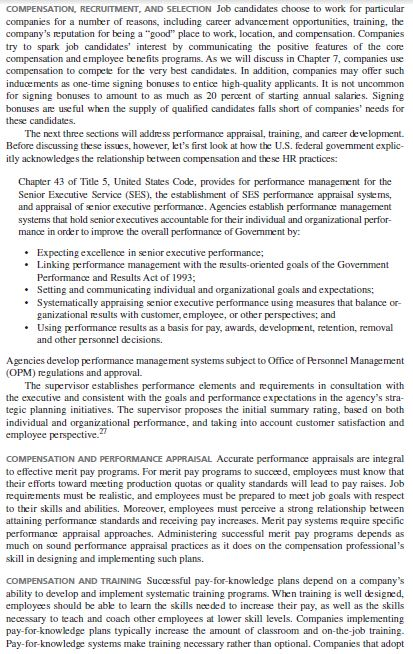
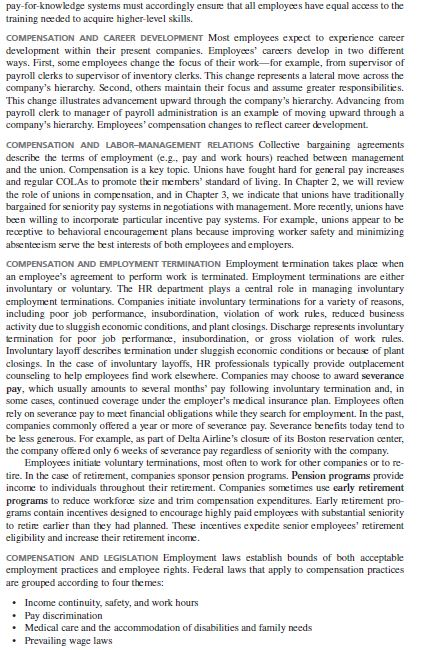
COMPENSATION, RECRUITMENT, AND SELECTION Job candidates choose to work for particular companies for a number of reasons, including career advancement opportunities, training, the company's reputation for being a "good" place to work, location, and compensation. Companies try to spark job candidates' interest by communicating the positive features of the core compensation and employee benefits programs. As we will discuss in Chapter 7. companies use compensation to compete for the very best candidates. In addition, companies may offer such inducements as one-time signing bonuses to entice high-quality applicants. It is not uncommon for signing bonuses to amount to as much as 20 percent of starting annual salaries. Signing bonuses are useful when the supply of qualified candidates falls short of companies' needs for these candidates The next three sections will address performance appraisal, training, and career development. Before discussing these issues, however, let's first look at how the U.S.federal goverment explic- itly acknowledges the relationship between compensation and these HR practices: Chapter 43 of Title 5. United States Code, provides for performance management for the Senior Executive Service (SES), the establishment of SES performance appraisal systems, and appraisal of senior executive performance. Agencies establish performance management systems that hold senior executives accountable for their individual and organizational perfor mance in order to improve the overall performance of Government by: Expecting excellence in senior executive performance; Linking performance management with the results-oriented goals of the Government Performance and Results Act of 1993; Setting and communicating individual and organizational goals and expectations: Systematically appraising senior executive performance using measures that balance or ganizational results with customer, employee, or other perspectives and Using performance results as a basis for pay, awards, development, retention, removal and other personnel decisions. Agencies develop performance management systems subject to Office of Personnel Management (OPM) regulations and approval. The supervisor establishes performance elements and requirements in consultation with the executive and consistent with the goals and performance expectations in the agency's stra- tegic planning initiatives. The supervisor proposes the initial summary rating, based on both individual and organizational performance, and taking into account customer satisfaction and employee perspective. COMPENSATION AND PERFORMANCE APPRAISAL Accurate performance appraisals are integral to effective merit pay programs. For merit pay programs to succeed, employees must know that their efforts toward meeting production quotas or quality standards will lead to pay raises. Job requirements must be realistic and employees must be prepared to meet job goals with respect to their skills and abilities. Moreover, employees must perceive a strong relationship between attaining performance standards and receiving pay increases. Menit pay systems require specific performance appraisal approaches. Administering successful merit pay programs depends as much on sound performance appraisal practices as it does on the compensation professional's skill in designing and implementing such plans COMPENSATION AND TRAINING Successful pay-for-knowledge plans depend on a company's ability to develop and implement systematic training programs. When training is well designed, employees should be able to learn the skills needed to increase their pay, as well as the skills necessary to teach and coach other employees at lower skill levels. Companies implementing pay-for knowledge plans typically increase the amount of classroom and on-the-job training. Pay-for-knowledge systems make training necessary rather than optional. Companies that adopt pay-for-knowledge systems must accordingly ensure that all employees have equal access to the training needed to acquire higher level skills. COMPENSATION AND CAREER DEVELOPMENT Most employees expect to experience career development within their present companies. Employees' careers develop in two different ways. First, some employees change the focus of their work-for example, from supervisor of payroll clerks to supervisor of inventory clerks. This change represents a lateral move across the company's hierarchy. Second, others maintain their focus and assume greater responsibilities. This change illustrates advancement upward through the company's hierarchy. Advancing from payroll clerk to manager of payroll administration is an example of moving upward through a company's hierarchy. Employees' compensation changes to reflect career development. COMPENSATION AND LABOR-MANAGEMENT RELATIONS Collective bargaining agreements describe the terms of employment (eg. pay and work hours) reached between management and the union. Compensation is a key topic. Unions have fought hard for general pay increases and regular COLAs to promote their members' standard of living. In Chapter 2, we will review the role of unions in compensation, and in Chapter 3, we indicate that unions have traditionally hargained for seniority pay systems in negotiations with management. More recently, unions have been willing to incorporate particular incentive pay systems. For example, unions appear to be receptive to behavioral encouragement plans because improving worker safety and minimizing absenteeism serve the best interests of both employees and employers. COMPENSATION AND EMPLOYMENT TERMINATION Employment termination takes place when an employee's agreement to perform work is terminated. Employment terminations are either involuntary or voluntary. The HR department plays a central role in managing involuntary employment terminations. Companies initiate involuntary terminations for a variety of reasons, including poor job performance, insubordination, violation of work rules, reduced business activity due to sluggish economic conditions, and plant closings. Discharge represents involuntary termination for poor job performance, insubordination, or gross violation of work rules. Involuntary layoff describes termination under sluggish economic conditions or because of plant closings. In the case of involuntary layoffs, HR professionals typically provide outplacement counseling to help employees find work elsewhere. Companies may choose to award severance pay, which usually amounts to several months' pay following involuntary termination and, in some cases, continued coverage under the employer's medical insurance plan. Employees often rely on severance pay to meet financial obligations while they search for employment. In the past, companies commonly offered a year or more of severance pay. Severance benefits today tend to be less generous. For example, as part of Delta Airline's closure of its Boston reservation center, the company offered only 6 weeks of severance pay regardless of seniority with the company. Employees initiate voluntary terminations, most often to work for other companies or to re- tire. In the case of retirement, companies sponsor pension programs. Pension programs provide income to individuals throughout their retirement Companies sometimes use early retirement programs to reduce workforce size and trim compensation expenditures. Early retirement pro- grams contain incentives designed to encourage highly paid employees with substantial seniority to retire earlier than they had planned. These incentives expedite senior employees' retirement eligibility and increase their retirement income COMPENSATION AND LEGISLATION Employment laws establish bounds of both acceptable employment practices and employee rights. Federal laws that apply to compensation practices are grouped according to four themes Income continuity, safety, and work hours Pay discrimination Medical care and the accommodation of disabilities and family needs Prevailing wage lawsStep by Step Solution
There are 3 Steps involved in it
1 Expert Approved Answer
Step: 1 Unlock

Question Has Been Solved by an Expert!
Get step-by-step solutions from verified subject matter experts
Step: 2 Unlock
Step: 3 Unlock
 Study Help