Question: please read and summarize the article. E Ce codeed.) Management and we KALLAR.COM CORALLO LEANONADESENLARGONLARGE GORI AND HABENUTA TIMES Discipline and Discharge in Litigious Times
please read and summarize the article.
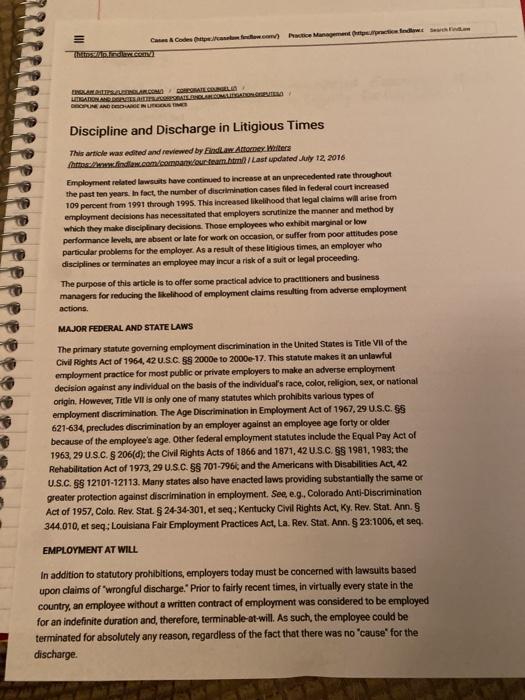
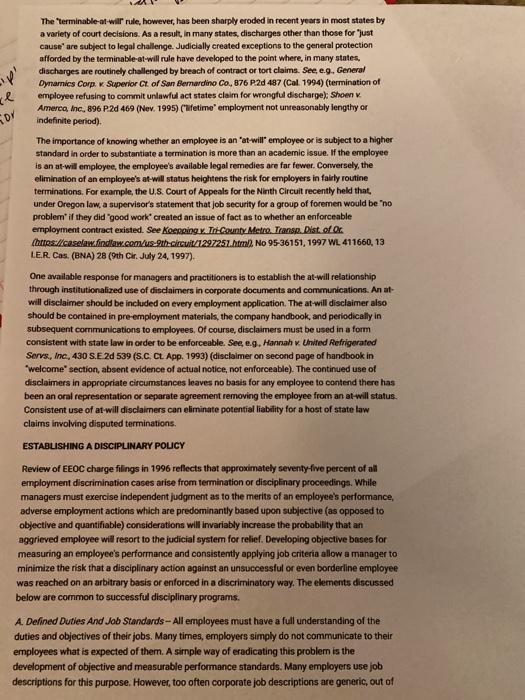
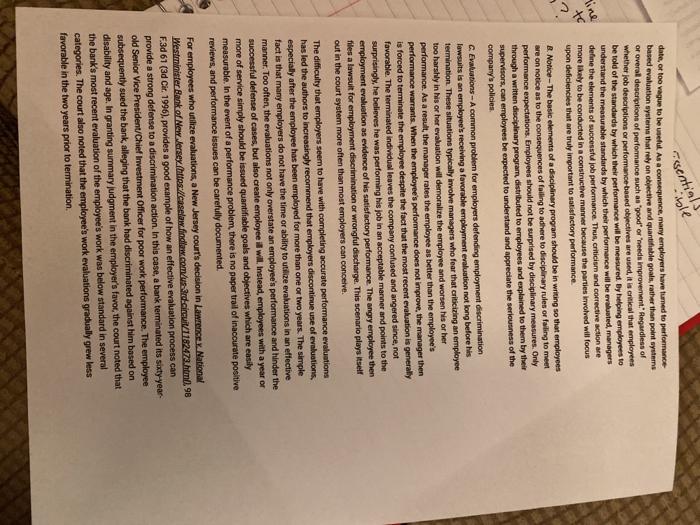
E Ce codeed.) Management and we KALLAR.COM CORALLO LEANONADESENLARGONLARGE GORI AND HABENUTA TIMES Discipline and Discharge in Litigious Times This article was edited and reviewed by law Attornes Weiters fatto.w.fin.com/com/ourfam.tm/Last updated July 12, 2016 Employment related lawsuits have continued to increase at an unprecedented rate throughout the past ten years. In fact, the number of discrimination cases filed in federal court increased 109 percent from 1991 through 1995. This increased likelihood that legal claims will arise from employment decisions has necessitated that employers scrutinize the manner and method by which they make disciplinary decisions. Those employees who exhibit marginal or low performance levels, are absent or late for work on occasion or suffer from poor attitudes pose particular problems for the employer. As a result of these litigious times, an employer who disciplines or terminates an employee may incur a risk of a suit or legal proceeding. The purpose of this article is to offer some practical advice to practitioners and business managers for reducing the likelihood of employment claims resulting from adverse employment actions MAJOR FEDERAL AND STATE LAWS The primary statute governing employment discrimination in the United States is Title Vil of the Civil Rights Act of 1964, 42 U.S.C. 5 2000 to 2000e-17. This statute makes it an unlawful employment practice for most public or private employers to make an adverse employment decision against any individual on the basis of the individual's race, color, religion, sex, or national origin. However, Title VI is only one of many statutes which prohibits various types of employment discrimination. The Age Discrimination in Employment Act of 1967, 29 U.S.C. 65 621-634, precludes discrimination by an employer against an employee age forty or older because of the employee's age. Other federal employment statutes include the Equal Pay Act of 1963,29 U.S.C.G 206(d): the Civil Rights Acts of 1866 and 1871,42 U.S.C. SS 1981, 1983, the Rehabilitation Act of 1973, 29 U.S.C. SS 701-7966 and the Americans with Disabilities Act, 42 U.S.C. SS 12101-12113. Many states also have enacted laws providing substantially the same or greater protection against discrimination in employment. See, e.g. Colorado Anti-Discrimination Act of 1957, Colo. Rev. Stat. G 24-34-301, et seq. Kentucky Civil Rights Act, Ky. Rev. Stat. Ann. 344.010, et seq: Louisiana Fair Employment Practices Act, La Rev. Stat. Ann. G 23:1006, et seq. EMPLOYMENT AT WILL In addition to statutory prohibitions, employers today must be concerned with lawsuits based upon claims of "wrongful discharge." Prior to fairly recent times, in virtually every state in the country, an employee without a written contract of employment was considered to be employed for an indefinite duration and therefore, terminable-at-will. As such, the employee could be terminated for absolutely any reason, regardless of the fact that there was no 'cause" for the discharge ve DY The "terminable-at-will rule, however, has been sharply eroded in recent years in most states by a variety of court decisions. As a result, in many states, discharges other than those for "Just cause" are subject to legal challenge. Judicially created exceptions to the general protection afforded by the terminable-at-will rule have developed to the point where, in many states, discharges are routinely challenged by breach of contractor tort claims. See, e.g. General Dynamics Corp. w Superior Ct of San Bemardino Co, 876 P2d 487 (Cal. 1994) (termination of employee refusing to commit unlawful act states claim for wrongful discharge): Show Amerco, Inc. 896 P2d 469 (Nev. 1995) ('Wetime employment not unreasonably lengthy or Indefinite period) The importance of knowing whether an employee is an "at-will employee or is subject to a higher standard in order to substantiate a termination is more than an academic issue. If the employee is an at-will employee, the employee's available legal remedies are for fewer. Conversely, the elimination of an employee's at will status heightens the risk for employers in fairly routine terminations. For example, the U.S. Court of Appeals for the Ninth Circuit recently held that under Oregon law, a supervisor's statement that job security for a group of foremen would be "no problem if they did good work created an issue of fact as to whether an enforceable employment contract existed. See Koenging . Tri-County Metro. Transp. Dist of Ox (htts://caselaw.findlaw.com/us-9th-circuit 1297257.htm2, No 95-36151, 1997 WL 411660, 13 LE.R. Cas. (BNA) 28 (9th Cir. July 24, 1997). One available response for managers and practitioners is to establish the at-will relationship through institutionalized use of disclaimers in corporate documents and communications. An at will disclaimer should be included on every employment application. The at will disclaimer also should be contained in pre-employment materials, the company handbook, and periodically in subsequent communications to employees. Of course, disclaimers must be used in a form consistent with state law in order to be enforceable. See, e.g. Hannah United Refrigerated Servs, Inc., 430 S.E 2d 539 (S.C. Ct. App. 1993) (disclaimer on second page of handbook in welcome section, absent evidence of actual notice, not enforceable). The continued use of disclaimers in appropriate circumstances leaves no basis for any employee to contend there has been an oral representation or separate agreement removing the employee from an at-will status. Consistent use of at will disclaimers can eliminate potential liability for a host of state law claims involving disputed terminations ESTABLISHING A DISCIPLINARY POUCY Review of EEOC charge filings in 1996 reflects that approximately seventy-five percent of all employment discrimination cases arise from termination or disciplinary proceedings. While managers must exercise independent judgment as to the merits of an employee's performance, adverse employment actions which are predominantly based upon subjective (as opposed to objective and quantifiable) considerations will invariably increase the probability that an aggrieved employee will resort to the judicial syster for relief. Developing objective bases for measuring an employee's performance and consistently applying job criteria allow a manager to minimize the risk that a disciplinary action against an unsuccessful or even borderline employee was reached on an arbitrary basis or enforced in a discriminatory way. The elements discussed below are common to successful disciplinary programs. A. Defined Duties And Job Standards - All employees must have a full understanding of the duties and objectives of their jobs. Many times, employers simply do not communicate to their employees what is expected of them. A simple way of eradicating this problem is the development of objective and measurable performance standards. Many employers use job descriptions for this purpose. However, too often corporate job descriptions are generic, out of sentials ble line + date, or too vague to be useful. As a consequence, many employers have tumed to performance based evaluation systems that rely on objective and quantifiable goale, rather than point systems or overall descriptions of performance such as "good" or "needs improvement. Regardless of whether job descriptions or performance-based objectives are used, it is critical that employees be told of the standards by which their performance will be measured by helping employees to understand the measurable standards by which their performance will be evaluated, managers define the elements of successful job performance. Thus, criticism and corrective action are more likely to be conducted in a constructive manner because the parties involved will focus upon deficiencies that are truly important to satisfactory performance Notice- The basic elements of a disciplinary program should be in writing so that employees are on notice as to the consequences of failing to adhere to disciplinary rules or falling to meet performance expectations. Employees should not be surprised by disciplinary measures. Only through a written disciplinary program, distributed to employees and explained to them by their supervisors, can employees be expected to understand and appreciate the seriousness of the company's policies c. Evaluations - A common problem for employers defending employment discrimination lawsults is an employee's receiving a favorable employment evaluation not long before his termination. These situations typically involve managers who fear that criticizing an employee too harshly in his or her evaluation will demoralize the employee and worsen his or her performance. As a result, the manager rates the employee as better than the employee's performance warrants. When the employee's performance does not improve the manager then is forced to terminate the employee despite the fact that the most recent evaluation is generally favorable. The terminated individual leaves the company confused and angered since, not surprisingly, he believes he was performing his job in an acceptable manner and points to the employment evaluation as evidence of his satisfactory performance. The angry employee then files a lawsuit for employment discrimination or wrongful discharge. This scenario plays itself out in the court system more often than most employers can conceive. The difficulty that employers seem to have with completing accurate performance evaluations has led the authors to increasingly recommend that employers discontinue use of evaluations, especially after the employee has been employed for more than one or two years. The simple fact is that many employers do not have the time or ability to utilize evaluations in an effective manner. Too often, the evaluations not only overstate an employee's performance and hinder the successful defense of cases, but also create employeeil will. Instead, employees with a year of more of service simply should be issued quantifiable goals and objectives which are easily measurable. In the event of a performance problem, there is no paper trail of inaccurate positive reviews, and performance issues can be carefully documented. For employees who utilize evaluations, a New Jersey court's decision in Lawrence National Westminster Bank of New Jersey.https://caselawfindow.com/us 3rd ciuit1182473.html. 98 F.3d 61 (3d Cir. 1996), provides a good example of how an effective evaluation process can provide a strong defense to a discrimination action. In this case, a bank terminated its sixty-year- old Senior Vice President/Chief Investment Officer for poor work performance. The employee subsequently sued the bank, alleging that the bank had discriminated against him based on disability and age. In granting summary judgment in the employer's favor, the court noted that the bank's most recent evaluation of the employee's work was below standard in several categories. The court also noted that the employee's work evaluations gradually grew less favorable in the two years prior to termination









 Study Help