







Question: please read case 8.2 in the pictures and write solutions! Assessment 2 Solutions Write one paragraph List and discuss three possible solutions to solve the
please read case 8.2 in the pictures and write solutions! Assessment 2
Solutions Write one paragraph List and discuss three possible solutions to solve the problems that you discussed under the Analysis section of the paper. You must also include the same theories, concepts, and/or principles from the chapter that you discussed in the Analysis section of the paper. Discuss/explain how you, they will help solve the problems in the case study
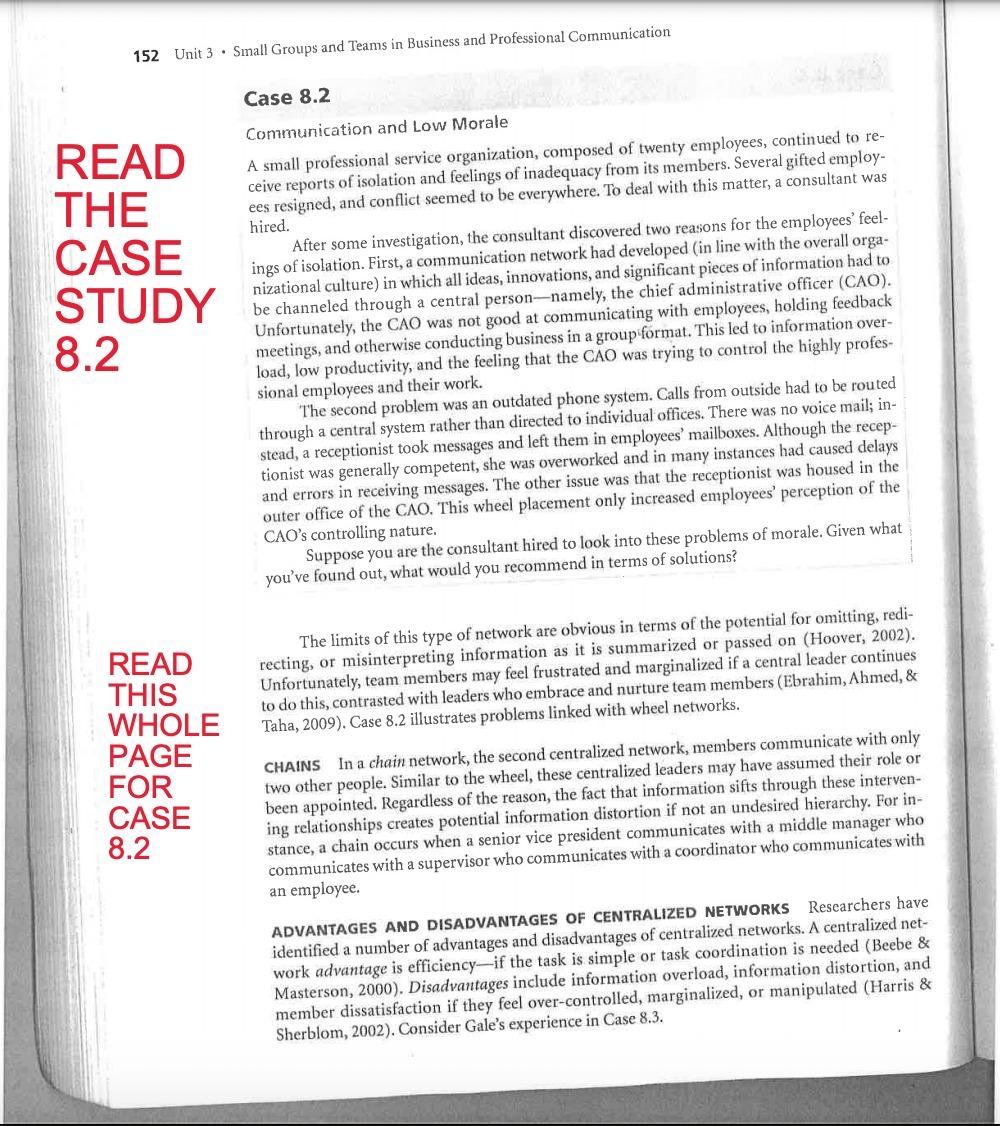
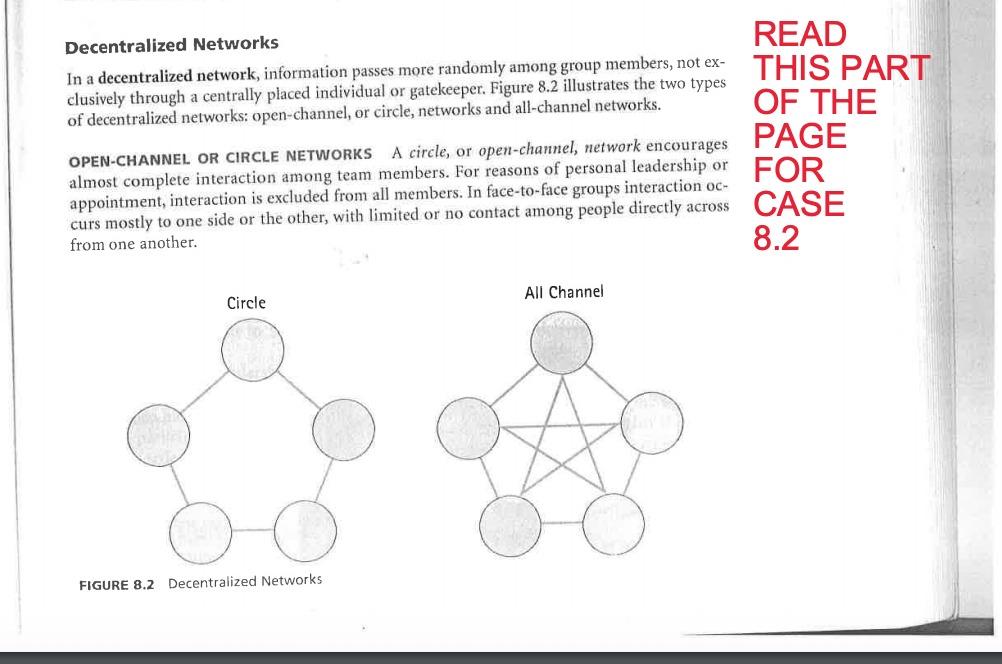
152 Unit 3. Small Groups and Teams in Business and Professional Communication Case 8.2 READ THE CASE STUDY 8.2 Conmunication and Low Morale A small professional service organization, composed of twenty employees, continued to re- ceive reports of isolation and feelings of inadequacy from its members. Several gifted employ- ees resigned, and conflict seemed to be everywhere. To deal with this matter, a consultant was hired. After some investigation, the consultant discovered two reasons for the employees' feel- ings of isolation. First, a communication network had developed (in line with the overall orga- nizational culture) in which all ideas, innovations, and significant pieces of information had to be channeled through a central person-namely, the chief administrative officer (CAO). Unfortunately, the CAO was not good at communicating with employees, holding feedback meetings, and otherwise conducting business in a group format. This led to information over- load, low productivity, and the feeling that the CAO was trying to control the highly profes- sional employees and their work. The second problem was an outdated phone system. Calls from outside had to be routed through a central system rather than directed to individual offices. There was no voice mail; in- stead, a receptionist took messages and left them in employees' mailboxes. Although the recep- tionist was generally competent, she was overworked and in many instances had caused delays and errors in receiving messages. The other issue was that the receptionist was housed in the outer office of the CAO. This wheel placement only increased employees' perception of the CAO's controlling nature. Suppose you are the consultant hired to look into these problems of morale. Given what you've found out, what would you recommend in terms of solutions? The limits of this type of network are obvious in terms of the potential for omitting, redi- recting, or misinterpreting information as it is summarized or passed on (Hoover, 2002). Unfortunately, team members may feel frustrated and marginalized if a central leader continues to do this, contrasted with leaders who embrace and nurture team members (Ebrahim, Ahmed, & Taha, 2009). Case 8.2 illustrates problems linked with wheel networks. READ THIS WHOLE PAGE FOR CASE 8.2 CHAINS In a chain network, the second centralized network, members communicate with only two other people. Similar to the wheel, these centralized leaders may have assumed their role or been appointed. Regardless of the reason, the fact that information sifts through these interven- ing relationships creates potential information distortion if not an undesired hierarchy. For in- stance, a chain occurs when a senior vice president communicates with a middle manager who communicates with a supervisor who communicates with a coordinator who communicates with an employee ADVANTAGES AND DISADVANTAGES OF CENTRALIZED NETWORKS Researchers have identified a number of advantages and disadvantages of centralized networks. A centralized net- work advantage is efficiency if the task is simple or task coordination is needed (Beebe & Masterson, 2000). Disadvantages include information overload, information distortion, and member dissatisfaction if they feel over-controlled, marginalized, or manipulated (Harris & Sherblom, 2002). Consider Gale's experience in Case 8.3. Decentralized Networks In a decentralized network, information passes more randomly among group members, not ex- clusively through a centrally placed individual or gatekeeper. Figure 8.2 illustrates the two types of decentralized networks: open-channel, or circle, networks and all-channel networks. READ THIS PART OF THE PAGE FOR CASE 8.2 OPEN-CHANNEL OR CIRCLE NETWORKS A circle, or open-channel, network encourages almost complete interaction among team members. For reasons of personal leadership or appointment, interaction is excluded from all members. In face-to-face groups interaction oc- curs mostly to one side or the other, with limited or no contact among people directly across from one another. All Channel Circle FIGURE 8.2 Decentralized Networks 152 Unit 3. Small Groups and Teams in Business and Professional Communication Case 8.2 READ THE CASE STUDY 8.2 Conmunication and Low Morale A small professional service organization, composed of twenty employees, continued to re- ceive reports of isolation and feelings of inadequacy from its members. Several gifted employ- ees resigned, and conflict seemed to be everywhere. To deal with this matter, a consultant was hired. After some investigation, the consultant discovered two reasons for the employees' feel- ings of isolation. First, a communication network had developed (in line with the overall orga- nizational culture) in which all ideas, innovations, and significant pieces of information had to be channeled through a central person-namely, the chief administrative officer (CAO). Unfortunately, the CAO was not good at communicating with employees, holding feedback meetings, and otherwise conducting business in a group format. This led to information over- load, low productivity, and the feeling that the CAO was trying to control the highly profes- sional employees and their work. The second problem was an outdated phone system. Calls from outside had to be routed through a central system rather than directed to individual offices. There was no voice mail; in- stead, a receptionist took messages and left them in employees' mailboxes. Although the recep- tionist was generally competent, she was overworked and in many instances had caused delays and errors in receiving messages. The other issue was that the receptionist was housed in the outer office of the CAO. This wheel placement only increased employees' perception of the CAO's controlling nature. Suppose you are the consultant hired to look into these problems of morale. Given what you've found out, what would you recommend in terms of solutions? The limits of this type of network are obvious in terms of the potential for omitting, redi- recting, or misinterpreting information as it is summarized or passed on (Hoover, 2002). Unfortunately, team members may feel frustrated and marginalized if a central leader continues to do this, contrasted with leaders who embrace and nurture team members (Ebrahim, Ahmed, & Taha, 2009). Case 8.2 illustrates problems linked with wheel networks. READ THIS WHOLE PAGE FOR CASE 8.2 CHAINS In a chain network, the second centralized network, members communicate with only two other people. Similar to the wheel, these centralized leaders may have assumed their role or been appointed. Regardless of the reason, the fact that information sifts through these interven- ing relationships creates potential information distortion if not an undesired hierarchy. For in- stance, a chain occurs when a senior vice president communicates with a middle manager who communicates with a supervisor who communicates with a coordinator who communicates with an employee ADVANTAGES AND DISADVANTAGES OF CENTRALIZED NETWORKS Researchers have identified a number of advantages and disadvantages of centralized networks. A centralized net- work advantage is efficiency if the task is simple or task coordination is needed (Beebe & Masterson, 2000). Disadvantages include information overload, information distortion, and member dissatisfaction if they feel over-controlled, marginalized, or manipulated (Harris & Sherblom, 2002). Consider Gale's experience in Case 8.3. Decentralized Networks In a decentralized network, information passes more randomly among group members, not ex- clusively through a centrally placed individual or gatekeeper. Figure 8.2 illustrates the two types of decentralized networks: open-channel, or circle, networks and all-channel networks. READ THIS PART OF THE PAGE FOR CASE 8.2 OPEN-CHANNEL OR CIRCLE NETWORKS A circle, or open-channel, network encourages almost complete interaction among team members. For reasons of personal leadership or appointment, interaction is excluded from all members. In face-to-face groups interaction oc- curs mostly to one side or the other, with limited or no contact among people directly across from one another. All Channel Circle FIGURE 8.2 Decentralized Networks
Step by Step Solution
There are 3 Steps involved in it
1 Expert Approved Answer
Step: 1 Unlock

Question Has Been Solved by an Expert!
Get step-by-step solutions from verified subject matter experts
Step: 2 Unlock
Step: 3 Unlock
 Study Help