







Question: Please read case study, and answer question 3, thank you to Case Study A Question of Evidence Timothy B. Patrick and Norma M. Lang Chris,
Please read case study, and answer question 3, thank you
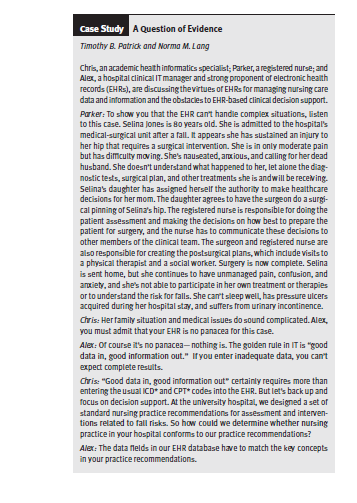
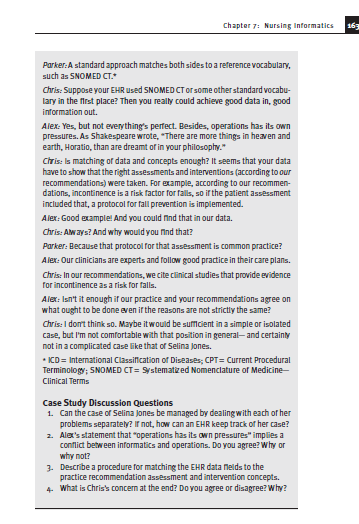
to Case Study A Question of Evidence Timothy B. Patrick and Norma M. Lang Chris, an academic health informatics specialist: Parker, a registered nurse; and Alex, a hospital clinical IT manager and strong proponent of electronic health records (EHRs), are discussing the virtues of EHRs for managing nursing care data and information and the obstacles to EHR-based clinical decision support. Parker: To show you that the EHR can't handle complex situations, listen to this case. Selina Jones is 8o years old. She is admitted to the hospital's medical-surgical unit after a fall. It appears she has sustained an injury to her hip that requires a surgical intervention. She is in only moderate pain but has difficulty moving. She's nauseated, anxious, and calling for her dead husband. She doesn't understand what happened to her, let alone the diag- nostic tests, surgical plan, and other treatments she is andwill be receiving. Selina's daughter has assigned herself the authority to make healthcare decisions for her mom. The daughter agrees to have the surgeon do a surgi- cal pinning of Selina's hip. The registered nurse is responsible for doing the patient assessment and making the decisions on how best to prepare the patient for surgery, and the nurse has to communicate these decisio other members of the clinical team. The surgeon and registered nurse are also responsible for creating the postsurgical plans, which include visits to a physical therapist and a social worker. Surgery is now complete. Selina is sent home, but she continues to have unmanaged pain, confusion, and anxiety, and she's not able to participate in her own treatment or therapies or to understand the risk forfalls. She can't sleep well, has pressure ulcers acquired during her hospital stay, and suffers from urinary incontinence. Chris: Her family situation and medical issues do sound complicated. Alex, you must admit that your EHR is no panacea for this case. Alex: Of course it's no panacea, nothing is. The golden rule in IT is "good data in, good information out." If you enter inadequate data, you can't expect complete results. Chris "Good data in, good information out" certainly requires more than entering the usual ICD and CPT codes into the EHR. But let's back up and focus on decision support. At the university hospital, we designed a set of standard nursing practice recommendations for assessment and interven- tions related to fall risks. So how could we determine whether nursing practice in your hospital conforms to our practice recommendations? Alex: The data fields in our EHR database have to match the key concepts in your practice recommendations. Chapter 7: Nursing Informatics 16 Parker: A standard approach matches both sides to a reference vocabulary. such as SNOMED CT. Chris: Suppose your EHR Used SNOMEDCT or some other standard vocabu- lary in the first place? Then you really could achieve good data in, good information out. Alex: Yes, but not everything's perfect. Besides, operations has its own pressures. As Shakespeare wrote, "There are more things in heaven and earth, Horatio, than are dreamt of in your philosophy." Chris: Is matching or data and concepts enough? It seems that your data have to show that the right assessments and interventions (according to our recommendations) were taken. For oample, according to our recommen- dations, incontinence is a risk factor for falls, so if the patient assessment included that, a protocol for fall prevention is implemented. Alex: Good example! And you could Nind that in our data. Chris: Always? And why would you find that? Parker: Because that protocol for that assessment is common practice? Alex: Our clinicians are experts and follow good practice in their care plans. Chris: In our recommendations, we cite clinical studies that provide evidence for incontinence as a risk forfalls. Alex: Isn't it enough if our practice and your recommendations agree on what ought to be done even if the reasons are not strictly the same? Chris: I don't think so. Maybe it would be sufficient in a simple or isolated case, but I'm not comfortable with that position in general and certainly not in a complicated case like that of Selina Jones. ICD= International Classification of Diseases: CPT= Current Procedural Terminology; SNOMEDCT= Systematized Nomenclature of Medicine Clinical Terms Case Study Discussion Questions 1. Can the case of Selina Jones be managed by dealing with each of her problems separately? If not, how can an EHR keep track of her case? 2. Alex's statement that operations has its own pressures" implies a conflict between informatics and operations. Do you agree? Why or why not? 3. Describe a procedure for matching the EHR data nelds to the practice recommendation assessment and intervention concepts. 4. What is Chris's concern at the end? Do you agree or disagree? WhyStep by Step Solution
There are 3 Steps involved in it
1 Expert Approved Answer
Step: 1 Unlock

Question Has Been Solved by an Expert!
Get step-by-step solutions from verified subject matter experts
Step: 2 Unlock
Step: 3 Unlock
 Study Help