Question: Please read the abstract, methods, and results and identify: 1. any measured variables and how they have been operationalized 2. any manipulated variables and what
Please read the abstract, methods, and results and identify:
1. any measured variables and how they have been operationalized
2. any manipulated variables and what the specific levels of those variables are
3. any individual difference variables and what the specific levels of those variables are
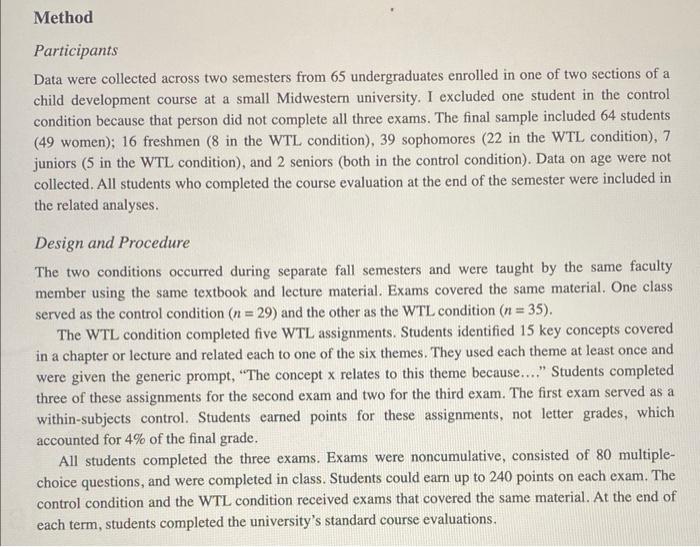
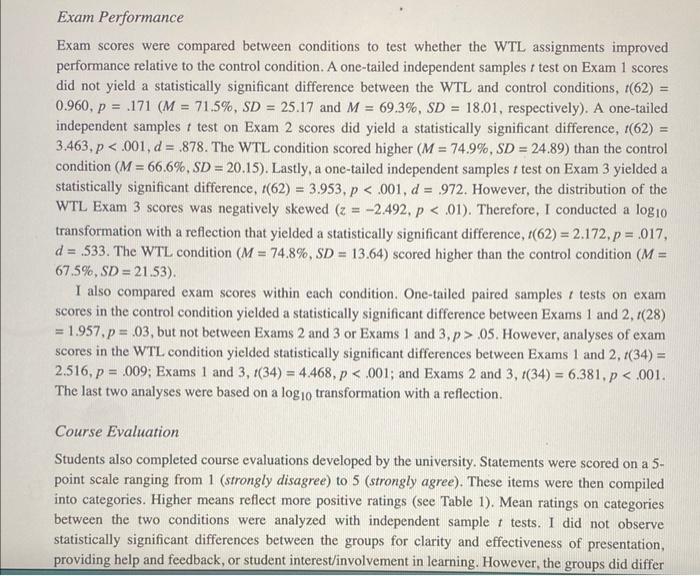
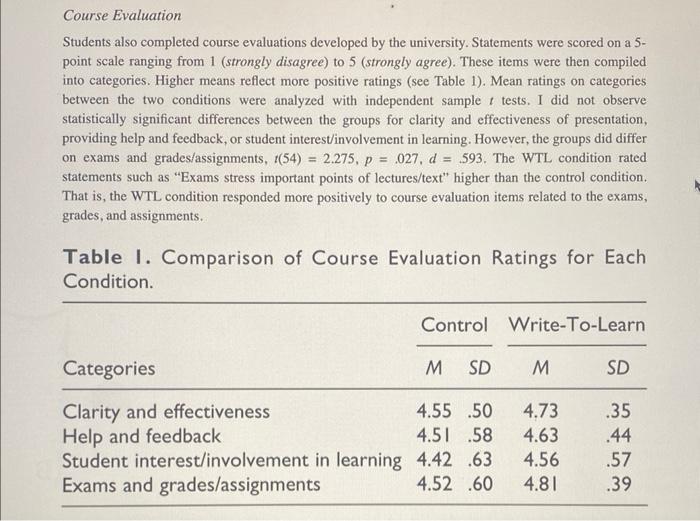
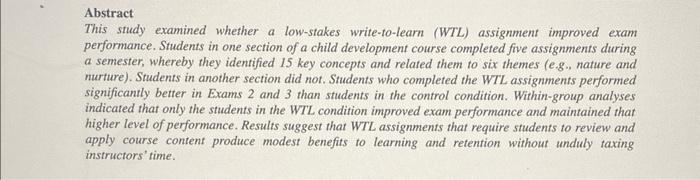
Participants Data were collected across two semesters from 65 undergraduates enrolled in one of two sections of a child development course at a small Midwestern university. I excluded one student in the control condition because that person did not complete all three exams. The final sample included 64 students (49 women); 16 freshmen ( 8 in the WTL condition), 39 sophomores ( 22 in the WTL condition), 7 juniors ( 5 in the WTL condition), and 2 seniors (both in the control condition). Data on age were not collected. All students who completed the course evaluation at the end of the semester were included in the related analyses. Design and Procedure The two conditions occurred during separate fall semesters and were taught by the same faculty member using the same textbook and lecture material. Exams covered the same material. One class served as the control condition (n=29) and the other as the WTL condition (n=35). The WTL condition completed five WTL assignments. Students identified 15 key concepts covered in a chapter or lecture and related each to one of the six themes. They used each theme at least once and were given the generic prompt, "The concept x relates to this theme because..." Students completed three of these assignments for the second exam and two for the third exam. The first exam served as a within-subjects control. Students earned points for these assignments, not letter grades, which accounted for 4% of the final grade. All students completed the three exams. Exams were noncumulative, consisted of 80 multiplechoice questions, and were completed in class. Students could earn up to 240 points on each exam. The control condition and the WTL condition received exams that covered the same material. At the end of each term, students completed the university's standard course evaluations. Exam scores were compared between conditions to test whether the WTL assignments improved performance relative to the control condition. A one-tailed independent samples t test on Exam 1 scores did not yield a statistically significant difference between the WTL and control conditions, t(62)= 0.960,p=.171(M=71.5%,SD=25.17 and M=69.3%,SD=18.01, respectively). A one-tailed independent samples t test on Exam 2 scores did yield a statistically significant difference, t(62)= 3.463,p<.001 the wtl condition scored higher than control lastly a one-tailed independent samples t test on exam yielded statistically significant difference however distribution of scores was negatively skewed therefore i conducted log10 transformation with reflection that d=".533." also compared within each condition. paired tests in between exams and but not or>.05. However, analyses of exam scores in the WTL condition yielded statistically significant differences between Exams 1 and 2,t(34)= 2.516,p=.009; Exams 1 and 3,t(34)=4.468,p<.001 and exams the last two analyses were based on a log10 transformation with reflection. course evaluation students also completed evaluations developed by university. statements scored scale ranging from disagree to agree these items then compiled into categories. higher means reflect more positive ratings table mean categories between conditions analyzed independent sample t tests. i did not observe statistically significant differences groups for clarity effectiveness of presentation providing help feedback or student interest in learning. however differ grades wtl condition rated such as stress important points lectures than control condition. that is responded positively related assignments. i. comparison each abstract this study examined whether low-stakes write-to-learn assignment improved exam performance. one section child development five assignments during semester whereby they identified key concepts them six themes nature murture another not. who performed significantly better within-group indicated only performance maintained level results suggest require review apply content produce modest benefits learning retention without unduly taxing instructors time>









 Study Help