







Question: please read the article and answer Question 2 READ THE ARTICLE BELOW AND ANSWER THE QUESTIONS THAT FOLLOW: BMW Sets Out 7 Principles For Use
please read the article and answer Question 2 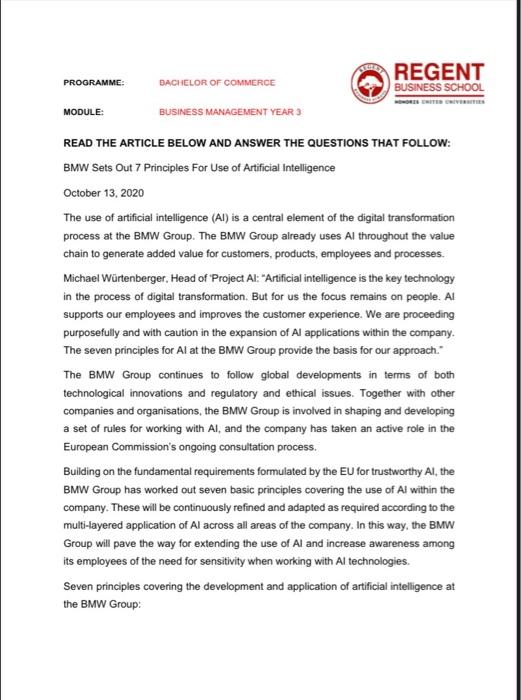
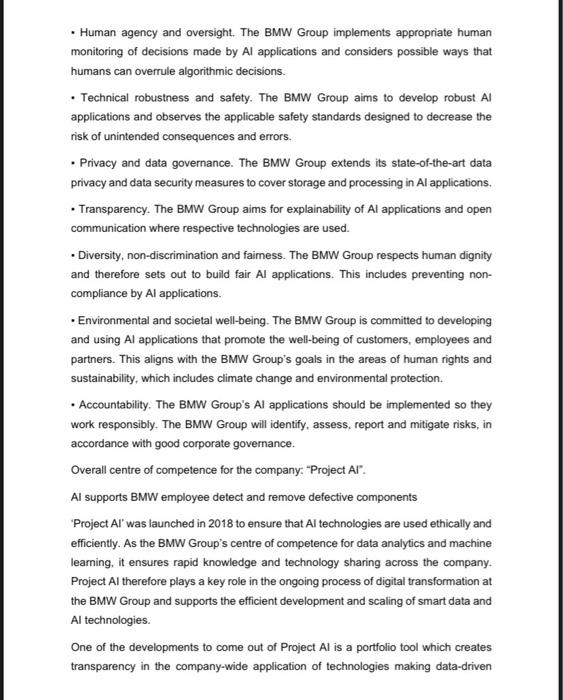
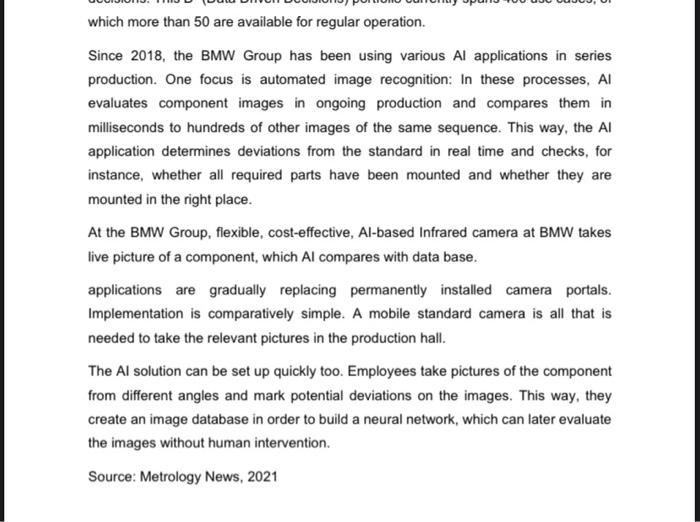
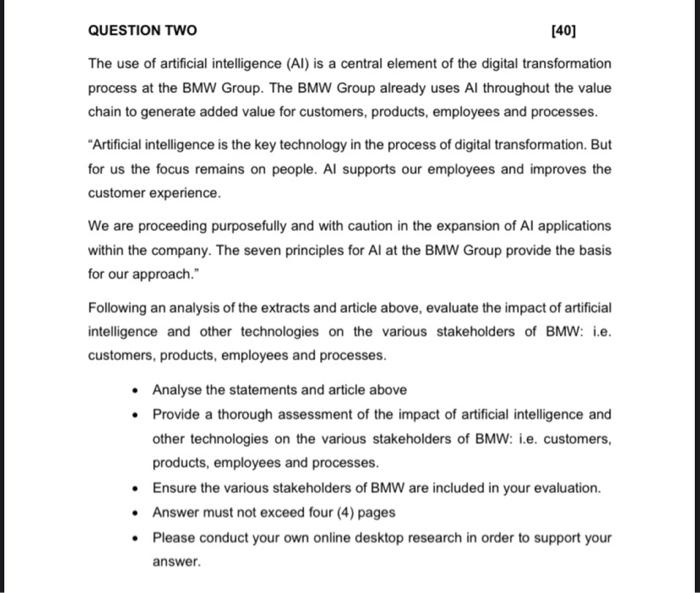
READ THE ARTICLE BELOW AND ANSWER THE QUESTIONS THAT FOLLOW: BMW Sets Out 7 Principles For Use of Artificial Intelligence October 13,2020 The use of artificial intelligence (Al) is a central element of the digital transformation process at the BMW Group. The BMW Group already uses Al throughout the value chain to generate added value for customers, products, employees and processes. Michael Wrtenberger, Head of 'Project Al: "Artificial intelligence is the key technology in the process of digital transformation. But for us the focus remains on people. Al supports our employees and improves the customer experience. We are proceeding purposefully and with caution in the expansion of Al applications within the company. The seven principles for Al at the BMW Group provide the basis for our approach." The BMW Group continues to follow giobal developments in terms of both technological innovations and regulatory and ethical issues. Together with other companies and organisations, the BMW Group is involved in shaping and developing a set of rules for working with Al, and the company has taken an active role in the European Commission's ongoing consultation process. Building on the fundamental requirements formulated by the EU for trustworthy Al, the BMW Group has worked out seven basic principles covering the use of Al within the company. These will be continuously refined and adapted as required according to the multi-layered application of Al across all areas of the company. In this way, the BMW Group will pave the way for extending the use of Al and increase awareness among its employees of the need for sensitivity when working with Al technologies. Seven principles covering the development and application of artificial intelligence at the BMW Group: - Human agency and oversight. The BMW Group implements appropriate human monitoring of decisions made by Al applications and considers possible ways that humans can overrule algorithmic decisions. - Technical robustness and safety. The BMW Group aims to develop robust Al applications and observes the applicable safety standards designed to decrease the risk of unintended consequences and errors. - Privacy and data governance. The BMW Group extends its state-of-the-art data privacy and data security measures to cover storage and processing in Al applications. - Transparency. The BMW Group aims for explainability of Al applications and open communication where respective technologies are used. - Diversity, non-discrimination and faimess. The BMW Group respects human dignity and therefore sets out to build fair Al applications. This includes preventing noncompliance by Al applications. - Environmental and societal well-being. The BMW Group is committed to developing and using Al applications that promote the well-being of customers, employees and partners. This aligns with the BMW Group's goals in the areas of human rights and sustainability, which includes climate change and environmental protection. - Accountability. The BMW Group's Al applications should be implemented so they work responsibly. The BMW Group will identify, assess, report and mitigate risks, in accordance with good corporate governance. Overall centre of competence for the company: "Project Al". Al supports BMW employee detect and remove defective components 'Project Al' was launched in 2018 to ensure that Al technologies are used ethically and efficiently. As the BMW Group's centre of competence for data analytics and machine learning, it ensures rapid knowledge and technology sharing across the company. Project Al therefore plays a key role in the ongoing process of digital transformation at the BMW Group and supports the efficient development and scaling of smart data and Al technologies. One of the developments to come out of Project Al is a portfolio tool which creates transparency in the company-wide application of technologies making data-driven which more than 50 are available for regular operation. Since 2018, the BMW Group has been using various Al applications in series production. One focus is automated image recognition: In these processes, Al evaluates component images in ongoing production and compares them in milliseconds to hundreds of other images of the same sequence. This way, the Al application determines deviations from the standard in real time and checks, for instance, whether all required parts have been mounted and whether they are mounted in the right place. At the BMW Group, flexible, cost-effective, Al-based Infrared camera at BMW takes live picture of a component, which Al compares with data base. applications are gradually replacing permanently installed camera portals. Implementation is comparatively simple. A mobile standard camera is all that is needed to take the relevant pictures in the production hall. The Al solution can be set up quickly too. Employees take pictures of the component from different angles and mark potential deviations on the images. This way, they create an image database in order to build a neural network, which can later evaluate the images without human intervention. Source: Metrology News, 2021 QUESTION TWO [40] The use of artificial intelligence (AI) is a central element of the digital transformation process at the BMW Group. The BMW Group already uses Al throughout the value chain to generate added value for customers, products, employees and processes. "Artificial intelligence is the key technology in the process of digital transformation. But for us the focus remains on people. Al supports our employees and improves the customer experience. We are proceeding purposefully and with caution in the expansion of Al applications within the company. The seven principles for Al at the BMW Group provide the basis for our approach." Following an analysis of the extracts and article above, evaluate the impact of artificial intelligence and other technologies on the various stakeholders of BMW: i.e. customers, products, employees and processes. - Analyse the statements and article above - Provide a thorough assessment of the impact of artificial intelligence and other technologies on the various stakeholders of BMW: i.e. customers, products, employees and processes. - Ensure the various stakeholders of BMW are included in your evaluation. - Answer must not exceed four (4) pages - Please conduct your own online desktop research in order to support your Step by Step Solution
There are 3 Steps involved in it
1 Expert Approved Answer
Step: 1 Unlock

Question Has Been Solved by an Expert!
Get step-by-step solutions from verified subject matter experts
Step: 2 Unlock
Step: 3 Unlock
 Study Help