







Question: Please read the article and answer the questions below. In April 2018, 9-year-old Christian Bolling was hiking with his parents and sister in Virginia's Blue
Please read the article and answer the questions below.
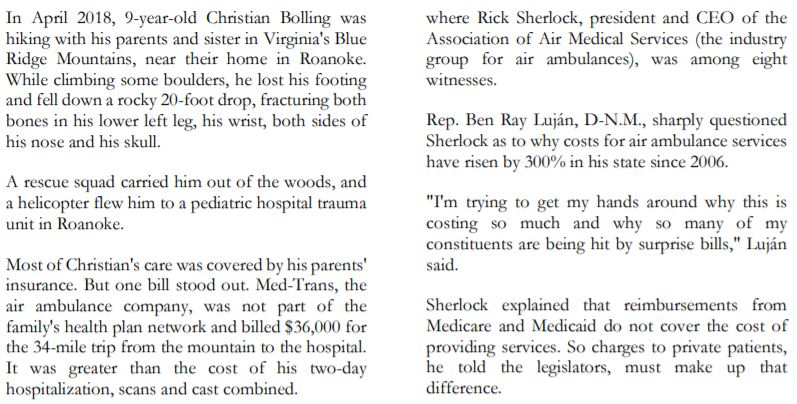
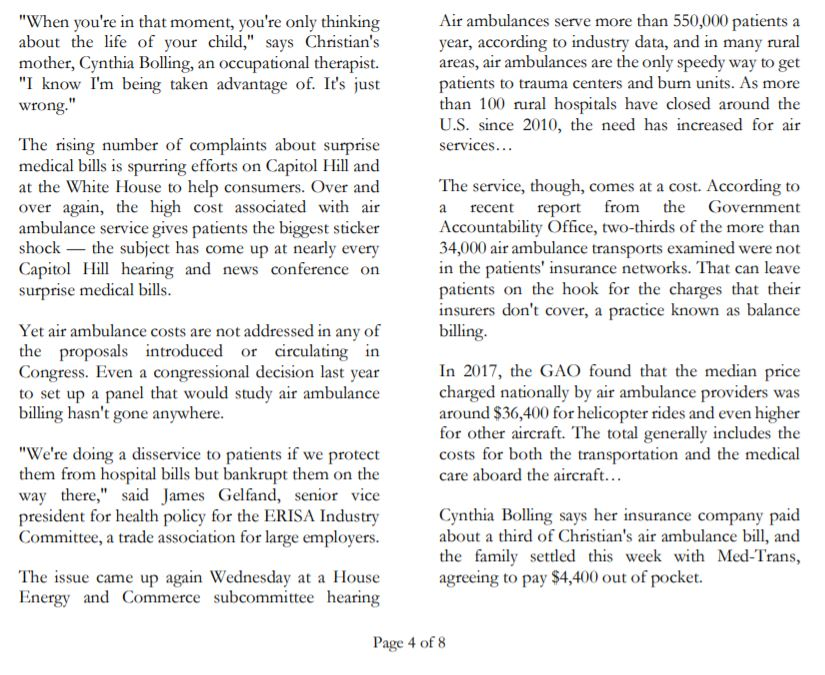
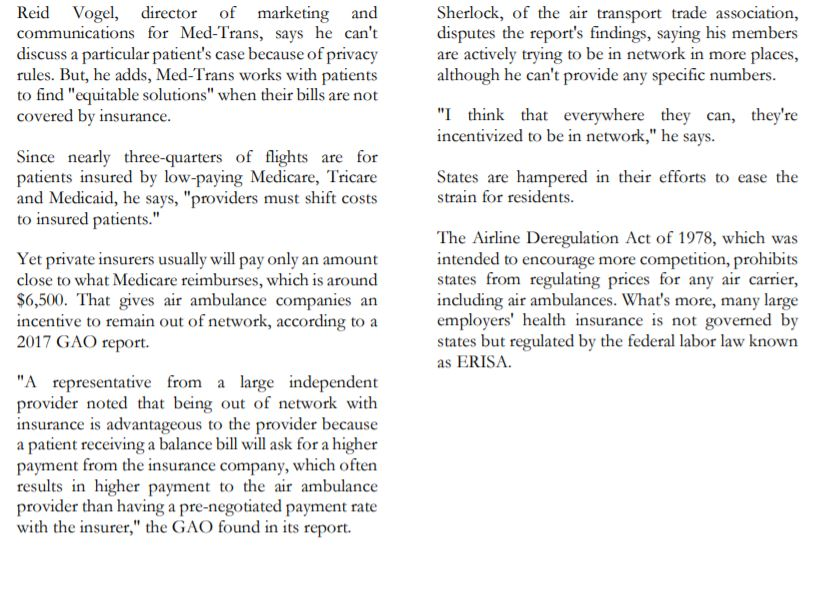
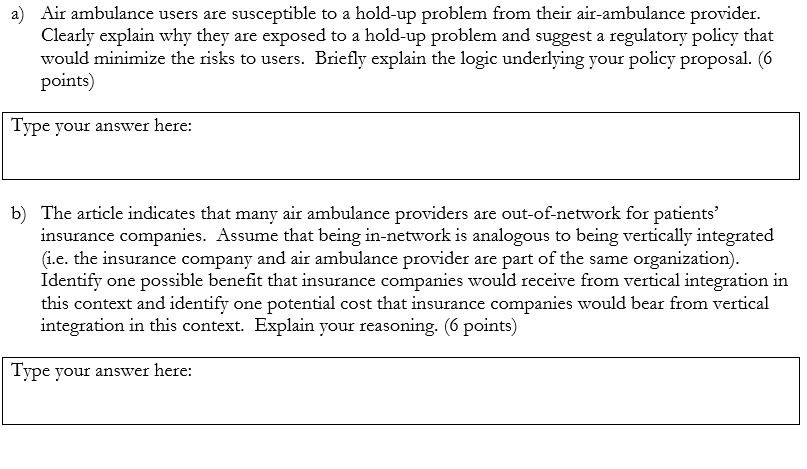
In April 2018, 9-year-old Christian Bolling was hiking with his parents and sister in Virginia's Blue Ridge Mountains, near their home in Roanoke. While climbing some boulders, he lost his footing and fell down a rocky 20-foot drop, fracturing both bones in his lower left leg, his wrist, both sides of his nose and his skull. where Rick Sherlock, president and CEO of the Association of Air Medical Services (the industry group for air ambulances), was among eight witnesses. Rep. Ben Ray Lujn, D-N.M., sharply questioned Sherlock as to why costs for air ambulance services have risen by 300% in his state since 2006. A rescue squad carried him out of the woods, and a helicopter flew him to a pediatric hospital trauma unit in Roanoke. "I'm trying to get my hands around why this is costing so much and why so many of my constituents are being hit by surprise bills," Lujn said. Most of Christian's care was covered by his parents' insurance. But one bill stood out. Med-Trans, the air ambulance company, was not part of the family's health plan network and billed $36,000 for the 34-mile trip from the mountain to the hospital. It was greater than the cost of his two-day hospitalization, scans and cast combined. Sherlock explained that reimbursements from Medicare and Medicaid do not cover the cost of providing services. So charges to private patients, he told the legislators, must make up that difference. "When you're in that moment, you're only thinking about the life of your child," says Christian's mother, Cynthia Bolling, an occupational therapist. "I know I'm being taken advantage of. It's just wrong." Air ambulances serve more than 550,000 patients a year, according to industry data, and in many rural areas, air ambulances are the only speedy way to get patients to trauma centers and burn units. As more than 100 rural hospitals have closed around the U.S. since 2010, the need has increased for air services... The rising number of complaints about surprise medical bills is spurring efforts on Capitol Hill and at the White House to help consumers. Over and over again, the high cost associated with air ambulance service gives patients the biggest sticker shock the subject has come up at nearly every Capitol Hill hearing and news conference on surprise medical bills. The service, though, comes at a cost. According to a recent report from the Government Accountability Office, two-thirds of the more than 34,000 air ambulance transports examined were not in the patients' insurance networks. That can leave patients on the hook for the charges that their insurers don't cover, a practice known as balance billing. Yet air ambulance costs are not addressed in any of the proposals introduced or circulating in Congress. Even a congressional decision last year to set up a panel that would study air ambulance billing hasn't gone anywhere. In 2017, the GAO found that the median price charged nationally by air ambulance providers was around $36,400 for helicopter rides and even higher for other aircraft. The total generally includes the costs for both the transportation and the medical care aboard the aircraft... "We're doing a disservice to patients if we protect them from hospital bills but bankrupt them on the way there," said James Gelfand, senior vice president for health policy for the ERISA Industry Committee, a trade association for large employers. Cynthia Bolling says her insurance company paid about a third of Christian's air ambulance bill, and the family settled this week with Med-Trans, agreeing to pay $4,400 out of pocket. The issue came up again Wednesday at a House Energy and Commerce subcommittee hearing Page 4 of 8 Reid Vogel, director of marketing and communications for Med-Trans, says he can't discuss a particular patient's case because of privacy rules. But, he adds, Med-Trans works with patients to find "equitable solutions" when their bills are not covered by insurance. Sherlock, of the air transport trade association, disputes the report's findings, saying his members are actively trying to be in network in more places, although he can't provide any specific numbers. "I think that everywhere they can, they're incentivized to be in network," he says. Since nearly three-quarters of flights are for patients insured by low-paying Medicare, Tricare and Medicaid, he says, "providers must shift costs to insured patients." States are hampered in their efforts to ease the strain for residents. Yet private insurers usually will pay only an amount close to what Medicare reimburses, which is around $6,500. That gives air ambulance companies an incentive to remain out of network, according to a 2017 GAO report. The Airline Deregulation Act of 1978, which was intended to encourage more competition, prohibits states from regulating prices for any air carrier, including air ambulances. What's more, many large employers' health insurance is not governed by states but regulated by the federal labor law known as ERISA. "A representative from a large independent provider noted that being out of network with insurance is advantageous to the provider because a patient receiving a balance bill will ask for a higher payment from the insurance company, which often results in higher payment to the air ambulance provider than having a pre-negotiated payment rate with the insurer," the GAO found in its report. a) Air ambulance users are susceptible to a hold-up problem from their air-ambulance provider. Clearly explain why they are exposed to a hold-up problem and suggest a regulatory policy that would minimize the risks to users. Briefly explain the logic underlying your policy proposal. (6 points) Type your answer here: b) The article indicates that many air ambulance providers are out-of-network for patients' insurance companies. Assume that being in-network is analogous to being vertically integrated (i.e. the insurance company and air ambulance provider are part of the same organization). Identify one possible benefit that insurance companies would receive from vertical integration in this context and identify one potential cost that insurance companies would bear from vertical integration in this context. Explain your reasoning. (6 points) Type your answer here
Step by Step Solution
There are 3 Steps involved in it

Get step-by-step solutions from verified subject matter experts
 Study Help