Question: please read the article and summarize it. th by Anna Brewer Director of HR Administrative Compliance Houston, Texas Regulatory compliance Comments Exempt vs. non exempt:
please read the article and summarize it.
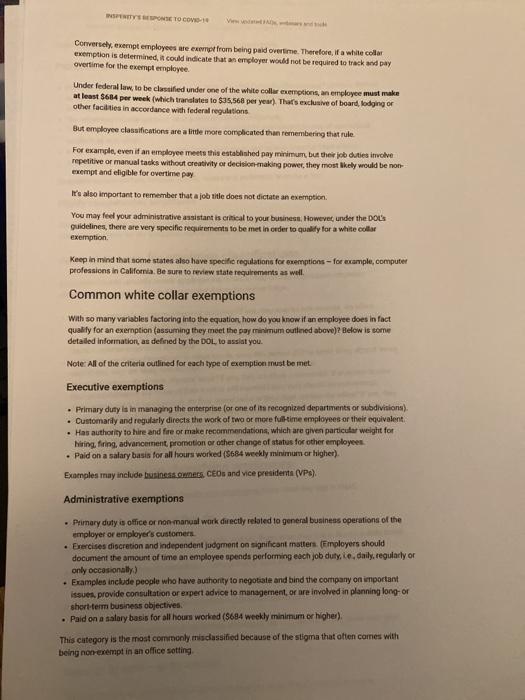
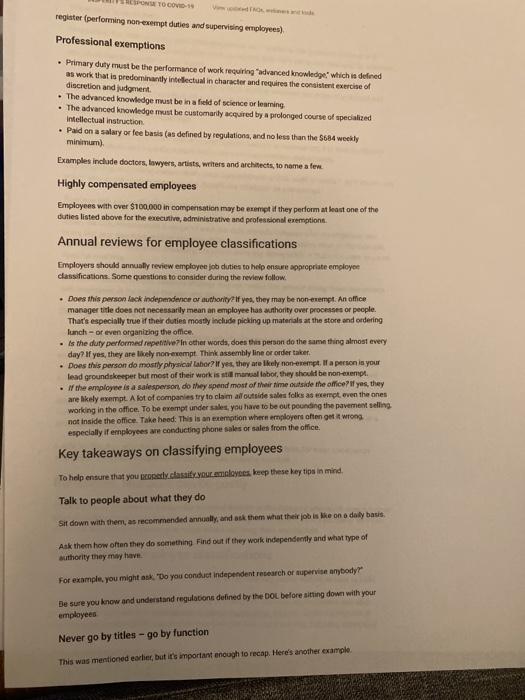
th by Anna Brewer Director of HR Administrative Compliance Houston, Texas Regulatory compliance Comments Exempt vs. non exempt: A guide to white collar workers How confident are you in your employee classifications and the process you use to categorize them? Do you really understand the differences between exempt vs. non-exempt classifications when it comes to your white collar employees? One of the biggest misconceptions with employee classification in that anyone who isn't bussing tables or taking orders at the corner delican quality for one of the white collar exemptions under the Department of Labor(DOL) Unfortunately, It's not that simple. You shouldn't automatically assume that certain employees are exempt So, how does one decide if an employee is exempt vs non exempe? Pay rate, job duties and responsibilities are all key factors in determining it an employee is exempt or non-exempt, not the type of clothes they wear or their work environment This guide can help you better understand the qualifications for exemption and hopefully, minimize your potential for a wage claim, DOL audit or IRS fines for employee mincinsification Exempt vs. non-exempt In a nutshell, the most significant difference between non exempt workers and their peers who qualify for a white collar exemption is overtime pay and timekeeping requirements. SITYSPONSE TO COV Conversely, exempt employees are exempt from being paid over time. Therefore, if a white color exemption is determined, it could indicate that an employer would not be required to track and pay overtime for the exempt employee. Under federal law, to be classified under one of the white collar exemptions, an employee must make at least $684 per week (which translates to $35,568 per year). That's exclusive of board, lodging or other facilities in accordance with federal regulations But employee classifications are a little more complicated than remembering that rule For example, even if an employee meets this established pay minimum, but their job duties involve repetitive or manual tasks without creativity or decision-making power, they most likely would be non exempt and eligible for overtime pay It's also important to remember that a job title does not dictate an exemption You may feel your administrative assistant is critical to your business. However under the DOLE guidelines, there are very specific requirements to be met in order to qualify for a white collar exemption Keep in mind that some states also have specific regulations for exemptions for example, computer professions in California. Be sure to review state requirements as well Common white collar exemptions With so many variables factoring into the equation, how do you know if an employee does in fact qualify for an exemption (assuming they meet the pay minimum outlined above)? Below is some detailed information, as defined by the DOL to assist you. Note: All of the criteria outlined for each type of exemption must be met Executive exemptions Primary duty is in managing the enterprise for one of its recognized departments or subdivisions) Customarily and regularly directs the work of two or more fub-time employees or their equivalent Has authority to hire and fre or make recommendations, which are given particular weight for Hiring, firing, advancement promotion or other change of status for other employees Paid on a salary basis for all hours worked (5684 weekly minimum or higher). Examples may include business owners. CEOs and vice presidents (VPs). Administrative exemptions Primary duty is office or non manual work directly related to general business operations of the employer or employer's customers Exercises discretion and independent judgment on significant matters. (Employers should document the amount of time an employee spends performing each job duty. Le daily, regularly or only occasionally) Examples include people who have authority to negotiate and bind the company on important issues, provide consultation or expert advice to management, or are involved in planning long-or short-term business objectives Paid on a salary basis for all hours worked (5684 weekly minimum or higher) This category is the most commonly miscussified because of the stigma that otten comes with being non-exempt in an office setting COME TO COVO-99 register (performing non-exempt duties and supervising employees) Professional exemptions Primary duty must be the performance of work requiring advanced knowledge which is defined as work that is predominantly intelectual in character and requires the consiste exercise of discretion and judgment The advanced knowledge must be in a field of science or learning The advanced knowledge must be customerly cuired by a prolonged course of specialized Intellectual instruction . Pald on a salary or fee basis (as defined by regulations, and no less than the 5684 weekly minimum) Examples include doctors, lawyers, artists, writers and architects, to name a few. Highly compensated employees Employees with over $100.000 in compensation may be exempt if they perform at least one of the duties listed above for the executive, adreinistrative and professional exemption Annual reviews for employee classifications Employers should annually review employee job duties to help ensure appropriate employee classifications. Some questions to consider during the review follow. Does this person Jack independence or authority? If yes, they may be non-exempt. An office manager title does not necessarily mean an employee has authority over processes or people. That's especially true of their duties mostly include picking up materials at the store and ordering lunch or even organizing the office Is the duty performed repetitive? In other words, does this person do the same thing almost every day? If yes, they are likely non-exempt Think assembly line or ordertaker Does this person do mostly physical Labor? yes, they are likely non-exempt. If a person is your lead ground keeper but most of their work is still man lobor, they should be non-exempt. . If the amployee is a salesperson, do they spend most of their time utside the office if yes, they are likely exempt. A lot of companies try to claim all outside sales folks as exempt, even the ones working in the office. To be exempt under sales, you have to be out pounding the pavement selling not inside the office. Take heed: This is an exemption where employers often get wrong especially if employees we conducting phone sales or sales from the office Key takeaways on classifying employees To help ensure that you copy.clay your emloyees, keep these key tips in mind. Talk to people about what they do Sit down with them, as recommended annually and ask them what their job is the on a daily basis Ask them how often they do something Find out if they work independently and what type of authority they may have For example, you might ask, "Do you conduct independent research or supervise anybody Be sure you know and understand regulations defined by the DOL before sitting down with your employees Never go by titles - go by function This was mentioned earlier, but it's important enough to recop. Here's another example









 Study Help