Question: please read the case background and answer the following question. 1.Analyze Thompson Technologies organizational design prior to the strategic planning retreat. include structure, culture and
please read the case background and answer the following question.
1.Analyze Thompson Technologies organizational design prior to the strategic planning retreat. include structure, culture and control in your analysis.
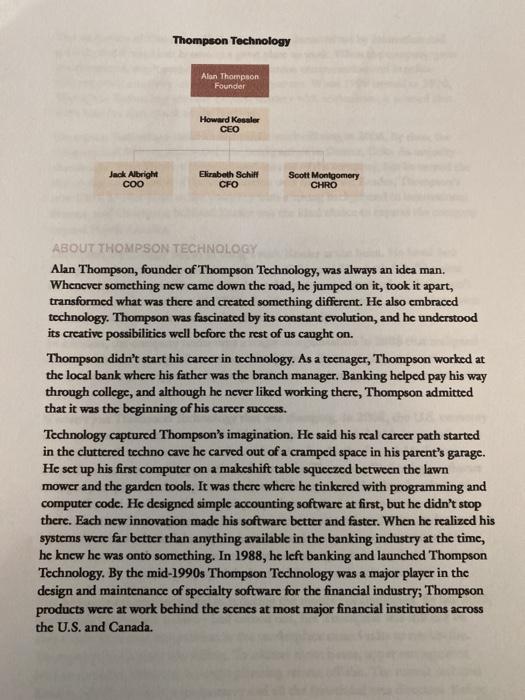
Thompson Technology Alan Thompson Founder Howard Kessler CEO Jack Albright COO Elizabeth Schiff CFO Scott Montgomery CHRO ABOUT THOMPSON TECHNOLOGY Alan Thompson, founder of Thompson Technology, was always an idea man. Whenever something new came down the road, he jumped on it, took it apart, transformed what was there and created something different. He also embraced technology. Thompson was fascinated by its constant evolution, and he understood its creative possibilities well before the rest of us caught on. Thompson didn't start his career in technology. As a tecnager, Thompson worked at the local bank where his father was the branch manager. Banking helped pay his way through college, and although he never liked working there, Thompson admitted that it was the beginning of his career success. Technology captured Thompson's imagination. He said his real career path started in the cluttered techno cave hc carved out of a cramped space in his parent's garage. He set up his first computer on a makeshift table squeezed between the lawn mower and the garden tools. It was there where he tinkered with programming and computer code. He designed simple accounting software at first, but he didn't stop there. Each new innovation made his software better and faster. When he realized his systems were far better than anything available in the banking industry at the time, he knew he was onto something. In 1988, he left banking and launched Thompson Technology. By the mid-1990s Thompson Technology was a major player in the design and maintenance of specialty software for the financial industry; Thompson products were at work behind the scenes at most major financial institutions across the U.S. and Canada. The carty years of Thompson Technology were characterized by innovation and growth, and it was soon known as a great place to work. When the company grew and prospered, cmployees did too, with generous compensation and benefits that rewarded creativity and employee engagement. When 1999 turned to 2000, Thompson Technology greeted the new century with enthusiasm; it seemed that there wasn't a dark cloud on the horizon. Thompson Technology made its first public stock offering in 2006. By then, the company had 800 employees and new headquarters in Denver, Colo. As majority sharcholder, Alan Thompson maintained control of the company, but he turned the day-to-day management of the organization over to Howard Kessler, Thompson's new CEO. Kessler came to the company with a strong background in international finance, and Thompson believed Kessler was the ideal choice to expand the company beyond North America. Thompson Technology began to change with Kessler at the helm. He hired Jack Albright as the new chief operations officer (COO), and Elizabeth Schiff became the new chief financial officer (CFO). Scott Montgomery remained as Thompson's chief human resource officer (CHRO). Besides new management, other things were different as well; now there were shareholders to satisfy. In addition, the company underwent a major reorganization in 2008 that realigned departments and reassigned a number of employees. Some employees saw the reorganization as an opportunity for growth and new energy, but not everyone was happy. It wasn't just Thompson Technology that was changing. In 2008, the U.S. economy went into a severe recession, and the U.S. Congress responded with increased regulation and stricter scrutiny of the nation's banks. As the financial industry adapted to the new banking practices, demand for Thompson Technology software dropped precipitously. Sales plummeted, and Thompson Technology's culture of casy profits and sky-is-the-limit employee perks morphed into a new cra of cost containment and belt tightening. Every department was affected, but employees were hardest hit when a financial analysis showed that labor costs were not sustainable. The year ended with the implementation of a companywide hiring freeze to curtail labor costs and, it was hoped, squelch the need for more drastic measures. The hiring freeze was successful in reducing the number of employees. By late 2010, business in the finance industry had evened out, but Thompson was still not on casy street; increased competition in the marketplace caused sales to remain flat. Thompson's stock price was falling. To address those issues, upper management held an intensive three-day strategic planning retreat off-site. The retreat included Kessler, Schiff, Albright, Montgomery and all the functional arca directors. Before the retreat, the management teams spent many hours cloistered behind closed doors analyzing the various departments' strengths and weaknesses and assessing budgetary and revenue forecasts. Kessler mandated that everyone come to the retreat prepared to make some difficult decisions regarding Thompson's long-term future. Managers armed themselves with statistical data to defend the viability of their departments. Employees were on edge, and rumors were rampant because of the uncertainty about the future and the changes that might occur as a result of the retreat. The biggest worry was that the organization would downsize U.S. operations and move jobs offshore, cven though Thompson took pride that its products were built and scrviced entirely in the U.S. When managers returned from the retreat and remained tight-lipped about the results, employee tension increased as everyone waited for an announcement. Finally, on a Wednesday afternoon, Kessler sent the following e-mail to the staff All Staff As you are aware, senior managers spent several days in important strategic planning discussions regarding the future of Thompson Technology. It is important that we continue to meet the needs of our shareholders, our customers and our employees as we move through these difficult times. Keeping those needs in mind, we recognize that some changes are necessary at Thompson Technology. For information sharing and discussion of our strategic initiatives, all employees are asked to meet with their area directors on Friday morning at 9:00. Further information will be shared at that time. As always, thank you for the good work you do and for the outstanding service you provide to Thompson customers. Thompson employees are the foundation of our success Howard Kessler CEO Thompson Technology The rumor mill was instantly at full speed as heads popped up from cubicles and employees clumped together in speculation. Staff meetings were common at Thompson, but there had never been anything like this before. "What does it mean?" "This must be a major announcement. Why else would all departments meet at the exact same time?" "Have we been bought out?" "Are we shutting down?" "I didn't think things were this bad!" Productivity plummeted. Except for a lot of talk, the employees accomplished nothing from the time they received Kessler's e-mail to 9:00 Friday morning. 9:00 Friday Morning Employees met with their area directors as scheduled. Some arrived early, but in contrast to the usual staff meetings, nobody arrived late. Coffee service at staff meetings had been discontinued months ago as a cost-cutting effort, so when coffee and pastries were set out for the morning meetings, it only raised anxiety levels. Speculation continued as employees filled coffee cups and forked pastries onto paper plates. At exactly 9 a.m., everyone dispersed to their designated meeting areas. In conference rooms across the company, chairs were full, speculation ceased and employees waited. Of course, things are never as bad as rumors suggest. In most areas, relief could be seen in employees' faces as directors reiterated the organization's commitment to employees, but the directors left no doubt that the future would be different. Managers had agreed that further cost-cutting measures would have to be taken. Employees were told to expect changes in working conditions as the company tried to cut labor costs by 10 percent. In addition, efforts would be made to increase sales revenue by exploring new markets. But for now, at least, the company was ready to move forward with no plans to lay off employees









 Study Help