







Question: PLEASE READ THE CASES AND ANSWER AND LABLE BOTH QUESTIONS CASE 13.1 CASES 13.1a-g Fundraising Ethics Questions Related to Cases 13.1a-g In the following cases
PLEASE READ THE CASES AND ANSWER AND LABLE BOTH QUESTIONS CASE 13.1
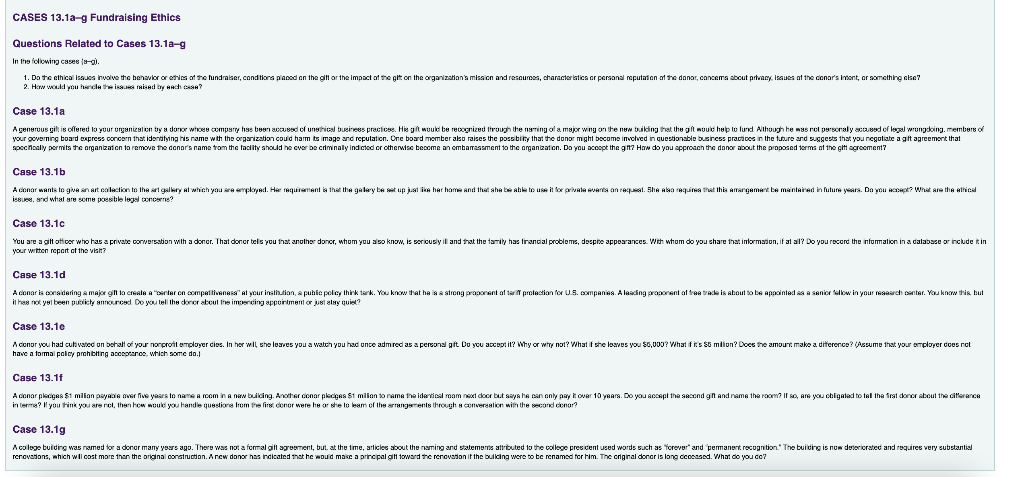
CASES 13.1a-g Fundraising Ethics Questions Related to Cases 13.1a-g In the following cases (a-g). 1. Do the ethical issues involve the behavior or ethics of the fundraiser, conditions placed on the gift or the impact of the gift on the organization's mission and resources, characteristics or personal reputation of the donor, concems about privacy issues of the donor's Intent, or something else? 2. How would you handle the issues raised by each case? Case 13.1a A generous gilt is offered to your organization by a donor whoes company has been accused of unethical business practices. His gift would be recognized through the naming of a major wing on the new building that the gift would help to fund. Although he was not personally accused of legal wrongdoing, members of your governing board express concern that identifying his name with the organization could harm its image and reputation. One board member also raises the possibility that the donor might became involved in questionable business practices in the future and suggests that you negotiate a gift agreement that specifically permits the organization to remove the donor's name from the facility should he ever be criminally indicted or otherwise become an embarassment to the organization. Do you accept the gift? How do you approach the donor about the proposed terms of the gift agreement? Case 13.1b A conor wants to give an art collection to the art gallery at which you are employed. Her requirement is that the gallery be set up just like her home and that she be able to use it for private events on request. She also requires that this arrangement be maintained in future years. Do you accept? What are the ethical issues, and what are some possible leasl consene? Case 13.1c You are a gift officer who has a private conversation with a donor. That donor tells you that another donor, whom you also know, is seriously ill and that the family has financial problems, despite appearances. With whom do you share that information, if at all? Do you record the information in a database or include it in your written report of the visit? Case 13.1d A conor is considering a major gift to create a "benter on competitiveness" at your institution, a public policy think tank. You know that he is a strong proponent of tarif protection for U.S. companies. A leading proponent of free trade is about to be appointed as a senior fellow in your research center. You know this, but it has not yet been publicly announced. Do you tell the donor about the impending appointment or just alay quiet? Case 13.10 A clonor you had cultivated on behalf of your nonprofit employer dies. In her will, she leaves you a watch you had once admired as a personal gift. Do you accept it? Why or why not? What if she leaves you $6,000? What if it's $5 million? Does the amount make a difference? (Assume that your employer does not have a formal policy prohibiting acceptance, which some do.) Case 13.11 A donar pleciges $1 million payable over five years to name a room in a new building. Another donar pleciges $1 million to name the identical mom next door but says he can only pay it over 10 years. Do you accept the second gift and name the room? If so, are you obligated to tell the first donor about the difference in terme? If you think you are not, then how would you handle questions from the first donor were he or she to leam of the arrangements through a conversation with the second donor? Case 13.1g A college building was named for a donor many years ago. There was not a formal gift agreement, but at the time, articles about the naming and statements attributed to the college president used words such as forever" and "permanent recognition. The building is now deteriorated and requires very substantial renovations, which will cost more than the original construction. A new donor has indicated that he would make a principal gift toward the renovation if the building were to be renamed for him. The original donor is long deceased. What do you doStep by Step Solution
There are 3 Steps involved in it
1 Expert Approved Answer
Step: 1 Unlock

Question Has Been Solved by an Expert!
Get step-by-step solutions from verified subject matter experts
Step: 2 Unlock
Step: 3 Unlock
 Study Help