







Question: please read the following case 7.2 and answer the six questions asked thank you Discussion Questions A-Z 6 1. What attitudes and values on the
please read the following case 7.2 and answer the six questions asked thank you
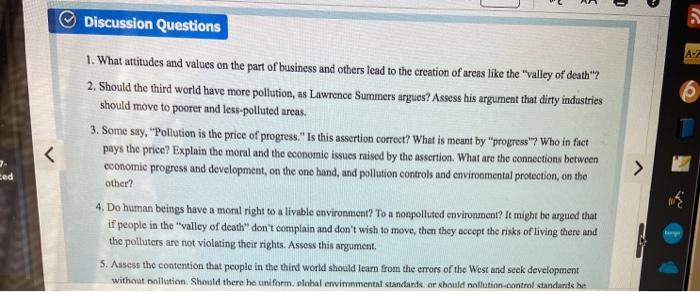
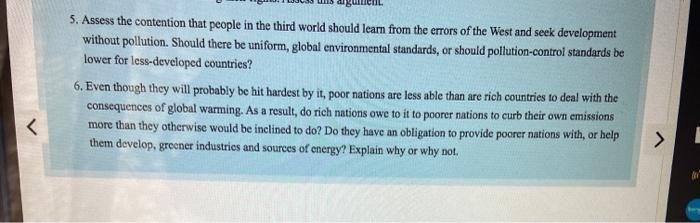
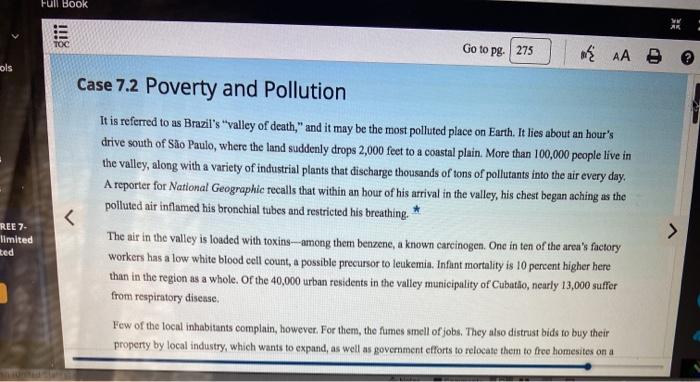
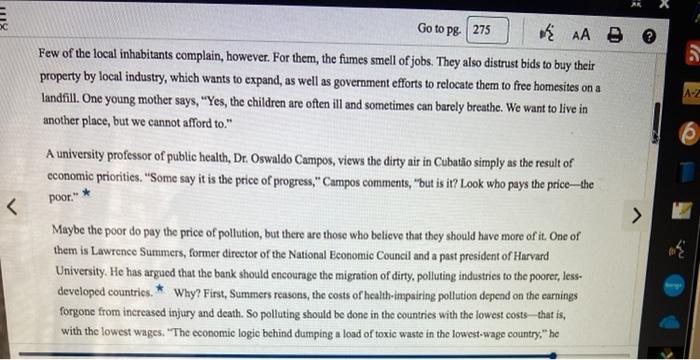
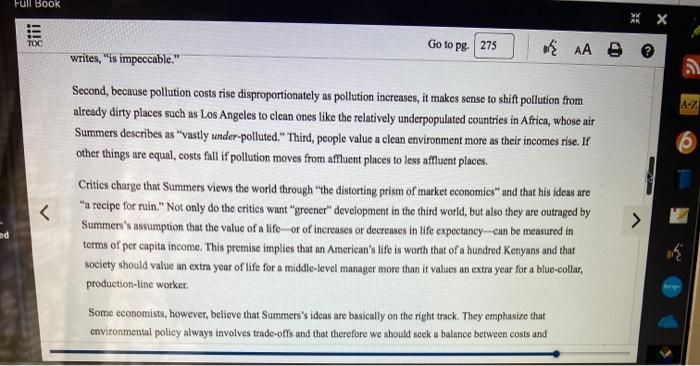
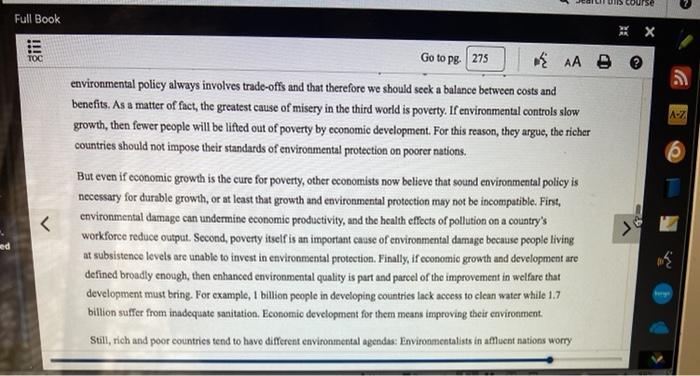
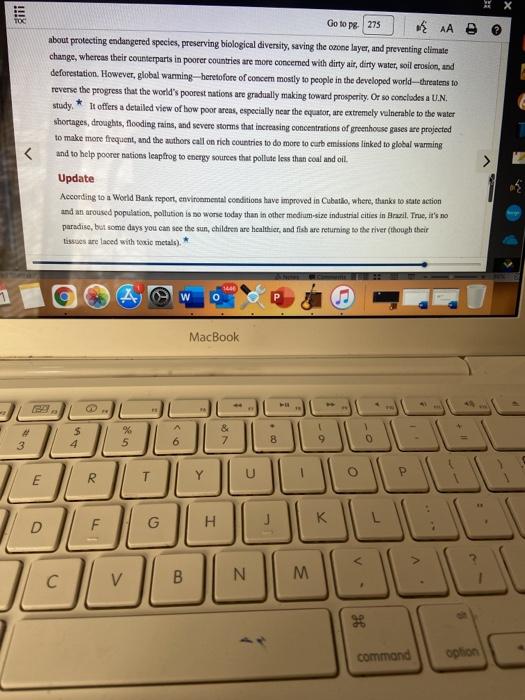
Discussion Questions A-Z 6 1. What attitudes and values on the part of business and others lead to the creation of areas like the valley of death"? 2. Should the third world have more pollution, as Lawrence Summers argues? Assess his argument that dirty industries should move to poorer and less-polluted areas. 3. Some say, "Pollution is the price of progress." Is this assertion correct? What is meant by "progress"? Who in fact pays the price? Explain the moral and the economic issues raised by the assertion. What are the connections between economic progress and development, on the one hand, and pollution controls and environmental protection, on the Sed other? 4. Do human beings have a moral right to a livable environment? To a nonpolluted environment? It might be argued that if people in the valley of death" don't complain and don't wish to move, then they accept the risks of living there and the polluters are not violating their rights. Assess this argument. 5. Assess the contention that people in the third world should leam from the errors of the West and seek development without nollation. Should there he uniform. Plobal environmental standards or should nollation control standarde he 5. Assess the contention that people in the third world should learn from the errors of the West and seek development without pollution. Should there be uniform, global environmental standards, or should pollution-control standards be lower for less-developed countries? 6. Even though they will probably be hit hardest by it, poor nations are less able than are rich countries to deal with the consequences of global warming. As a result, do rich nations owe to it to poorer nations to curb their own emissions more than they otherwise would be inclined to do? Do they have an obligation to provide poorer nations with, or help them develop, greener industries and sources of energy? Explain why or why not. Full Book TOC Go to pg. 275 WE AA ols Case 7.2 Poverty and Pollution It is referred to as Brazil's "valley of death," and it may be the most polluted place on Earth. It lies about an hour's drive south of So Paulo, where the land suddenly drops 2,000 feet to a coastal plain. More than 100,000 people live in the valley, along with a variety of industrial plants that discharge thousands of tons of pollutants into the air every day. A reporter for National Geographic recalls that within an hour of his arrival in the valley, his chest began aching as the polluted air inflamed his bronchial tubes and restricted his breathing. The air in the valley is loaded with toxins-among them benzene, a known carcinogen. One in ten of the area's factory workers has a low white blood cell count, a possible precursor to leukemia. Infant mortality is 10 percent higher here than in the region as a whole. Of the 40,000 urban residents in the valley municipality of Cubatio, nearly 13,000 suffer from respiratory disease REE 7- limited ted Few of the local inhabitants complain, however. For them, the fumes smell of jobs. They also distrust bids to buy their property by local industry, which wants to expand, as well as government efforts to relocate them to free homesites on a S A- Go to pg 275 a AA Few of the local inhabitants complain, however. For them, the fumes smell of jobs. They also distrust bids to buy their property by local industry, which wants to expand, as well as government efforts to relocate them to free homesites on a landfill. One young mother says, "Yes, the children are often ill and sometimes can barely breathe. We want to live in another place, but we cannot afford to." A university professor of public health, Dr. Oswaldo Campos, views the dirty air in Cubato simply as the result of economic priorities. "Some say it is the price of progress," Campos comments, "but is it? Look who pays the price the 6 poor." m Maybe the poor do pay the price of pollution, but there are those who believe that they should have more of it. One of them is Lawrence Summers, former director of the National Economic Council and a past president of Harvard University. He has argued that the bank should encourage the migration of dirty, polluting industries to the poorer, less- developed countries. * Why? First, Summers reasons, the costs of health-impairing pollution depend on the earnings forgone from increased injury and death. So polluting should be done in the countries with the lowest costs-that is, with the lowest wages. "The economic logic behind dumping a load of toxic waste in the lowest-wage country," he Full Book K X TOXC Go to Pg. 275 E AA writes, "is impeccable." A-Z 6 ed Riii Go to pe 275 E about protecting endangered species, preserving biological diversity, saving the ozone layer, and preventing climate change, whereas their counterparts in poorer countries are more concemed with dirty air, dirty water, soil erosion, and deforestation. However, global warming-heretofore of concem mostly to people in the developed world--threatens to reverse the progress that the world's poorest nations are gradually making toward prosperity. Or so concludes a U.N. * study It offers a detailed view of how poor areas, especially near the equator, are extremely vulnerable to the water shortages, droughts, flooding rains, and severe storms that increasing concentrations of greenhouse gases are projected to make more frequent, and the authors call on rich countries to do more to curb emissions linked to global warming and to help poorer nations leapfrog to energy sources that pollute less than coal and oil. Update According to a World Bank report, environmental conditions have improved in Cubatko, where, thanks to state action and an aroused population, pollution is to worse today than in other medium-size industrial cities in Brazil. Tre, it's no paradise, but some days you can see the sun, children are healthier, and fish are returning to the river (though their tissues are laced with toxic metals).
Step by Step Solution
There are 3 Steps involved in it
1 Expert Approved Answer
Step: 1 Unlock

Question Has Been Solved by an Expert!
Get step-by-step solutions from verified subject matter experts
Step: 2 Unlock
Step: 3 Unlock
 Study Help