







Question: please read the passages and give a summary in your own words from what you have read from the passages below. Please give as much
please read the passages and give a summary in your own words from what you have read from the passages below. Please give as much information as you can! there is no word limit.
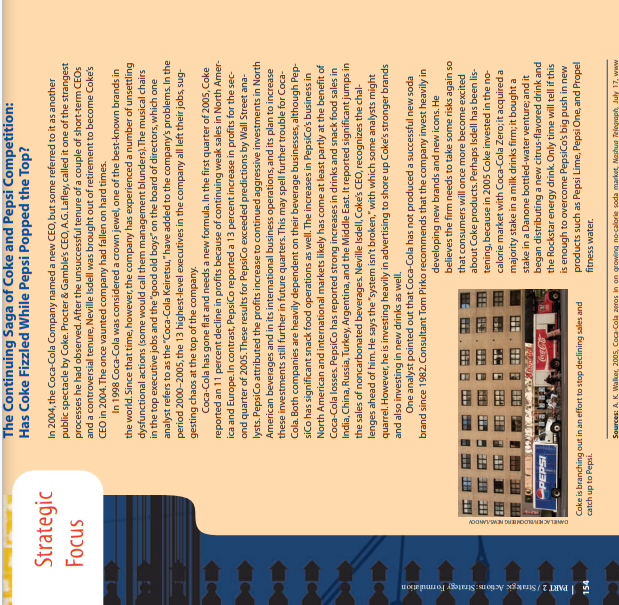
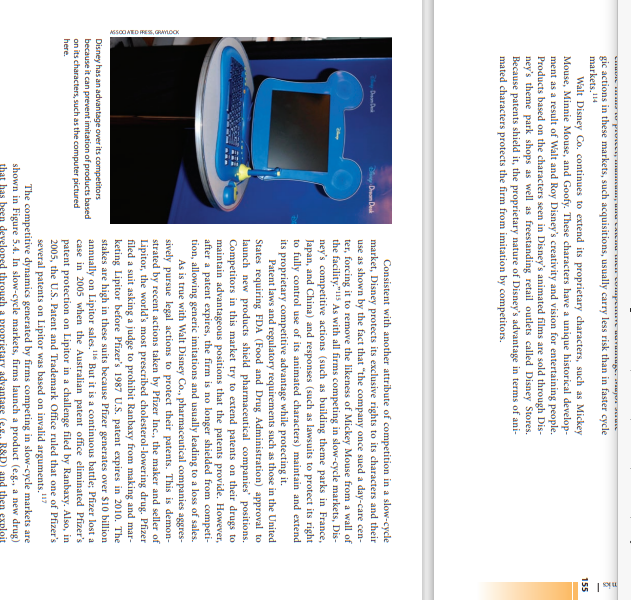
The Continuing Saga of Coke and Pepsi Competition: Has Coke Fizzled While Pepsi Popped the Top? In 2004, the Coca-Cola Company named a new CEO, but some referred to it as another public spectacle by Coke. Procter \& Gamble's CEO, A.G. Lafley, called it one of the strangest processes he had observed. After the unsuccessful tenure of a couple of short-term CEOs and a controversial tenure, Neville Isdell was brought out of retirement to become Coke's CEO in 2004. The once vaunted company had fallen on hard times. In 1998 Coca-Cola was considered a crown jewel, one of the best-known brands in the world. Since that time, however, the company has experienced a number of unsettling dysfunctional actions (some would call them management blunders).The musical chairs in the top executive jobs and the "good old boys" on the board of directors, which one analyst refers to as the "Coca-Cola Keiretsu," have added to the company's problems. In the period 2000-2005, the 13 highest-level executives in the company all left their jobs, suggesting chaos at the top of the company. Coca-Cola has gone flat and needs a new formula. In the first quarter of 2005, Coke reported an 11 percent decline in profits because of continuing weak sales in North America and Europe.In contrast, PepsiCo reported a 13 percent increase in profits for the secand quarter of 2005. These results for PepsiCo exceeded predictions by Wall Street analysts. PepsiCo attributed the profits increase to continued aggressive investments in North American beverages and in its international business operations, and its plan to increase these investments still further in future quarters. This may spell further trouble for CocaCola. Both companies are heavily dependent on their beverage businesses, although PepsiCo has significant snack food operations as well. The increases in PepsiCo's business in North American and international markets likely has come at least partly at the benefit of Coca-Cola losses. PepsiCo has reported strong increases in drinks and snack food sales in India, China, Russia, Turkey, Argentina, and the Middle East. It reported significant jumps in the sales of noncarbonated beverages. Neville Isdell, Coke's CEO, recognizes the challenges ahead of him. He says the "system isn't broken," with which some analysts might quarrel. However, he is investing heavily in advertising to shore up Coke's stronger brands and also investing in new drinks as well. One analyst pointed out that Coca-Cola has not produced a successful new soda brand since 1982. Consultant Tom Pirko recommends that the company invest heavily in developing new brands and new icons. He believes the firm needs to take some risks again so that consumers will once more become excited about Coke products.Perhaps Isdell has been listening, because in 2005 Coke invested in the nocalorie market with Coca-Cola Zero; it acquired a majority stake in a milk drinks firm; it bought a stake in a Danone bottled-water venture; and it began distributing a new citrus-flavored drink and the Rockstar energy drink. Only time will tell if this is enough to overcome PepsiCo's big push in new products such as Pepsi Lime, Pepsi One, and Propel Coke is branching out in an effort to stop declining sales and fitness water. catch up to Pepsi. Whereas competitive rivalry concerns the ongoing actions and responses between a firm and its competitors for an advantageous market position, competitive dynamics concerns the ongoing actions and responses taking place among all firms competing within a market for advantageous positions. To explain competitive rivalry, we described (1) factors that determine the degree to which firms are competitors (market commonality and resource similarity), (2) the drivers of competitive behavior for individual firms (awareness, motivation, and ability) and (3) factors affecting the likelihood that a competitor will act or attack (firstmover incentives, organizational size, and quality) and respond (type of competitive action, reputation, and market dependence). Building and sustaining competitive advantages are at the core of competitive rivalry, in that advantages are the key to creating value for shareholders. 110 To explain competitive dynamics, we discuss the effects of varying rates of competitive speed in different markets (called slow-cycle, fast-cycle, and standard-cycle markets, defined below) on the behavior (actions and responses) of all competitors within a given market. Competitive behaviors as well as the reasons or logic for taking them are similar within each market type, but differ across market type. 111 Thus, competitive dynamics differ in slow-cycle, fast-cycle, and standard-cycle markets. The sustainability of the firm's competitive advantages differs across the three market types. As noted in Chapter 1 , firms want to sustain their competitive advantages for as long as possible, although no advantage is permanently sustainable. The degree of sustainability is affected by how quickly competitive advantages can be imitated and how costly it is to do so. Slow-Cycle Markets Slow-cycle markets are those in which the firm's competitive advantages are shielded Slow-cycle markets are marfrom imitation commonly for long periods of time and where imitation is costly. 112 kers in which the firm's comThus, competitive advantages are sustainable in slow-cycle markets. petitive alvantages are Building a unique and proprietary capability produces a competitive advantage shielded from initation for and success in a slow-cycle market. This type of advantage is difficult for competitors to what are commonly long periunderstand. As discussed in Chapter 3, a difficult-to-understand and costly-to-imitate tion is costly. resource or capability usually results from unique historical conditions, causal ambiguity, and/or social complexity. Copyrights, geography, patents, and ownership of an information resource are examples of resources. 113 After a proprietary advantage is developed, the firm's competitive behavior in a slow-cycle market is oriented to protecting, maintaining, and extending that advantage. Thus, the competitive dynamics in slow-cycle markets usually concentrate on competitive actions and responses that enable firms to protect, maintain, and extend their competitive advantage. Major strategic actions in these markets, such acquisitions, usually carry less risk than in faster cycle markets. 114 gic actions in these markets, such acquisitions, usually carry less risk than in faster cycle markets. 114 Walt Disney Co. continues to extend its proprietary characters, such as Mickey Mouse, Minnie Mouse, and Goofy. These characters have a unique historical development as a result of Walt and Roy Disney's creativity and vision for entertaining people. Products based on the characters seen in Disney's animated films are sold through Disney's theme park shops as well as freestanding retail outlets called Disney Stores. Because patents shield it, the proprietary nature of Disney's advantage in terms of animated characters protects the firm from imitation by competitors. Consistent with another attribute of competition in a slow-cycle market, Disney protects its exclusive rights to its characters and their use as shown by the fact that "the company once sued a day-care center, forcing it to remove the likeness of Mickey Mouse from a wall of the facility."115 As with all firms competing in slow-cycle markets, Disney's competitive actions (such as building theme parks in France, Japan, and China) and responses (such as lawsuits to protect its right to fully control use of its animated characters) maintain and extend its proprietary competitive advantage while protecting it. Patent laws and regulatory requirements such as those in the United States requiring FDA (Food and Drug Administration) approval to launch new products shield pharmaceutical companies' positions. Competitors in this market try to extend patents on their drugs to maintain advantageous positions that the patents provide. However, after a patent expires, the firm is no longer shielded from competition, allowing generic imitations and usually leading to a loss of sales. As is true with Walt Disney Co., pharmaceutical companies aggressively pursue legal actions to protect their patents. This is demonstrated by recent actions taken by Pfizer Inc., the maker and seller of Lipitor, the world's most prescribed cholesterol-lowering drug. Pfizer filed a suit asking a judge to prohibit Ranbaxy from making and marketing Lipitor before Pfizer's 1987 U.S. patent expires in 2010. The stakes are high in these suits because Pfizer generates over $10 billion on its characters, such as the computer pictured case in 2005 when the Australian patent office eliminated Pfizer's here. patent protection on Lipitor in a challenge filed by Ranbaxy. Also, in 2005, the U.S. Patent and Trademark Office ruled that one of Pfizer's several patents on Lipitor was based on invalid arguments. 117 The competitive dynamics generated by firms competing in slow-cycle markets are shown in Figure 5.4. In slow-cycle markets, firms launch a product (e.g., a new drug) edge required to imitate or improve the firm's products. Technology is diffused rapidly in fast-cycle markets, making it available to competitors in a short period. The technology often used by fast-cycle competitors isn't proprietary, nor is it protected by patents as is the technology used by firms competing in slow-cycle markets. For example, only a few hundred parts, which are readily available on the open market, are required to build a PC. Patents protect only a few of these parts, such as microprocessor chips. 121 Fast-cycle markets are more volatile than slow-cycle and standard-cycle markets. Indeed, the pace of competition in fast-cycle markets is almost frenzied, as companies rely on innovations as the engines of their growth. Because prices fall quickly in these markets, companies need to profit quickly from their product innovations. Imitation of many fast-cycle products is relatively easy, as demonstrated by Dell Inc. and HewlettPackard, along with a host of local PC vendors, that have partly or largely imitated IBM's PC design to create their products. Continuous declines in the costs of parts, as well as the fact that the information required to assemble a PC isn't especially complicated and is readily available, make it possible for additional competitors to enter this market without significant difficulty. 122 The fast-cycle market characteristics described above make it virtually impossible for companies in this type of market to develop sustainable competitive advantages. Recognizing this, firms avoid "loyalty" to any of their products, preferring to cannibalize their own before competitors learn how to do so through successful imitation. This emphasis creates competitive dynamics that differ substantially from those found in slow-cycle markets. Instead of concentrating on protecting, maintaining, and extending competitive advantages, as in slow-cycle markets, companies competing in fast-cycle markets focus on learning how to rapidly and continuously develop new competitive advantages that are superior to those they replace. Commonly, they search for fast and effective means of developing new products. For example, it is common in some industries for firms to use strategic alliances to gain access to new technologies and thereby develop and introduce more new products into the market. 123 The competitive behavior of firms competing in fast-cycle markets is shown in Figure 5.5. As suggested by the figure, competitive dynamics in this market type entail taking actions and responses that are oriented to rapid and continuous product introductions and the development of a stream of ever-changing competitive advantages. The firm launches a product to achieve a competitive action and then exploits the advantage for as long as possible. However, the firm also tries to develop another temporary competitive advantage before competitors can respond to the first one (see Figure 5.5). Thus, competitive dynamics in fast-cycle markets often result in rapid product upgrades as well as quick product innovations. 124 As our discussion suggests, innovation plays a dominant role in the competitive dynamics in fast-cycle markets. For individual firms, this means that innovation is a key source of competitive advantage. Through innovation, the firm can cannibalize its own products before competitors successfully imitate them. As noted earlier, it is difficult for firms competing in fast-cycle markets to maintain a competitive advantage in terms of their products. Partly because of this, both IBM and Hewlett-Packard (HP) experienced problems in competing effectively over time. In fact, IBM sold its PC business to Lenovo, China's largest PC manufacturer. Changes may be in store for HP's PC business as well. Neither firm has been able to compete effectively with Dell, the current PC market leader. 125 Standard-Cycle Markets Standard-cycle markets are Standard-cycle markets are markets in which the firm's competitive advantages are markets in which the firm's moderately shielded from imitation and where imitation is moderately costly. Competimoderately costly. tive advantages dynamic. The competitive actions and responses that form a standardcycle market's competitive dynamics are designed to seek large market shares, to gain customer loyalty through brand names, and to carefully control their operations in order to consistently provide the same positive experience for customers. 126 Standard-cycle companies serve many customers in competitive markets. Because the capabilities and core competencies on which their competitive advantages are based are less specialized, imitation is faster and less costly for standard-cycle firms than for those competing in slow-cycle markets. However, imitation is slower and more expensive in these markets than in fast-cycle markets. Thus, competitive dynamics in standard-cycle markets rest midway between the characteristics of dynamics in slowcycle and fast-cycle markets. Imitation comes less quickly and is more expensive for standard-cycle competitors when a firm is able to develop economies of scale by combining coordinated and integrated design and manufacturing processes with a large sales volume for its products. Because of large volumes, the size of mass markets, and the need to develop scale standard-cycle markets rest midway between the characteristics of dynamics in slowcycle and fast-cycle markets. Imitation comes less quickly and is more expensive for standard-cycle competitors when a firm is able to develop economies of scale by combining coordinated and integrated design and manufacturing processes with a large sales volume for its products. Because of large volumes, the size of mass markets, and the need to develop scale economies, the competition for market share is intense in standard-cycle markets. This form of competition is readily evident in the battles between Coca-Cola and PepsiCo, as discussed in the Strategic Focus. As noted, they compete in markets all over the world. In recent years, PepsiCo has been winning the battles in domestic and international markets. This outcome is partly due to effective strategic actions by PepsiCo and ineffective actions by Coca-Cola's top management, which evidenced chaos in the period of 1998-2004. Innovation can also drive competitive actions and responses in standard-cycle markets, especially when rivalry is intense. Some innovations in standard-cycle markets are incremental rather than radical in nature (incremental and radical innovations are discussed in Chapter 13). One of the reasons for PepsiCo's success in competition against Coca-Cola has been the innovative new products it has introduced. As described in the Strategic Focus, Coke's current CEO, Neville Isdell, is emphasizing heavy advertising to support its existing strong brand and to support the introduction of a variety of new beverage products in the market. Thus, both Coca-Cola and PepsiCo are emphasizing innovation in their competition. In the final analysis, innovation has a substantial influence on competitive dynamics as it affects the actions and responses of all companies competing within a slowcycle, fast-cycle, or standard-cycle market. We have emphasized the importance of innovation to the firm's strategic competitiveness in earlier chapters and will do so again in Chapter 13. Our discussion of innovation in terms of competitive dynamics extends the earlier discussions by showing its importance in all types of markets in which firms compete. - Competitors are firms competing in the same market, offering . For the individual firm, the set of competitive actions and similar products, and targeting similar customers. Competitive responses it takes while engaged in competitive rivalry is called rivalry is the ongoing set of competitive actions and competi- competitive behavior. Competitive dynamics is the set of actions tive responses occurring between competitors as they compete and responses taken by all firms that are competitors within a against each other for an advantageous market position. The particular market. outcomes of competitive rivalry influence the firm's ability to sustain its competitive advantages as well as the level (average, . Firms study competitive rivalry in order to be able to predict the below average, or above average) of its financial returns. competitive actions and responses that each of their competitors likely will take. Competitive actions are either strategic or
Step by Step Solution
There are 3 Steps involved in it

Get step-by-step solutions from verified subject matter experts
 Study Help