







Question: please read through the question before answering. I an trying to program this using python. How do I plot equation 3? please show how to
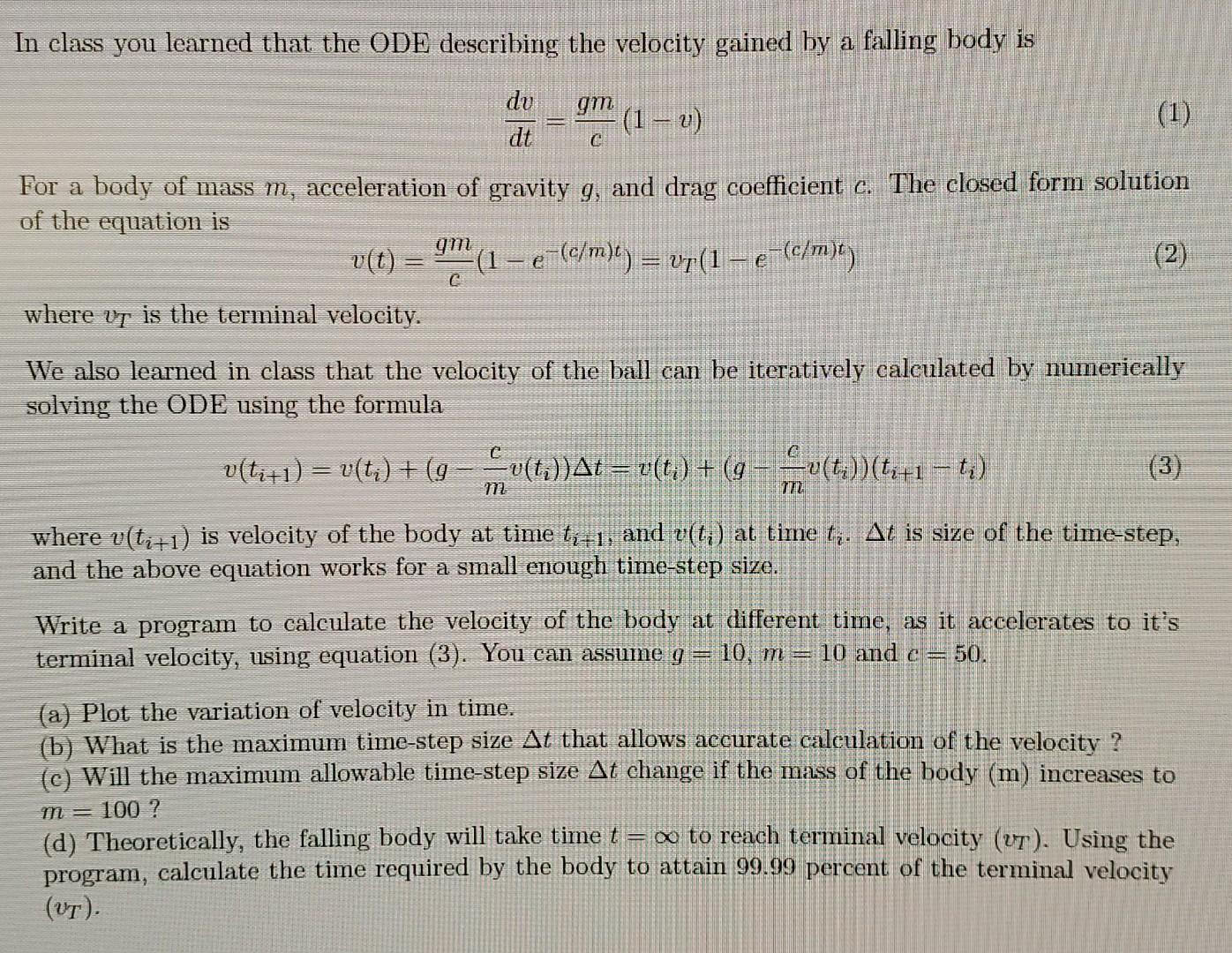
please read through the question before answering. I an trying to program this using python. How do I plot equation 3? please show how to do a) and b)
In class you learned that the ODE describing the velocity gained by a falling body is dv dt gm (1 u) (1) c For a body of mass m, acceleration of gravity g, and drag coefficient c. The closed form solution of the equation is gm (t) = (1 - e-(c/m)) = vr(1- e-(c/m)) (2) where it is the terminal velocity. C We also learned in class that the velocity of the ball can be iteratively calculated by numerically solving the ODE using the formula e v(ti+1) = v(t.) + (g-u(t))At = v(t) + (g - u(t:))(t: +1 ty) (3) m 777 where vti+1) is velocity of the body at time ti=1, and v(41) at time ti. At is size of the time-step, and the above equation works for a small enough time-step size. Write a program to calculate the velocity of the body at different time, as it accelerates to it's terminal velocity, using equation (3). You can assume g = 10, m = 10 and c=50. (a) Plot the variation of velocity in time. (b) What is the maximum time-step size At that allows accurate calculation of the velocity ? (c) Will the maximum allowable time-step size At change if the mass of the body (m) increases to 100 ? (d) Theoretically, the falling body will take time t = to reach terminal velocity (ur). Using the program, calculate the time required by the body to attain 99.99 percent of the terminal velocity (UT). m
Step by Step Solution
There are 3 Steps involved in it

Get step-by-step solutions from verified subject matter experts
 Study Help