Question: PLEASE READ/DISCUSS THE FOLLOWING CASE STUDY, AND ANSWER THE QUESTIONS BELOW...EXPLAIN YOUR ANSWERS AND SHOW YOUR CALCULATIONS. COMMENT ON AT LEAST ONE OTHER STUDENT'S POST/ANSWERS.
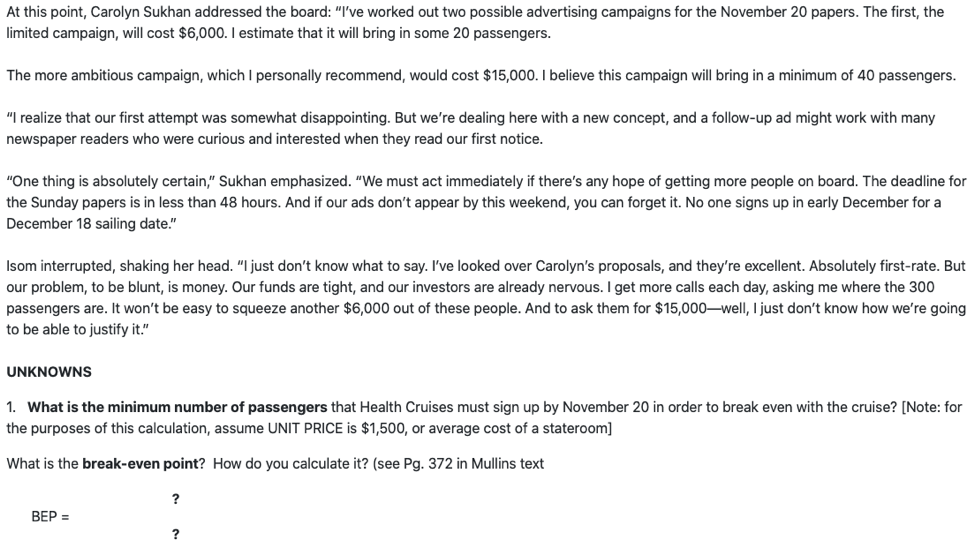
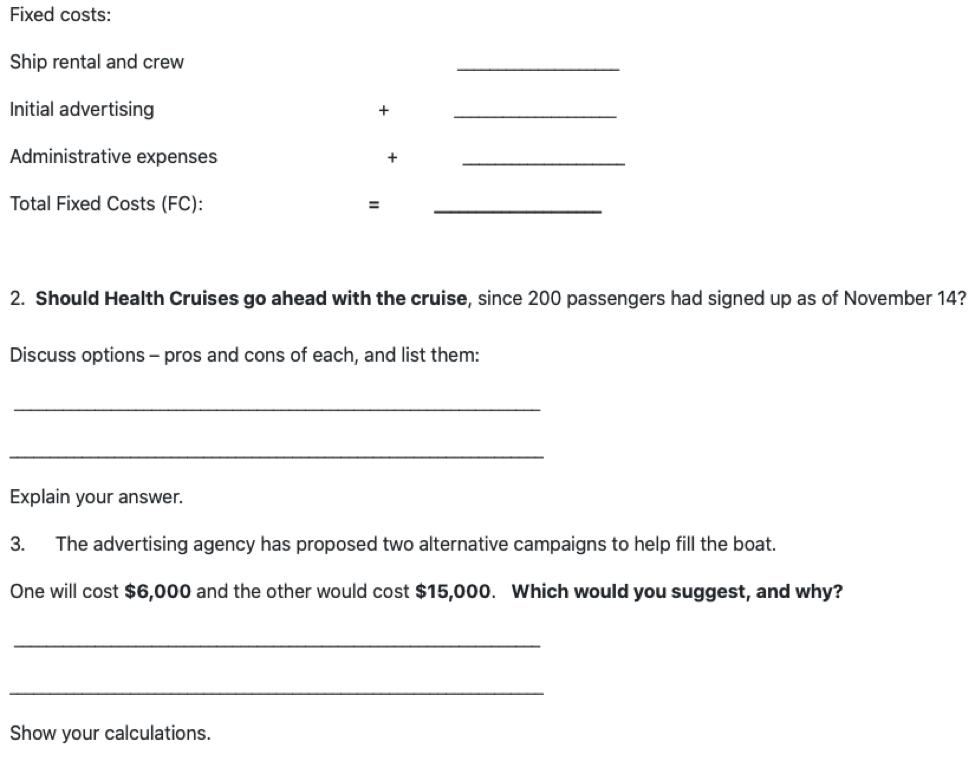
PLEASE READ/DISCUSS THE FOLLOWING CASE STUDY, AND ANSWER THE QUESTIONS BELOW...EXPLAIN YOUR ANSWERS AND SHOW YOUR CALCULATIONS. COMMENT ON AT LEAST ONE OTHER STUDENT'S POST/ANSWERS. Health Cruises, Inc., packages cruises to Caribbean islands such as Martinique and the Bahamas. Like conventional cruises, the packages are designed to be fun. But the cruise is structured to help participants become healthier by breaking old habits, such as smoking or overeating. The Miami-based firm was conceived by Susan Isom, 30, a self-styled innovator and entrepreneur. Prior to this venture, she had spent several years in North Carolina promoting a behavior-modification clinic. Isom determined that many people were very concerned about developing good health habits, yet they seemed unable to break away from their old habits because of the pressures of day-to-day living. She reasoned that they might have a chance for much greater success in a pleasant and socially supportive environment, where good health habits were fostered. Accordingly, she established Health Cruises, Inc., hired 10 consulting psychologists and health specialists to develop a program, and chartered a ship. DeForrest Young, a Miami management consultant, became the chairperson of Health Cruises. Seven of Isom's business associates contributed an initial capital outlay totaling more than $250,000. Of this amount, $65,000 went for the initial advertising budget, $10,000 for other administrative expenses, and $220,000 for the ship rental and crew. Mary Porter, a Denver schoolteacher who would like to lose weight, has signed up to sail on a two-week cruise to Nassau, departing December 19. She and her shipmates will be paying an average of $1,500 for the voyage. The most desirable staterooms cost $2,200. Mary learned of the cruise by reading the travel section of her Sunday newspaper on October 16. On that date, the Pittsford and LaRue Advertising Agency placed promotional notices for the cruise in several major metropolitan newspapers. Mary was fascinated by the idea of combining therapy sessions with swimming, movies, and an elegant atmosphere. Pittsford and LaRue account executive Carolyn Sukhan originally estimated that 300 people would sign up for the cruise after reading the October 16 ads. But as of November 14, only 200 had done so. Isom and Health Cruises, Inc., faced an important decision. "Here's the situation as I see it," explained a disturbed Isom at the Health Cruises board meeting. "We've already paid out more than a quarter of a million to get this cruise rolling. It's going to cost us roughly $200 per passenger for the two weeks, mostly for food. Pittsford and LaRue predicted that 300 people would respond to the advertising campaign, but we've only got 200. "I see three basic options: (1) we cancel the cruise and take our losses; (2) we run the cruise with the 200 and a few more that will trickle in over the next month; or (3) we shell out some more money on advertising and hope that we can pull in more people." My recommendation to this board is that we try to recruit more passengers. There are simply too many empty rooms on that ship. Each one costs us a bundle." At this point, Carolyn Sukhan addressed the board: "I've worked out two possible advertising campaigns for the November 20 papers. The first, the limited campaign, will cost $6,000. I estimate that it will bring in some 20 passengers. The more ambitious campaign, which I personally recommend, would cost $15,000. I believe this campaign will bring in a minimum of 40 passengers. "I realize that our first attempt was somewhat disappointing. But we're dealing here with a new concept, and a follow-up ad might work with many newspaper readers who were curious and interested when they read our first notice. "One thing is absolutely certain," Sukhan emphasized. "We must act immediately if there's any hope of getting more people on board. The deadline for the Sunday papers is in less than 48 hours. And if our ads don't appear by this weekend, you can forget it. No one signs up in early December for a December 18 sailing date." Isom interrupted, shaking her head. "I just don't know what to say. I've looked over Carolyn's proposals, and they're excellent. Absolutely first-rate. But our problem, to be blunt, is money. Our funds are tight, and our investors are already nervous. I get more calls each day, asking me where the 300 passengers are. It won't be easy to squeeze another $6,000 out of these people. And to ask them for $15,000well, I just don't know how we're going to be able to justify it." UNKNOWNS 1. What is the minimum number of passengers that Health Cruises must sign up by November 20 in order to break even with the cruise? (Note: for the purposes of this calculation, assume UNIT PRICE is $1,500, or average cost of a stateroom] What is the break-even point? How do you calculate it? (see Pg. 372 in Mullins text ? BEP = ? Fixed costs: Ship rental and crew Initial advertising Administrative expenses Total Fixed Costs (FC): 2. Should Health Cruises go ahead with the cruise, since 200 passengers had signed up as of November 14? Discuss options - pros and cons of each, and list them: Explain your answer. 3. The advertising agency has proposed two alternative campaigns to help fill the boat. One will cost $6,000 and the other would cost $15,000. Which would you suggest, and why? Show your calculations









 Study Help