Question: Please respond to this discussion post and answer What are potential ethical challenges in enhancing motivation and engagement, and how might they be addressed? Michael
Please respond to this discussion post and answer What are potential ethical challenges in enhancing motivation and engagement, and how might they be addressed?
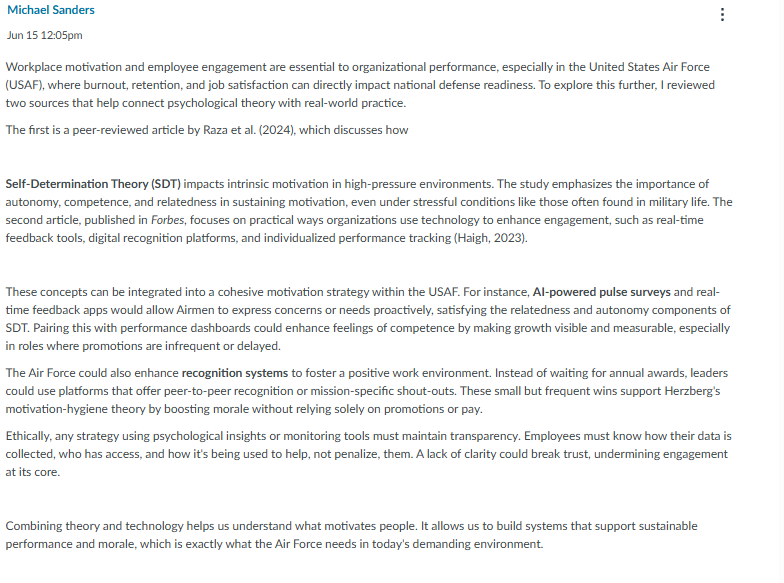
Michael Sanders : Jun 15 12:05pm Workplace motivation and employee engagement are essential to organizational performance, especially in the United States Air Force (USAF), where burnout, retention, and job satisfaction can directly impact national defense readiness. To explore this further, | reviewed two sources that help connect psychological theory with real-world practice. The first is a peer-reviewed article by Raza et al. (2024), which discusses how Self-Determination Theory (SDT) impacts intrinsic motivation in high-pressure environments. The study emphasizes the importance of autonomy, competence, and relatedness in sustaining motivation, even under stressful conditions like those often found in military life. The second article, published in Forbes, focuses on practical ways organizations use technology to enhance engagement, such as real-time feedback tools, digital recognition platforms, and individualized performance tracking (Haigh, 2023). These concepts can be integrated into a cohesive motivation strategy within the USAF. For instance, Al-powered pulse surveys and real- time feedback apps would allow Airmen to express concerns or needs proactively, satisfying the relatedness and autonomy components of SDT. Pairing this with performance dashboards could enhance feelings of competence by making growth visible and measurable, especially in roles where promotions are infrequent or delayed. The Air Force could also enhance recognition systems to foster a positive work environment. Instead of waiting for annual awards, leaders could use platforms that offer peer-to-peer recognition or mission-specific shout-outs. These small but frequent wins support Herzberg's motivation-hygiene theory by boosting morale without relying solely on promotions or pay. Ethically, any strategy using psychological insights or monitoring tools must maintain transparency. Employees must know how their data is collected, who has access, and how it's being used to help, not penalize, them. A lack of clarity could break trust, undermining engagement at its core. Combining theory and technology helps us understand what motivates people. It allows us to build systems that support sustainable performance and morale, which is exactly what the Air Force needs in today's demanding environment









 Study Help