



Question: Please show the steps, thanks a lot! 2. Consider a world in which people live for only two periods (periods 1 and 2). (a) Consider
Please show the steps, thanks a lot!
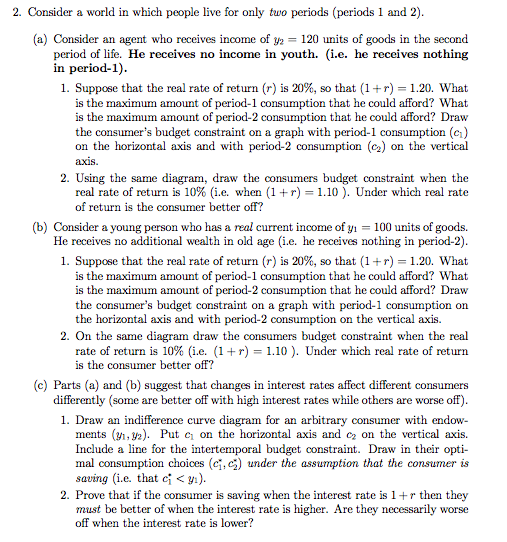
2. Consider a world in which people live for only two periods (periods 1 and 2). (a) Consider an agent who receives income of y2 = 120 units of goods in the second period of life. He receives no income in youth. (i.e. he receives nothing in period-1). 1. Suppose that the real rate of return (r) is 20%, so that (1+r) = 1.20. What is the maximum amount of period-1 consumption that he could afford? What is the maximum amount of period-2 consumption that he could afford? Draw the consumer's budget constraint on a graph with period-1 consumption (9) on the horizontal axis and with period-2 consumption () on the vertical axis. 2. Using the same diagram, draw the consumers budget constraint when the real rate of return is 10% (i.e. when (1+r) = 1.10 ). Under which real rate of return is the consumer better off? (b) Consider a young person who has a real current income of y = 100 units of goods. He receives no additional wealth in old age (i.e. he receives nothing in period-2). 1. Suppose that the real rate of return (r) is 20%, so that (1+r) = 1.20. What is the maximum amount of period-1 consumption that he could afford? What is the maximum amount of period-2 consumption that he could afford? Draw the consumer's budget constraint on a graph with period-1 consumption on the horizontal axis and with period-2 consumption on the vertical axis. 2. On the same diagram draw the consumers budget constraint when the real rate of return is 10% (i.e. (1+r) = 1.10 ). Under which real rate of return is the consumer better off? () Parts (a) and (b) suggest that changes in interest rates affect different consun sumers differently (some are better off with high interest rates while others are worse off). 1. Draw an indifference curve diagram for an arbitrary consumer with endow- ments (41,42). Put on the horizontal axis and on the vertical axis. Include a line for the intertemporal budget constraint. Draw in their opti- mal consumption choices (CC) under the assumption that the consumer is saving (i.e. that c
Step by Step Solution
There are 3 Steps involved in it

Get step-by-step solutions from verified subject matter experts