Question: Please show work and upvotes will be given for correct answer! A company owns M warehouses, N retail outlets, and (MXN) trucks, each of which
Please show work and upvotes will be given for correct answer!
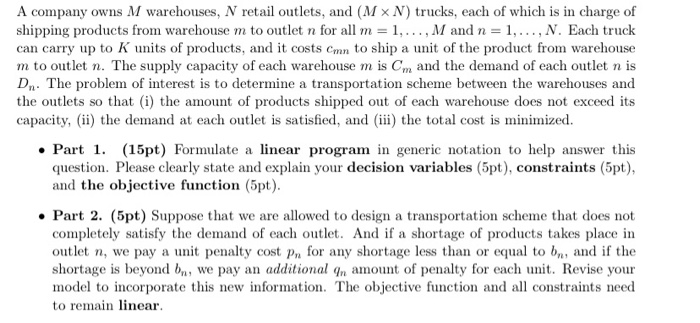
A company owns M warehouses, N retail outlets, and (MXN) trucks, each of which is in charge of shipping products from warehouse m to outlet n for all m = 1,...,M and n = 1,..., N. Each truck can carry up to K units of products, and it costs Cmn to ship a unit of the product from warehouse m to outlet n. The supply capacity of each warehouse m is om and the demand of each outlet n is Dr. The problem of interest is to determine a transportation scheme between the warehouses and the outlets so that (i) the amount of products shipped out of each warehouse does not exceed its capacity, (ii) the demand at each outlet is satisfied, and (iii) the total cost is minimized. Part 1. (15pt) Formulate a linear program in generic notation to help answer this question. Please clearly state and explain your decision variables (5pt), constraints (5pt), and the objective function (5pt). Part 2. (5pt) Suppose that we are allowed to design a transportation scheme that does not completely satisfy the demand of each outlet. And if a shortage of products takes place in outlet n, we pay a unit penalty cost pe for any shortage less than or equal to bn, and if the shortage is beyond bn, we pay an additional en amount of penalty for each unit. Revise your model to incorporate this new information. The objective function and all constraints need to remain linear. A company owns M warehouses, N retail outlets, and (MXN) trucks, each of which is in charge of shipping products from warehouse m to outlet n for all m = 1,...,M and n = 1,..., N. Each truck can carry up to K units of products, and it costs Cmn to ship a unit of the product from warehouse m to outlet n. The supply capacity of each warehouse m is om and the demand of each outlet n is Dr. The problem of interest is to determine a transportation scheme between the warehouses and the outlets so that (i) the amount of products shipped out of each warehouse does not exceed its capacity, (ii) the demand at each outlet is satisfied, and (iii) the total cost is minimized. Part 1. (15pt) Formulate a linear program in generic notation to help answer this question. Please clearly state and explain your decision variables (5pt), constraints (5pt), and the objective function (5pt). Part 2. (5pt) Suppose that we are allowed to design a transportation scheme that does not completely satisfy the demand of each outlet. And if a shortage of products takes place in outlet n, we pay a unit penalty cost pe for any shortage less than or equal to bn, and if the shortage is beyond bn, we pay an additional en amount of penalty for each unit. Revise your model to incorporate this new information. The objective function and all constraints need to remain linear









 Study Help