







Question: Please show work on how to solve the problems attached, thank you! Part A: The agriculturalist's problem IS points] Consider the agriculturalist's problem of allocating
Please show work on how to solve the problems attached, thank you!
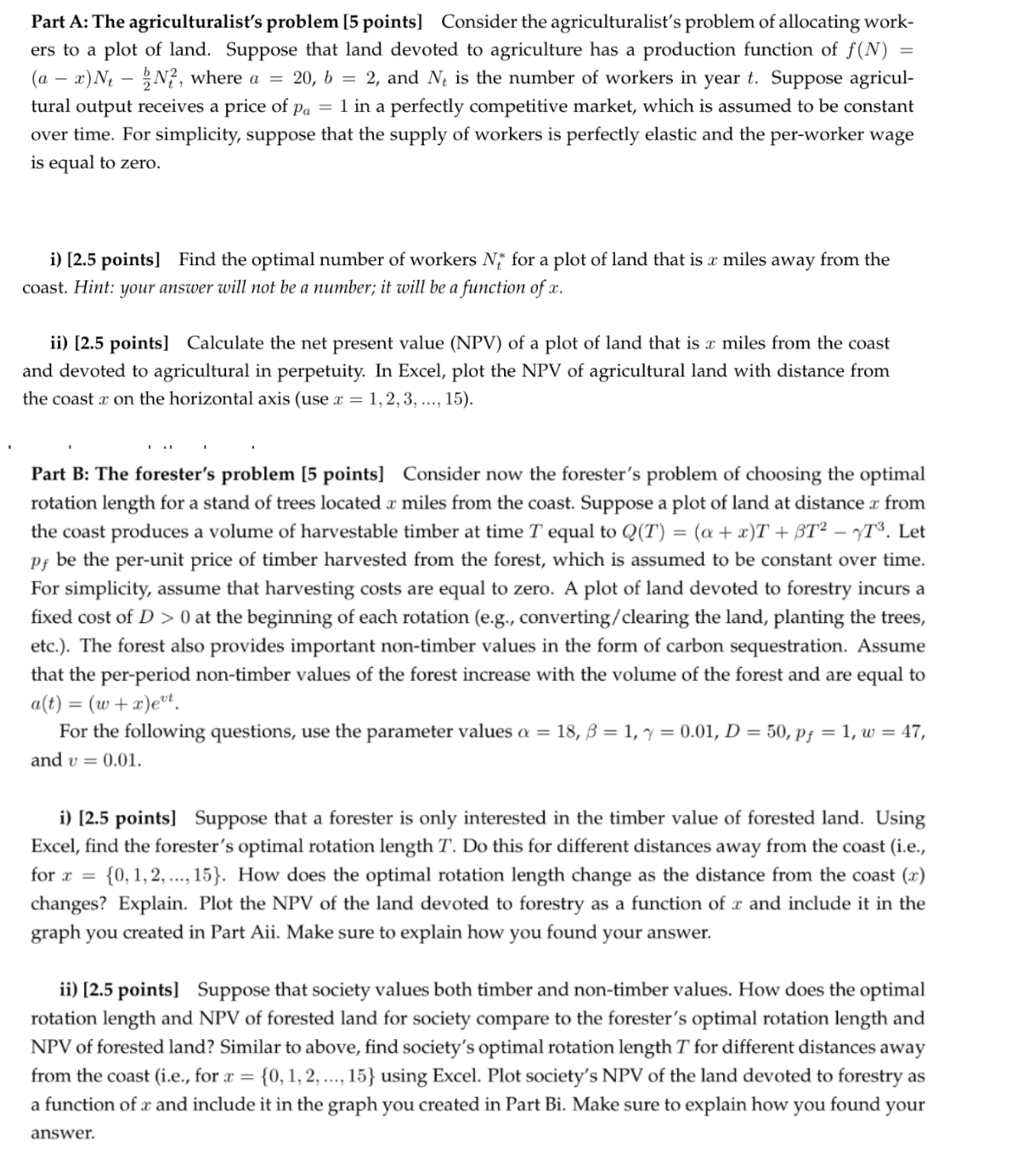
![Part A: The agriculturalist's problem IS points] Consider the agriculturalist's problem of](https://dsd5zvtm8ll6.cloudfront.net/si.experts.images/questions/2024/09/66f6c05d71b96_13366f6c05d461c4.jpg)
Part A: The agriculturalist's problem IS points] Consider the agriculturalist's problem of allocating work ers to a plot of land. Suppose that land devoted to agriculture has a production function of f (N) = (a MN, gNE, where a = 20, b = 2, and N: is the number of workers in year 1'. Suppose agricul- tural output receives a price of pa = 1 in a perfectly competitive market, which is assumed to be constant over time. For simplicity, suppose that the supply of workers is perfectly elastic and the per-worker wage is equal to zero. i] [2.5 points] Find the optimal number of workers N; for a plot of land that is 2: miles away from the coast. Hint: your answer will not be a number; it will be afunctian ofx. ii] [2.5 points] Calculate the net present value (NPV) of a plot of land that is :1: miles from the coast and devoted to agricultural in perpetuity. In Excel, plot the NPV of agricultural land with distance from the coast a: on the horizontal axis (use :i: = 1, 2, 3, ..., 15). Part B: The forester's problem [5 points] Consider now the forester's problem of choosing the optimal rotation length for a stand of trees located 2: miles from the coast Suppose a plot of land at distance a: from the coast produces a volume of harvestable timber at time T equal to Q(T) = (or + x)T + 3T2 1T3. Let p f be the per-unit price of timber harvested from the forest, which is assumed to be constant over time. For simplicity, assume that harvesting costs are equal to zero. A plot of land devoted to forestry incurs a xed cost of D > 0 at the beginning of each rotation (e.g., converting! clearing the land, planting the trees, etc). The forest also provides important non-timber values in the form of carbon sequestration. Assume that the per-period non-timber values of the forest increase with the volume of the forest and are equal to o(t) = (w + x)e"". For the following questions, use the parameter values a = 18, :3 = 1, 7 = 0.01, D = 50, p,- = 1, w = 47. and v = 0.01. it [2.5 points] Suppose that a forester is only interested in the timber value of forested land. Using Excel, find the forester's optimal rotation length T. Do this for different distances away from the coast (i.e., for r = {0, 1,2, 15}. How does the optimal rotation length change as the distance from the coast (2:) changes? Explain. Plot the NPV of the land devoted to forestry as a function of :r and include it in the graph you created in Part All. Make sure to explain how you found your answer. ii) [2.5 points] Suppose that society values both timber and non-timber values. How does the optimal rotation length and NPV of forested land for society compare to the forester's optimal rotation length and NPV of forested land? Similar to above, find society's optimal rotation length T for different distances away from the coast (i.e.. for :r = {0. l. 2, .. .. 15} using Excel. Plot society's NPV of the land devoted to forestry as a function of a: and include it in the graph you created in Part Bi. Make sure to explain how you found your answer. Part C: Land use over space [5 points] Let's now consider how land is allocated to the two different activities that we investigated above: agriculture and forestry. i) [1.5 points] Suppose the market for land is perfectly competitive. Over what distance from the coast :1: would we expect land to be devoted to agriculture? What about forestry? Explain your answer. Use your graphs and any Excel tables from Parts A and B to come up with an answer. ii) [1.5 points] How does land use in the competitive market compare to the use of land that is optimal for society? Explain your answer. iii) [2 points] Suppose that society and the agriculturalist have the same value for land that is devoted to agriculture. What is the NPV of land to society if land use is determined by a competitive market? How does this compare to society's NPV of land if land-use is allocated across activities to maximize social welfare? Part D: Climate Policy [5 points] Suppose that the Canadian government has decided to be proactive in the ght against climate change. In particular, the government has recognized that the non-timber values that forests provide for carbon sequestration are not being fully utilized within the competitive market for land. The government decides to import a climate policy advisor that recently graduated from UC Berkeley. Based on his superb training in natural resource economics, he recommends implementing a policy that incentivizes foresters to choose a rotation length that is equal to the optimal rotation length from society's perspective. After running some numbers, the advisor calculates that a site-use tax equal to $100 per parcel of land would incentivize foresters to choose a rotation length that is relatively close to the rotation length that maximizes society's NPV of forested land. i) [2.5 points] Is the advisor's policy a good recommendation? Is society better off with a siteuse tax of $100 per land parcel? Explain. ii} [2.5 points] The government wants to be sure that they are getting what they paid for in a climate policy advisor, so they decide to get a second opinion by hiring a graduate from UC Davis that recently took a course in natural resource economics (most likely in the Spring of 2020}. The consultant instead advises the government to implement a per-unit-volume subsidy on timber harvest equal to $2.25 so that the per-unit-volume price of timber for the forester is now 30; + 2.25. [5 the consultant's policy a good recommendation? Is society better off with a per-unit-volume subsidy on timber harvest equal to $2.25? Explain
Step by Step Solution
There are 3 Steps involved in it

Get step-by-step solutions from verified subject matter experts
 Study Help