







Question: please solve a, b, c, and d, The initial value problem (IVP). (7) dy dx - 3,23 >(2) - 0. which was discussed in Example
please solve a, b, c, and d,
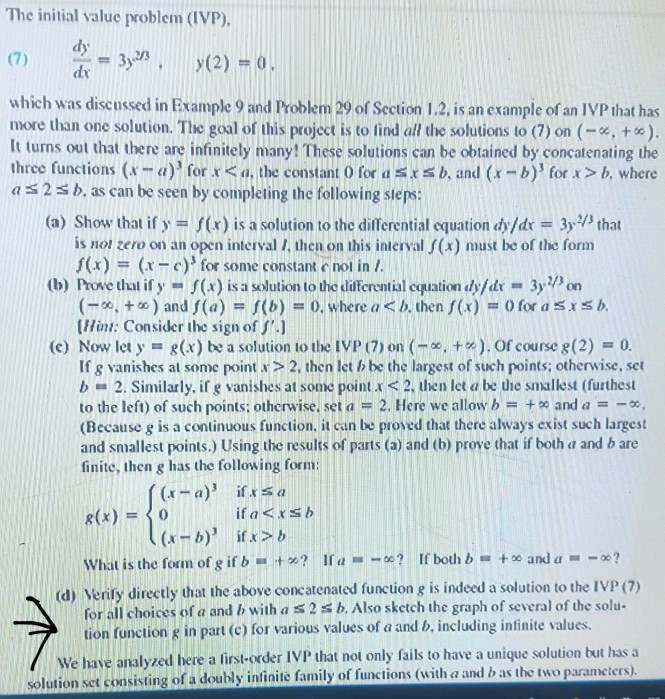
The initial value problem (IVP). (7) dy dx - 3,23 >(2) - 0. which was discussed in Example 9 and Problem 29 of Section 1.2, is an example of an IVP that has more than one solution. The goal of this project is to find all the solutions to (7) on (-, + 5 ). It turns out that there are infinitely many! These solutions can be obtained by concatenationg the three functions (x - a)' for x b, where a 2 3 b. as can be seen by completing the following steps: (a) Show that if y' = f(.x) is a solution to the differential equation dy/dr = 3y-/ that is not zero on an open interval /, then on this interval f(x) must be of the form f (x) = (.x- e)' for some constant c not in /. (b) Prove that if y - f (.x) is a solution to the differential equation dy/ dy = 3y3/3 on (-co, + oo ) and f (a) = f(b) = 0. where a > 2, then let fa be the largest of such points; otherwise, set b = 2. Similarly, if g vanishes at some point x b What is the form of g if b = + ? If a = - ? If both b = + co and a - co? (d) Verify directly that the above concatenated function ? is indeed a solution to the IVP (7) for all choices of a and b with a $ 2 # b. Also sketch the graph of several of the solu- tion function g in part (c) for various values of a and b, including infinite values. We have analyzed here a first-order IVP that not only fails to have a unique solution but has a solution set consisting of a doubly infinite family of functions (with a and b as the two parameters)
Step by Step Solution
There are 3 Steps involved in it

Get step-by-step solutions from verified subject matter experts
 Study Help