







Question: Please solve all part and label which part is which Problem 2. (for a total of 35 points) To examine how glucose is regulated in
Please solve all part and label which part is which
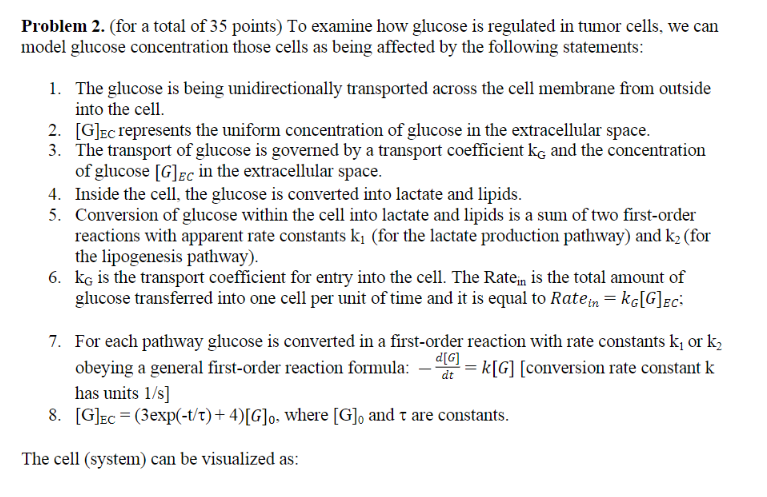
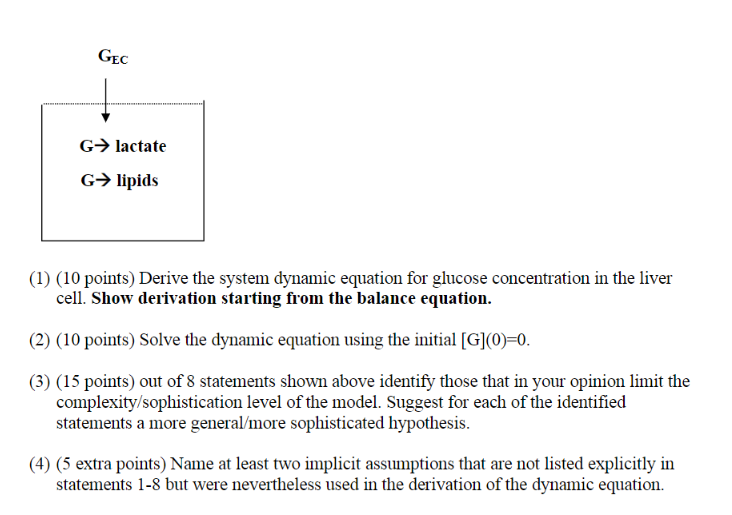
Problem 2. (for a total of 35 points) To examine how glucose is regulated in tumor cells, we can model glucose concentration those cells as being affected by the following statements: 1. The glucose is being unidirectionally transported across the cell membrane from outside into the cell. 2. [G]EC represents the uniform concentration of glucose in the extracellular space. 3. The transport of glucose is governed by a transport coefficient kG and the concentration of glucose [G]EC in the extracellular space. 4. Inside the cell, the glucose is converted into lactate and lipids. 5. Conversion of glucose within the cell into lactate and lipids is a sum of two first-order reactions with apparent rate constants k1 (for the lactate production pathway) and k2 (for the lipogenesis pathway). 6. kG is the transport coefficient for entry into the cell. The Rate ein is the total amount of glucose transferred into one cell per unit of time and it is equal to Rate in=kG[G]EC; 7. For each pathway glucose is converted in a first-order reaction with rate constants k1 or k2 obeying a general first-order reaction formula: dtd[G]=k[G] [conversion rate constant k has units 1/s] 8. [G]EC=(3exp(t/)+4)[G]0, where [G]0 and are constants. The cell (system) can be visualized as: (1) (10 points) Derive the system dynamic equation for glucose concentration in the liver cell. Show derivation starting from the balance equation. (2) (10 points) Solve the dynamic equation using the initial [G](0)=0. (3) (15 points) out of 8 statements shown above identify those that in your opinion limit the complexity/sophistication level of the model. Suggest for each of the identified statements a more general/more sophisticated hypothesis. (4) (5 extra points) Name at least two implicit assumptions that are not listed explicitly in statements 18 but were nevertheless used in the derivation of the dynamic equation
Step by Step Solution
There are 3 Steps involved in it

Get step-by-step solutions from verified subject matter experts
 Study Help