







Question: *******please solve all the quastion if possible i really need it than you!!!! a. 1. How many grams of carbon are needed in the following
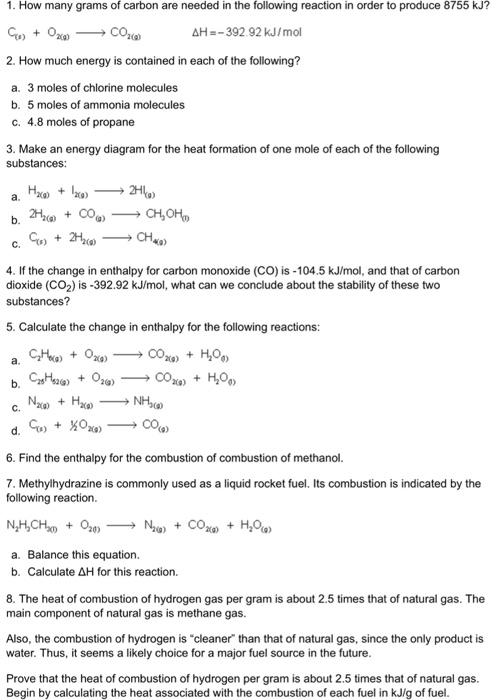
a. 1. How many grams of carbon are needed in the following reaction in order to produce 8755 kJ? CO + O2 CO2 AH =-392.92 KJ/mol 2. How much energy is contained in each of the following? a. 3 moles of chlorine molecules b. 5 moles of ammonia molecules C. 4.8 moles of propane 3. Make an energy diagram for the heat formation of one mole of each of the following substances: H2O + 1200 240 b. 226 +00 CH, OH CC) + 2H2O CH) 4. If the change in enthalpy for carbon monoxide (CO) is - 104.5 kJ/mol, and that of carbon dioxide (CO2) is -392.92 kJ/mol, what can we conclude about the stability of these two substances? 5. Calculate the change in enthalpy for the following reactions: C. Here) + 0.300) 0020) + H20 Cod Heag) + 026) CO20) + HO. N2 + Ha Go + XO2) COCO C. a. b. NHO C. d. 6. Find the enthalpy for the combustion of combustion of methanol. 7. Methylhydrazine is commonly used as a liquid rocket fuel. Its combustion is indicated by the following reaction. NHCH + O29) Nico + CO 2 + H206 a. Balance this equation. b. Calculate AH for this reaction. 8. The heat of combustion of hydrogen gas per gram is about 2.5 times that of natural gas. The main component of natural gas is methane gas. Also, the combustion of hydrogen is "cleaner" than that of natural gas, since the only product is water. Thus, it seems a likely choice for a major fuel source in the future. Prove that the heat of combustion of hydrogen per gram is about 2.5 times that of natural gas. Begin by calculating the heat associated with the combustion of each fuel in kJ/g of fuel
Step by Step Solution
There are 3 Steps involved in it

Get step-by-step solutions from verified subject matter experts
 Study Help