







Question: please solve by hand 4 Magnetic Levitation In this problem, you will analyze the robustness of a controller for the linearized magnetic levitator shown below.
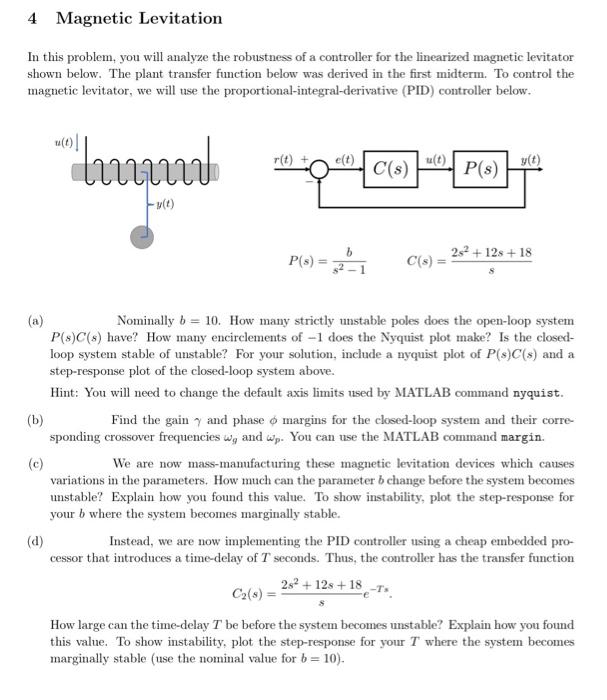
4 Magnetic Levitation In this problem, you will analyze the robustness of a controller for the linearized magnetic levitator shown below. The plant transfer function below was derived in the first midterm. To control the magnetic levitator, we will use the proportional-integral-derivative (PID) controller below. P(s)=s21bC(s)=s2s2+12s+18 (a) Nominally b=10. How many strictly unstable poles does the open-loop system P(s)C(s) have? How many encirclements of -1 does the Nyquist plot make? Is the closedloop system stable of unstable? For your solution, include a nyquist plot of P(s)C(s) and a step-response plot of the closed-loop system above. Hint: You will need to change the default axis limits used by MATLAB command nyquist. (b) Find the gain and phase margins for the closed-loop system and their corresponding crossover frequencies g and p. You can use the MATLAB command margin. (c) We are now mass-manufacturing these magnetic levitation devices which causes variations in the parameters. How much can the parameter b change before the system becomes unstable? Explain how you found this value. To show instability, plot the step-response for your b where the system becomes marginally stable. (d) Instead, we are now implementing the PID controller using a cheap embedded processor that introduces a time-delay of T seconds. Thus, the controller has the transfer function C2(s)=s2s2+12s+18eTs How large can the time-delay T be before the system becomes unstable? Explain how you found this value. To show instability, plot the step-response for your T where the system becomes marginally stable (use the nominal value for b=10 )
Step by Step Solution
There are 3 Steps involved in it

Get step-by-step solutions from verified subject matter experts
 Study Help