







Question: please solve c) the matlab code ASAP 2. Consider the boundary value problem PDE: u,t (0 0). = u,2,2, ICs: u(t = 0,2)- (a) Find
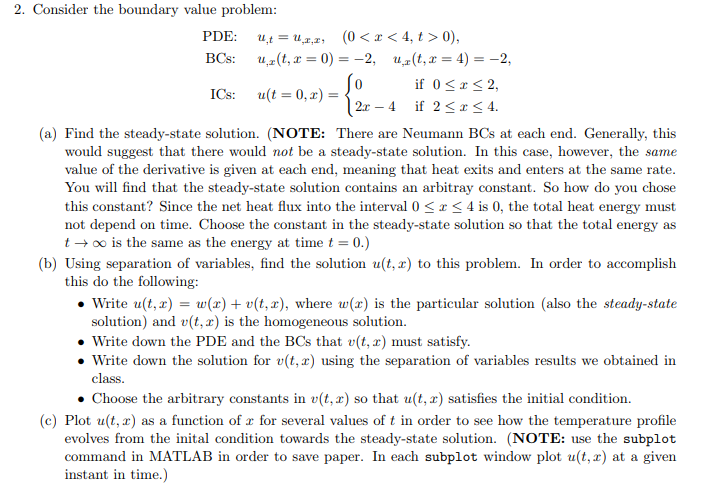
please solve c) the matlab code ASAP
2. Consider the boundary value problem PDE: u,t (0 0). = u,2,2, ICs: u(t = 0,2)- (a) Find the steady-state solution. (NOTE: There are Neumann BCs at each end. Generally, this would suggest that there would not be a steady-state solution. In this case, however, the same value of the derivative is given at each end, meaning that heat exits and enters at the same rate You will find that the steady-state solution contains an arbitray constant. So how do you chose this constant? Since the net heat flux into the interval 0 4 is 0, the total heat energy must not depend on time. Choose the constant in the steady-state solution so that the total energy as t oo is the same as the energy at time t 0) (b) Using separation of variables, find the solution u(t, z) to this problem. In order to accomplish this do the following: Write u(t,x) +v(t), where w( solution) and v(t. x) is the homogeneous solution. Write down the PDE and the BCs that v(t, z) must satisf,y is the particular solution (also the steady-state Write down the solution for v(t, r) using the separation of variables results we obtained in class Choose the arbitrary constants in v(t, x) so that u(t, x) satisfies the initial condition. (c) Plot u(t, z) as a function of r for several values of t in order to see how the temperature profile evolves from the inital condition towards the steady-state solution. (NOTE: use the subplot command in MATLAB in order to save paper. In each subplot window plot u(t, z) at a given instant in time.) 2. Consider the boundary value problem PDE: u,t (0 0). = u,2,2, ICs: u(t = 0,2)- (a) Find the steady-state solution. (NOTE: There are Neumann BCs at each end. Generally, this would suggest that there would not be a steady-state solution. In this case, however, the same value of the derivative is given at each end, meaning that heat exits and enters at the same rate You will find that the steady-state solution contains an arbitray constant. So how do you chose this constant? Since the net heat flux into the interval 0 4 is 0, the total heat energy must not depend on time. Choose the constant in the steady-state solution so that the total energy as t oo is the same as the energy at time t 0) (b) Using separation of variables, find the solution u(t, z) to this problem. In order to accomplish this do the following: Write u(t,x) +v(t), where w( solution) and v(t. x) is the homogeneous solution. Write down the PDE and the BCs that v(t, z) must satisf,y is the particular solution (also the steady-state Write down the solution for v(t, r) using the separation of variables results we obtained in class Choose the arbitrary constants in v(t, x) so that u(t, x) satisfies the initial condition. (c) Plot u(t, z) as a function of r for several values of t in order to see how the temperature profile evolves from the inital condition towards the steady-state solution. (NOTE: use the subplot command in MATLAB in order to save paper. In each subplot window plot u(t, z) at a given instant in time.)
Step by Step Solution
There are 3 Steps involved in it

Get step-by-step solutions from verified subject matter experts
 Study Help