







Question: Please solve for part D) and E) and provide reasoning/understanding 1. For each of the following sets of reactions, describe your reactor system and conditions
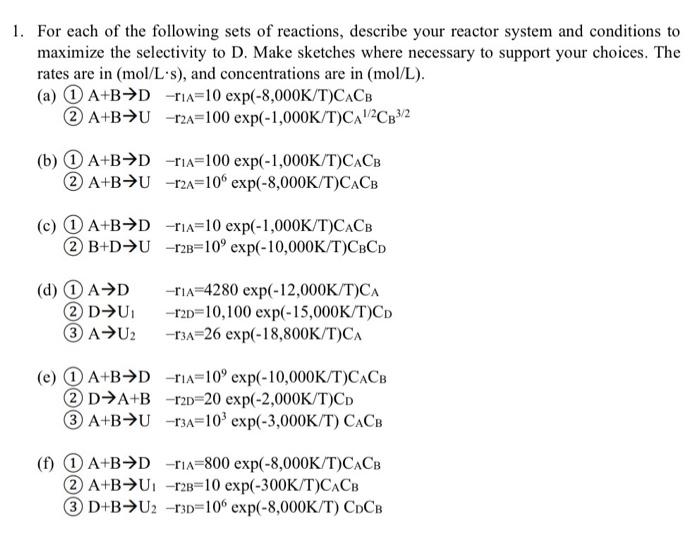
For each of the following sets of reactions, describe your reactor system and conditions to maximize the selectivity to D. Make sketches where necessary to support your choices. The rates are in (mol/Ls), and concentrations are in (mol/L). (a) 1A+BDr1A=10exp(8,000K/T)CACB (2) A+BUr2A=100exp(1,000K/T)CA1/2CB3/2 (b) 1A+BDr1A=100exp(1,000K/T)CACB (2) A+BUr2A=106exp(8,000K/T)CACB (c) AA+BDr1A=10exp(1,000K/T)CACB (2) B+DUr2B=109exp(10,000K/T)CBCD (d) (1) ADr1A=4280exp(12,000K/T)CA (2) DU1r2D=10,100exp(15,000K/T)CD (3) AU2r3A=26exp(18,800K/T)CA (e) 1 A A+BDr1A=109exp(10,000K/T)CACB (2) DA+Br2D=20exp(2,000K/T)CD (3) A+BUr3A=103exp(3,000K/T)CACB (f) (1) A+BDr1A=800exp(8,000K/T)CACB (2) A+BU1r2B=10exp(300K/T)CACB (3) D+BU2r3D=106exp(8,000K/T)CDCBB For each of the following sets of reactions, describe your reactor system and conditions to maximize the selectivity to D. Make sketches where necessary to support your choices. The rates are in (mol/Ls), and concentrations are in (mol/L). (a) 1A+BDr1A=10exp(8,000K/T)CACB (2) A+BUr2A=100exp(1,000K/T)CA1/2CB3/2 (b) 1A+BDr1A=100exp(1,000K/T)CACB (2) A+BUr2A=106exp(8,000K/T)CACB (c) AA+BDr1A=10exp(1,000K/T)CACB (2) B+DUr2B=109exp(10,000K/T)CBCD (d) (1) ADr1A=4280exp(12,000K/T)CA (2) DU1r2D=10,100exp(15,000K/T)CD (3) AU2r3A=26exp(18,800K/T)CA (e) 1 A A+BDr1A=109exp(10,000K/T)CACB (2) DA+Br2D=20exp(2,000K/T)CD (3) A+BUr3A=103exp(3,000K/T)CACB (f) (1) A+BDr1A=800exp(8,000K/T)CACB (2) A+BU1r2B=10exp(300K/T)CACB (3) D+BU2r3D=106exp(8,000K/T)CDCBB
Step by Step Solution
There are 3 Steps involved in it

Get step-by-step solutions from verified subject matter experts
 Study Help