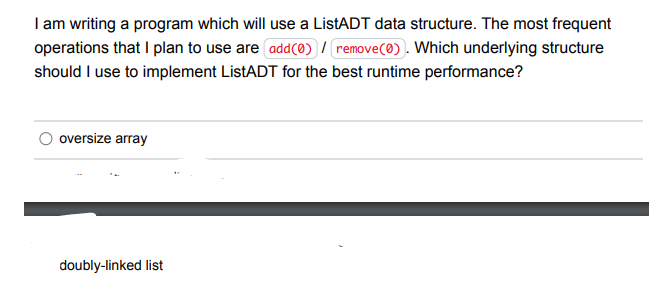
Question: Please Solve the Answer Accordingly and do not copy from others make sure you provide reasoning with your answer. I will dislike if the answer
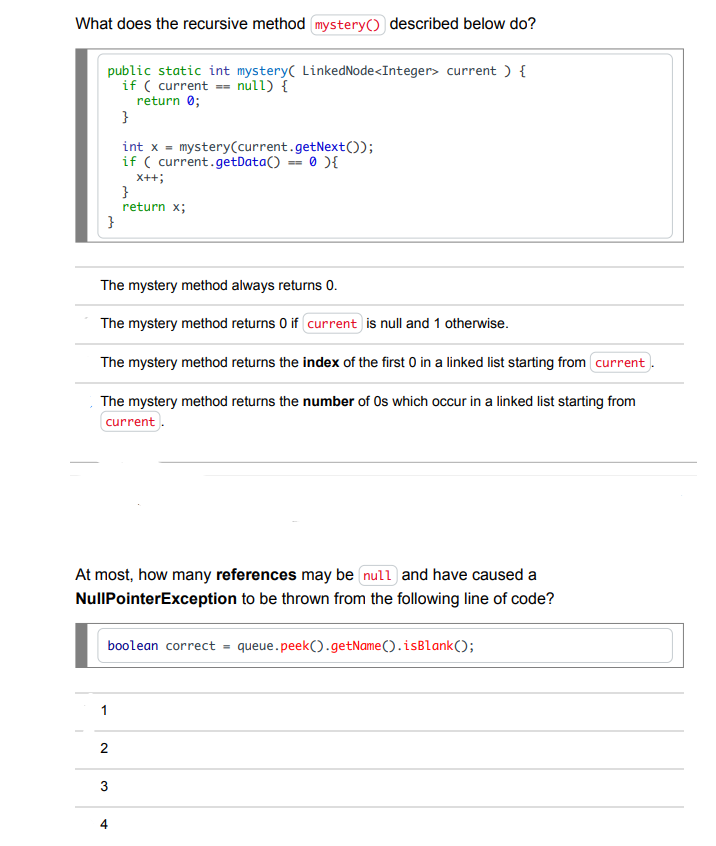
 Please Solve the Answer Accordingly and do not copy from othersmake sure you provide reasoning with your answer. I will dislike ifthe answer is poor public static int mystery( LinkedNode current) \{ if( current == null) \{ return 0 ; \} int x= mystery(current.getNext

Please Solve the Answer Accordingly and do not copy from others make sure you provide reasoning with your answer. I will dislike if the answer is poor
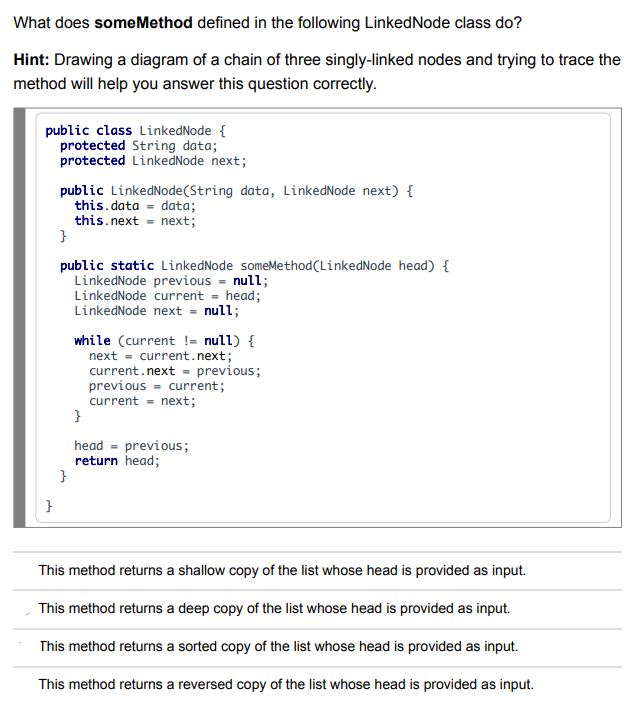
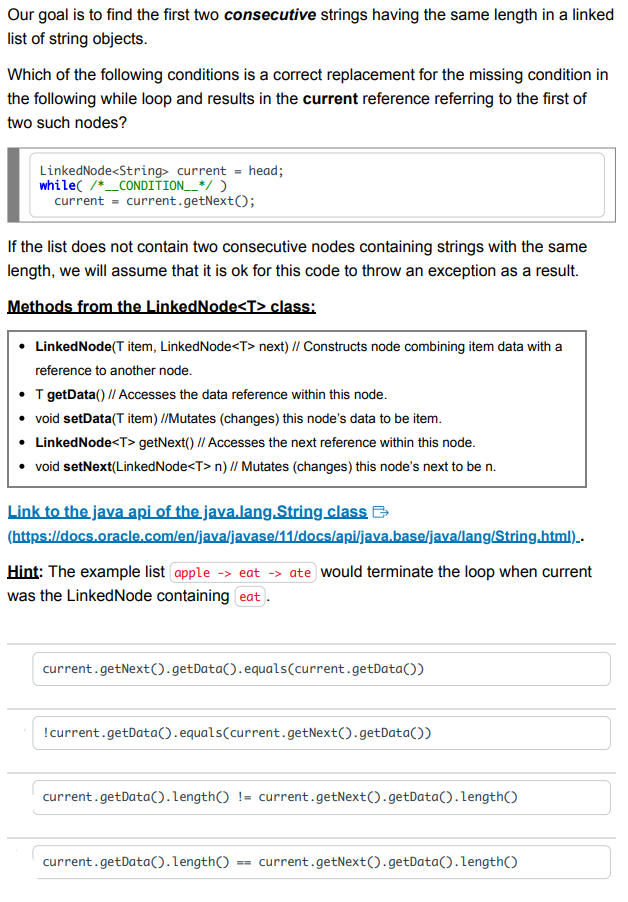
public static int mystery( LinkedNode current) \{ if ( current == null) \{ return 0 ; \} int x= mystery(current.getNext ()); if ( current.getData() =0){ x++; return x; The mystery method always returns 0 . The mystery method returns 0 if is null and 1 otherwise. The mystery method returns the index of the first 0 in a linked list starting from The mystery method returns the number of 0s which occur in a linked list starting from At most, how many references may be and have caused a NullPointerException to be thrown from the following line of code? Our goal is to find the first two consecutive strings having the same length in a linked list of string objects. Which of the following conditions is a correct replacement for the missing condition in the following while loop and results in the current reference referring to the first of two such nodes? LinkedNode String > current = head; while (/ __CONDITION__*/) current = current.getNext () If the list does not contain two consecutive nodes containing strings with the same length, we will assume that it is ok for this code to throw an exception as a result. Methods from the LinkedNode class: - LinkedNode(T item, LinkedNode next) // Constructs node combining item data with a reference to another node. - T getData() // Accesses the data reference within this node. - void setData(T item) //Mutates (changes) this node's data to be item. - LinkedNode getNext() // Accesses the next reference within this node. - void setNext(LinkedNode n ) // Mutates (changes) this node's next to be n. Link to the java api of the java.lang_String_class B (https://docs.oracle.com/en/java/javase/11/docs/api/java.base/javallang/String.html)_. Hint: The example list would terminate the loop when current was the LinkedNode containing current. getNext(). getData(). equals(current. getData()) What does someMethod defined in the following LinkedNode class do? Hint: Drawing a diagram of a chain of three singly-linked nodes and trying to trace the method will help you answer this question correctly. This method returns a shallow copy of the list whose head is provided as input. This method returns a deep copy of the list whose head is provided as input. This method returns a sorted copy of the list whose head is provided as input. This method returns a reversed copy of the list whose head is provided as input. I am writing a program which will use a ListADT data structure. The most frequent operations that I plan to use are . Which underlying structure should I use to implement ListADT for the best runtime performance

Step by Step Solution

There are 3 Steps involved in it

1 Expert Approved Answer
Step: 1 Unlock blur-text-image
Question Has Been Solved by an Expert!

Get step-by-step solutions from verified subject matter experts

Step: 2 Unlock
Step: 3 Unlock

Students Have Also Explored These Related Databases Questions!