







Question: Please Solve the Answer Accordingly and do not copy from others make sure you provide reasoning with your answer. I will dislike if the answer
Please Solve the Answer Accordingly and do not copy from others make sure you provide reasoning with your answer. I will dislike if the answer is poor
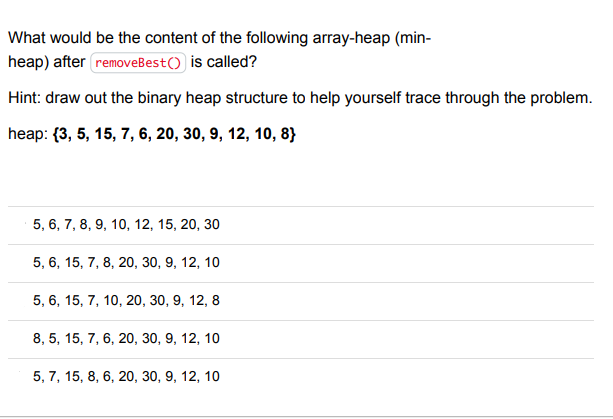
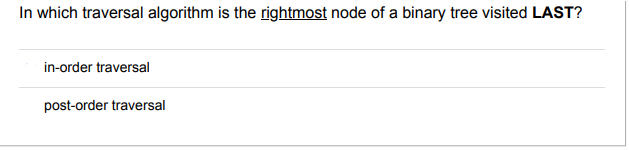
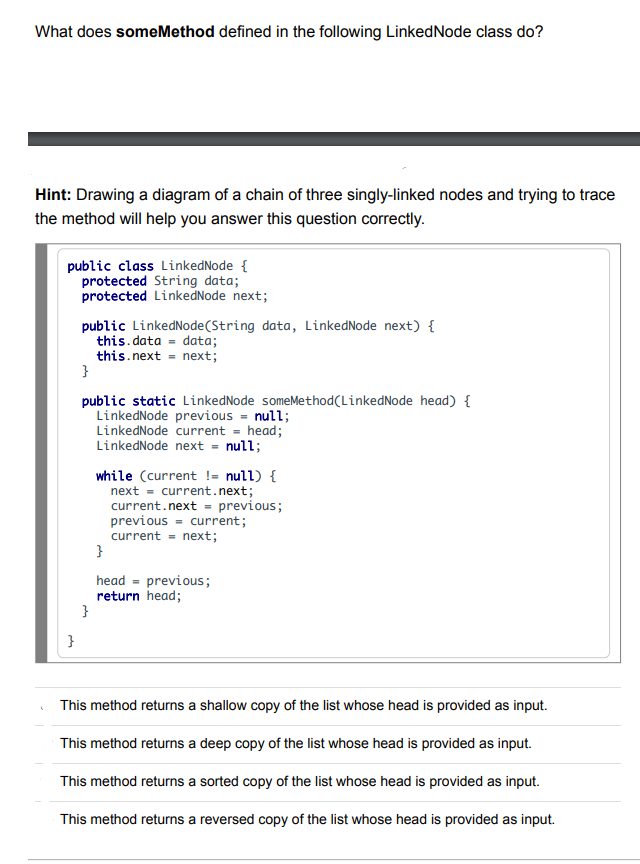
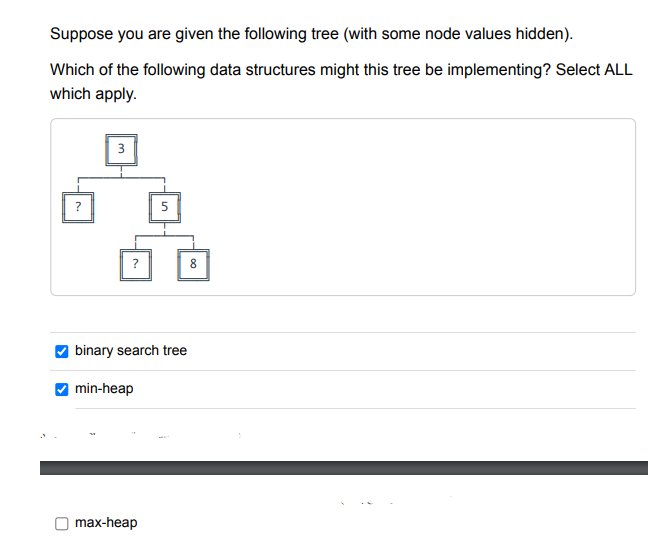
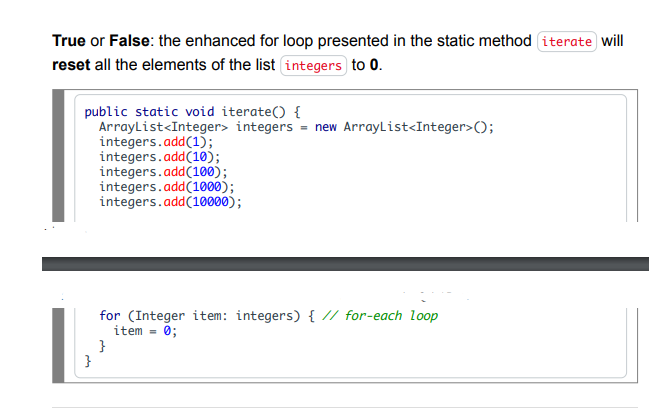
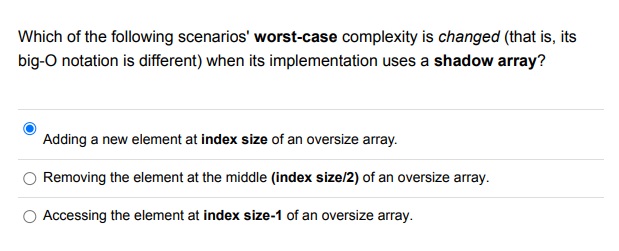
What would be the content of the following array-heap (min- heap) after is called? Hint: draw out the binary heap structure to help yourself trace through the problem. heap: {3,5,15,7,6,20,30,9,12,10,8} In which traversal algorithm is the rightmost node of a binary tree visited LAST? in-order traversal post-order traversal What does someMethod defined in the following LinkedNode class do? Hint: Drawing a diagram of a chain of three singly-linked nodes and trying to trace the method will help you answer this question correctly. public class LinkedNode \{ protected String data; protected LinkedNode next; public LinkedNode(String data, LinkedNode next) \{ this.data = data; this.next = next; public static LinkedNode someMethod(LinkedNode head) LinkedNode previous = null; LinkedNode current = head; LinkedNode next = null; while (current != null) \{ next = current. next; current. next = previous; previous = current; current = next; \} head = previous; return head; \} This method returns a shallow copy of the list whose head is provided as input. This method returns a deep copy of the list whose head is provided as input. This method returns a sorted copy of the list whose head is provided as input. This method returns a reversed copy of the list whose head is provided as input. Suppose you are given the following tree (with some node values hidden). Which of the following data structures might this tree be implementing? Select ALL which apply. binary search tree min-heap max-heap True or False: the enhanced for loop presented in the static method will reset all the elements of the list to 0 . public static void iterate() \{ Arraylist integers = new Arraylist 0; integers.add(1); integers.add(10); integers.add(100); integers. add (1000); integers.add (10000); for (Integer item: integers) {// for-each loop item =0; Which of the following scenarios' worst-case complexity is changed (that is, its big-O notation is different) when its implementation uses a shadow array? Adding a new element at index size of an oversize array. Removing the element at the middle (index size/2) of an oversize array. Accessing the element at index size-1 of an oversize array
Step by Step Solution
There are 3 Steps involved in it

Get step-by-step solutions from verified subject matter experts
 Study Help