Question: please solve these problems.. True (T) or False (F)? 1 If the standard LP primal is minimization, the dual is maximization with s constraints and
please solve these problems..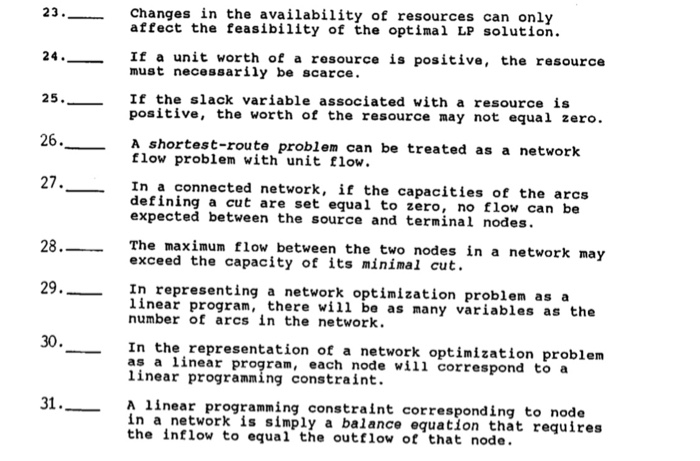
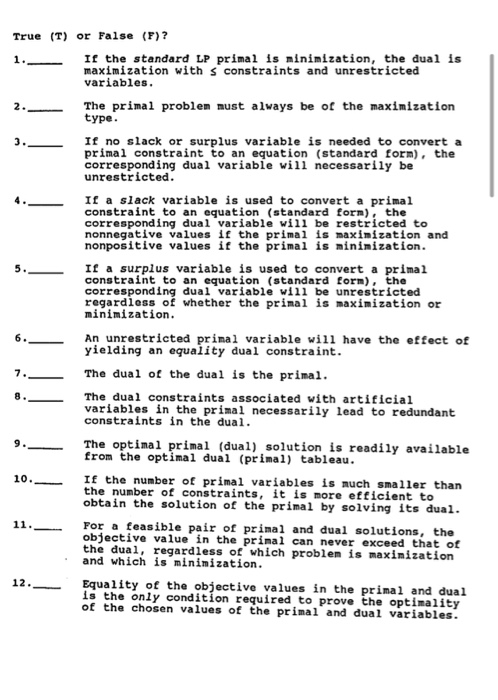
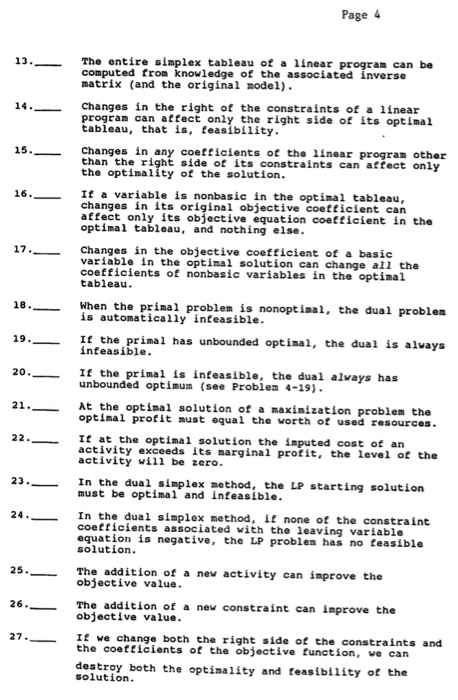
True (T) or False (F)? 1 If the standard LP primal is minimization, the dual is maximization with s constraints and unrestricted variables. 2 The primal problem nust always be of the maximization type. 3. If no slack or surplus variable is needed to convert a primal constraint to an equation (standard form), the corresponding dual variable will necessarily be unrestricted. 4. If a slack variable is used to convert a primal constraint to an equation (standard form), the corresponding dual variable will be restricted to nonnegative values if the primal is maximization and nonpositive values if the primal is minimization. 5. If a surplus variable is used to convert a primal constraint to an equation (standard form), the corresponding dual variable will be unrestricted regardiess of whether the primal is maximization or minimization. 6. An unrestricted prinal variable will have the effect of yielding an equality dual constraint. 7. The dual of the dual is the primal. 8. The dual constraints associated with artificial variables in the primal necessarily lead to redundant constraints in the dual. 9. The optimal primal (dual) solution is readily available from the optimal dual (primal) tableau. 10. If the number of primal variables is nuch smaller than the number of constraints, it is more efficient to obtain the solution of the primal by solving its dual. 11. For a feasible pair of primal and dual solutions, the objective value in the prinal can never exceed that of the dual, regardless of which problem is maximization and which is minimization. 12. Equality of the objective values in the primal and dual is the only condition required to prove the optimality of the chosen values of the primal and dual variables. Page 4 13. The entire simplex tableau of a linear program can be computed from knowledge of the associated inverse matrix (and the original model). 14. Changes in the right of the constraints of a linear progran can affect only the right side of its optimal tableau, that is, feasibility. 15. Changes in any coefficients of the ilnear progran other than the right side of its constraints can affect only the optimality of the solution. 6. If a variable is nonbasic in the optimal tableau, changes in its original objective coefficient can affect only its objective equation coefficient in the optimal tableau, and nothing else. 7. Changes in the objective coefficient of a basic variable in the optinal solution can change all the coefficients of nonbasic variables in the optimal tableau. 8. When the primal problem is nonoptinal, the dual problen is automatically infeasible. 9. If the primal has unbounded optinal, the dual is always infeasible. 0. If the primal is infeasible, the dual always has unbounded optimun (see Problem 4-19). 1. At the optimal solution of a maximization problem the optimal profit must equal the worth of used resources. 2. If at the optimal solution the inputed cost of an activity exceeds its narginal profit, the level of the activity will be zero. 3 . In the dual simplex method, the LP starting solution must be optimal and infeasible. 4 . In the dual simplex nethod, if none of the constraint coefficients associated with the leaving variable equation is negative, the LP problen has no feasible solution. 5 . The addition of a new activity can inprove the objective value. 6. The addition of a new constraint can inprove the objective value. If we change both the right side of the constraints and the coefficients of the objective function, we can destroy both the optinality and feasibility of the solution. 23. Changes in the availability of resources can only affect the feasibility of the optimal Lp solution. 24. If a unit worth of a resource is positive, the resource must necessarily be scarce. 25. If the slack variable associated with a resource is positive, the worth of the resource may not equal zero. 26. A shortest-route problem can be treated as a network flow problem with unit flow. 27. In a connected network, if the capacities of the arcs defining a cut are set equal to zero, no flow can be expected between the source and terminal nodes. 28. The maximum flow between the two nodes in a network may exceed the capacity of its minimal cut. 29. In representing a network optimization problem as a linear program, there will be as many variables as the number of arcs in the network. 30. In the representation of a network optimization problem as a linear program, each node will correspond to a linear programming constraint









 Study Help