







Question: Please solve this question by MATLAB! 2. Consider a thermocouple measuring 13(C). The corresponding measured temperature varies as: dT3m (T3-73m) dt Tm The measured temperature,
Please solve this question by MATLAB!
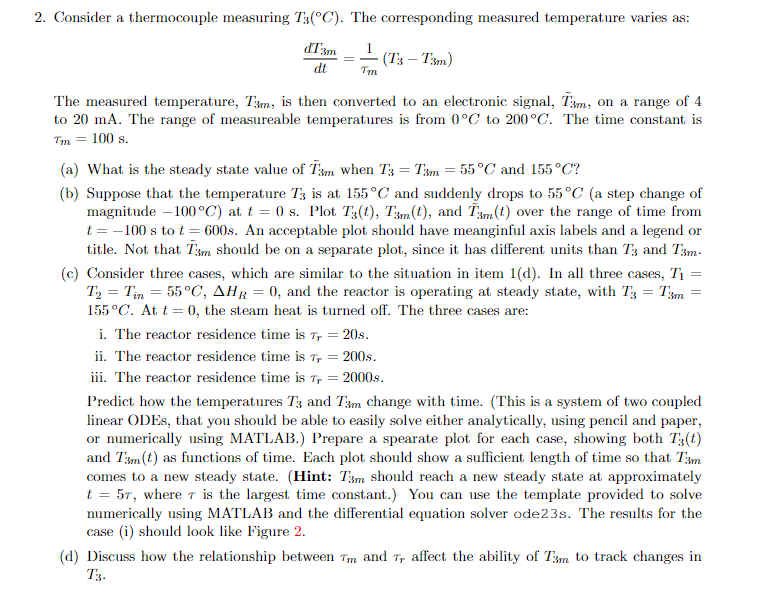
2. Consider a thermocouple measuring 13(C). The corresponding measured temperature varies as: dT3m (T3-73m) dt Tm The measured temperature, Tim, is then converted to an electronic signal, T:m, on a range of 4 to 20 mA. The range of measureable temperatures is from 0C to 200C. The time constant is Tm = 100 s. (a) What is the steady state value of T:m when T3 = T3m = 55C and 155 C? (b) Suppose that the temperature Tz is at 155 C and suddenly drops to 55C (a step change of magnitude -100C) at t = 0 s. Plot Tz(t), T3m(t), and T3m(t) over the range of time from t= -100 s to t = 600s. An acceptable plot should have meanginful axis labels and a legend or title. Not that T3m should be on a separate plot, since it has different units than Tz and T3m- (c) Consider three cases, which are similar to the situation in item 1(a). In all three cases, T = T, = Tin = 55C, AHR = 0, and the reactor is operating at steady state, with T3 = T3m = 155C. At t=0, the steam heat is turned off. The three cases are: i. The reactor residence time is Tr = 20s. ii. The reactor residence time is Tr = 200s. iii. The reactor residence time is Tr = 2000s. Predict how the temperatures T3 and T3m change with time. (This is a system of two coupled linear ODEs, that you should be able to easily solve either analytically, using pencil and paper, or numerically using MATLAB.) Prepare a spearate plot for each case, showing both Tz(t) and T3m(t) as functions of time. Each plot should show a sufficient length of time so that Tim comes to a new steady state. (Hint: 7:3m should reach a new steady state at approximately t = 57, where t is the largest time constant.) You can use the template provided to solve numerically using MATLAB and the differential equation solver ode23s. The results for the case (i) should look like Figure 2. (d) Discuss how the relationship between Tm and to affect the ability of T3m to track changes in 73. 2. Consider a thermocouple measuring 13(C). The corresponding measured temperature varies as: dT3m (T3-73m) dt Tm The measured temperature, Tim, is then converted to an electronic signal, T:m, on a range of 4 to 20 mA. The range of measureable temperatures is from 0C to 200C. The time constant is Tm = 100 s. (a) What is the steady state value of T:m when T3 = T3m = 55C and 155 C? (b) Suppose that the temperature Tz is at 155 C and suddenly drops to 55C (a step change of magnitude -100C) at t = 0 s. Plot Tz(t), T3m(t), and T3m(t) over the range of time from t= -100 s to t = 600s. An acceptable plot should have meanginful axis labels and a legend or title. Not that T3m should be on a separate plot, since it has different units than Tz and T3m- (c) Consider three cases, which are similar to the situation in item 1(a). In all three cases, T = T, = Tin = 55C, AHR = 0, and the reactor is operating at steady state, with T3 = T3m = 155C. At t=0, the steam heat is turned off. The three cases are: i. The reactor residence time is Tr = 20s. ii. The reactor residence time is Tr = 200s. iii. The reactor residence time is Tr = 2000s. Predict how the temperatures T3 and T3m change with time. (This is a system of two coupled linear ODEs, that you should be able to easily solve either analytically, using pencil and paper, or numerically using MATLAB.) Prepare a spearate plot for each case, showing both Tz(t) and T3m(t) as functions of time. Each plot should show a sufficient length of time so that Tim comes to a new steady state. (Hint: 7:3m should reach a new steady state at approximately t = 57, where t is the largest time constant.) You can use the template provided to solve numerically using MATLAB and the differential equation solver ode23s. The results for the case (i) should look like Figure 2. (d) Discuss how the relationship between Tm and to affect the ability of T3m to track changes in 73
Step by Step Solution
There are 3 Steps involved in it

Get step-by-step solutions from verified subject matter experts
 Study Help