







Question: Please summarize the case such that a reader of your report can have a general understanding of the purpose, method , and the results of
Please summarize the case such that a reader of your report can have a general understanding of the purpose, method, and the results of the case without reading it.
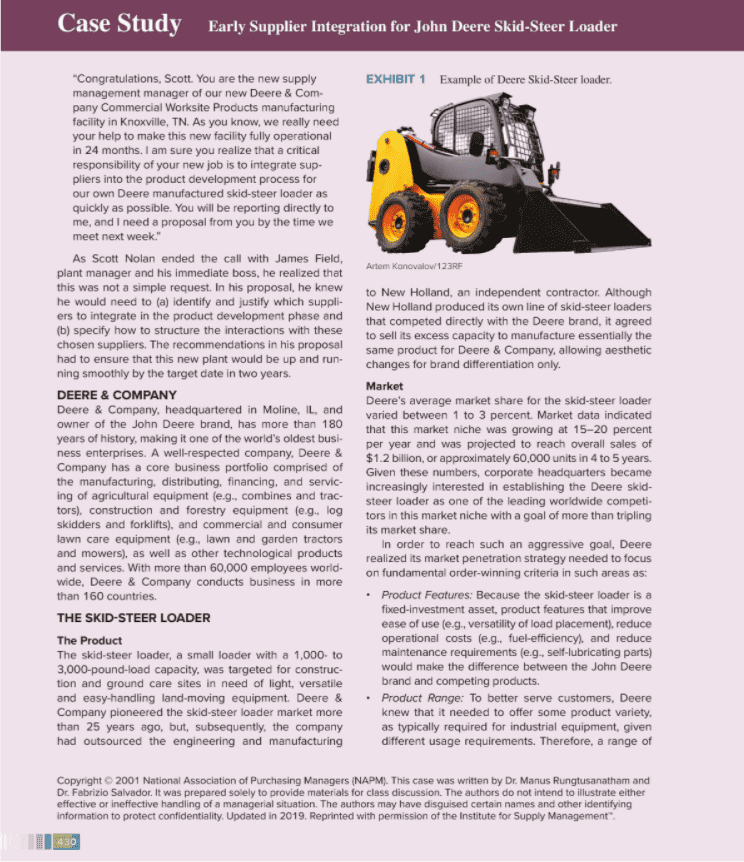
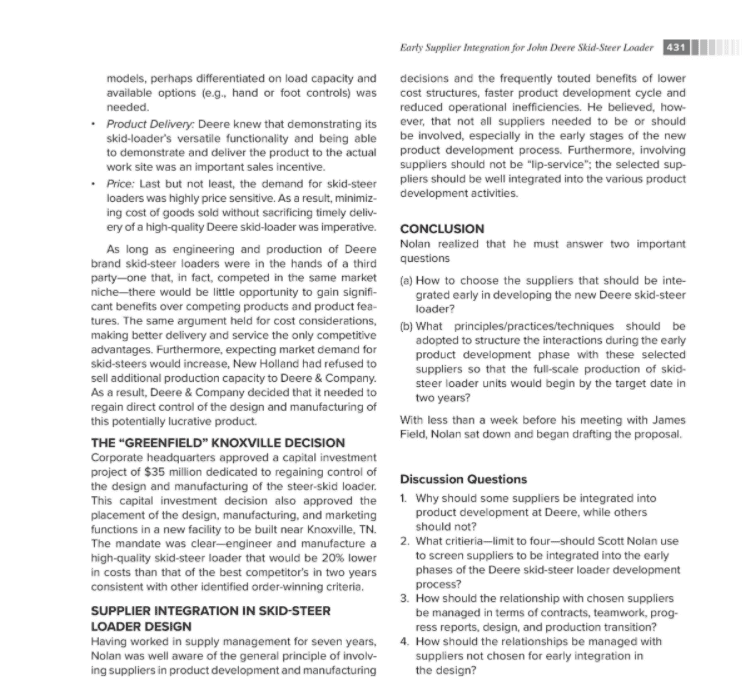
Case Study Early Supplier Integration for John Deere Skid Steer Loader EXHIBIT 1 Example of Deere Skid-Steer loader. "Congratulations, Scott. You are the new supply management manager of our new Deere & Com. pany Commercial Worksite Products manufacturing facility in Knoxville, TN. As you know, we really need your help to make this new facility fully operational in 24 months. I am sure you realize that a critical responsibility of your new job is to integrate sup- pliers into the product development process for our own Deere manufactured skid-steer loader as quickly as possible. You will be reporting directly to me, and I need a proposal from you by the time we meet next week." As Scott Nolan ended the call with James Field, plant manager and his immediate boss, he realized that this was not a simple request. In his proposal, he knew he would need to (a) identify and justify which suppli- ers to integrate in the product development phase and (b) specify how to structure the interactions with these chosen suppliers. The recommendations in his proposal had to ensure that this new plant would be up and run ning smoothly by the target date in two years. DEERE & COMPANY Deere & Company, headquartered in Moline, IL, and owner of the John Deere brand, has more than 180 years of history, making it one of the world's oldest busi- ness enterprises. A well-respected company. Deere & Company has a core business portfolio comprised of the manufacturing, distributing, financing, and servic- ing of agricultural equipment (e.g., combines and trac- tors), construction and forestry equipment (e.g. log skidders and forklifts), and commercial and consumer lawn care equipment (e.g, lawn and garden tractors and mowers), as well as other technological products and services. With more than 60,000 employees world- wide, Deere & Company conducts business in more than 160 countries THE SKID-STEER LOADER The Product The skid steer loader, a small loader with a 1,000 to 3,000-pound-load capacity, was targeted for construc- tion and ground care sites in need of light, versatile and easy-handling land-moving equipment Deere & Company pioneered the skid-steer loader market more than 25 years ago, but, subsequently, the company had outsourced the engineering and manufacturing Artem Konovalow123RF to New Holland, an independent contractor. Although New Holland produced its own line of skid-steer loaders that competed directly with the Deere brand, it agreed to sell its excess capacity to manufacture essentially the same product for Deere & Company, allowing aesthetic changes for brand differentiation only. Market Deere's average market share for the skid-steer loader varied between 1 to 3 percent. Market data indicated that this market niche was growing at 15-20 percent per year and was projected to reach overall sales of $1.2 billion, or approximately 60,000 units in 4 to 5 years. Given these numbers, corporate headquarters became increasingly interested in establishing the Deere skid- steer loader as one of the leading worldwide competi- tors in this market niche with a goal of more than tripling its market share In order to reach such an aggressive goal, Deere realized its market penetration strategy needed to focus on fundamental order-winning criteria in such areas as: Product Features: Because the skid-steer loader is a fixed-investment asset, product features that improve ease of use (e.g., versatility of load placement), reduce operational costs (e.g., fuel-efficiency). and reduce maintenance requirements (e.g., self-lubricating parts) would make the difference between the John Deere brand and competing products. Product Range: To better serve customers, Deere knew that it needed to offer some product variety as typically required for industrial equipment, given different usage requirements. Therefore, a range of Copyright 2001 National Association of Purchasing Managers (NAPM). This case was written by Dr. Manus Rungtusanatham and Dr. Fabrizio Salvador. It was prepared solely to provide materials for class discussion. The authors do not intend to illustrate either effective or ineffective handling of a managerial situation. The authors may have disguised certain names and other identifying information to protect confidentiality. Updated in 2019. Reprinted with permission of the Institute for Supply Management". 430 Earty Supplier Integration for John Deere Skid-Steer Loader 431 models, perhaps differentiated on load capacity and decisions and the frequently touted benefits of lower available options (e.g. hand or foot controls) was cost structures, faster product development cycle and needed reduced operational inefficiencies. He believed, how- Product Delivery: Deere knew that demonstrating its ever, that not all suppliers needed to be or should skid-loader's versatile functionality and being able be involved, especially in the early stages of the new to demonstrate and deliver the product to the actual product development process. Furthermore, involving work site was an important sales incentive. suppliers should not be "lip-service"; the selected sup- Price: Last but not least, the demand for skid-steer pliers should be well integrated into the various product loaders was highly price sensitive. As a result, minimiz- development activities. ing cost of goods sold without sacrificing timely deliv- ery of a high-quality Deere skid-loader was imperative. CONCLUSION As long as engineering and production of Deere Nolan realized that he must answer two important brand skid-steer loaders were in the hands of a third questions party-one that, in fact, competed in the same market (a) How to choose the suppliers that should be inte- niche-there would be little opportunity to gain signifi- grated early in developing the new Deere skid-steer cant benefits over competing products and product fea- loader? tures. The same argument held for cost considerations, (b) What principles/practices/techniques should be making better delivery and service the only competitive adopted to structure the interactions during the early advantages. Furthermore, expecting market demand for product development phase with these selected skid-steers would increase, New Holland had refused to sell additional production capacity to Deere & Company. suppliers so that the full-scale production of skid- steer loader units would begin by the target date in As a result, Deere & Company decided that it needed to two years? regain direct control of the design and manufacturing of this potentially lucrative product. With less than a week before his meeting with James THE "GREENFIELD" KNOXVILLE DECISION Field, Nolan sat down and began drafting the proposal. Corporate headquarters approved a capital investment project of $35 million dedicated to regaining control of the design and manufacturing of the steer-skid loader. Discussion Questions This capital investment decision also approved the 1. Why should some suppliers be integrated into placement of the design, manufacturing, and marketing product development at Deere, while others functions in a new facility to be built near Knoxville, TN. should not? The mandate was clear-engineer and manufacture a 2. What critieria-limit to four-should Scott Nolan use high-quality skid steer loader that would be 20% lower to screen suppliers to be integrated into the early in costs than that of the best competitor's in two years phases of the Deere skid steer loader development consistent with other identified order-winning criteria. process? 3. How should the relationship with chosen suppliers SUPPLIER INTEGRATION IN SKID-STEER be managed in terms of contracts, teamwork, prog- LOADER DESIGN ress reports, design, and production transition? Having worked in supply management for seven years, 4. How should the relationships be managed with Nolan was well aware of the general principle of involv- suppliers not chosen for early integration in ing suppliers in product development and manufacturing the designStep by Step Solution
There are 3 Steps involved in it
1 Expert Approved Answer
Step: 1 Unlock

Question Has Been Solved by an Expert!
Get step-by-step solutions from verified subject matter experts
Step: 2 Unlock
Step: 3 Unlock
 Study Help