Question: Please summarize the follow article, minimum 3 pages: 14.2 THE ELECTRIFYING JOB OF THE FRONT OFFICE MANAGER James A. Bardi corporate management concepts, to empower
Please summarize the follow article, minimum 3 pages:
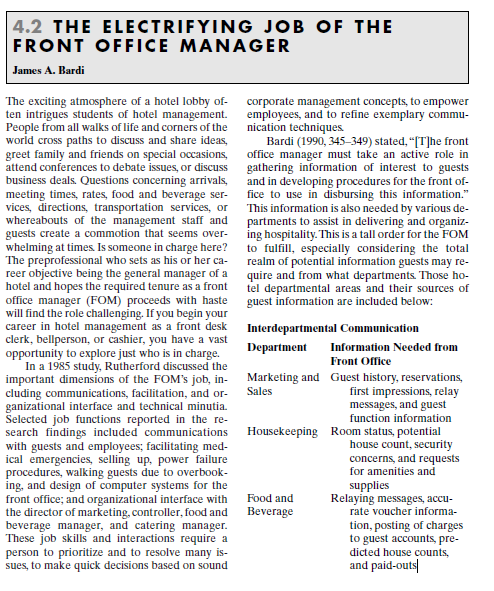
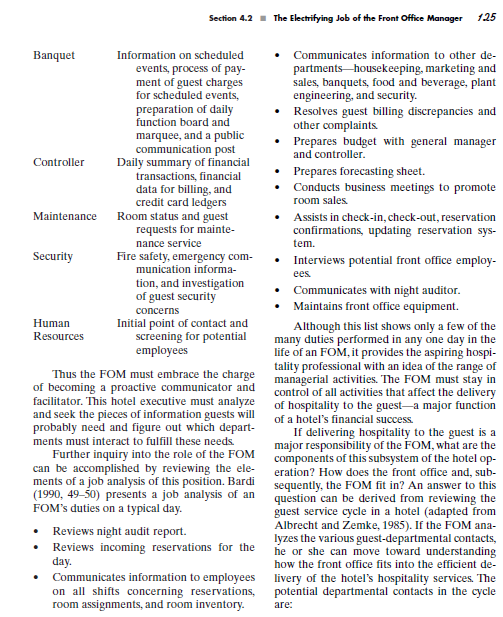
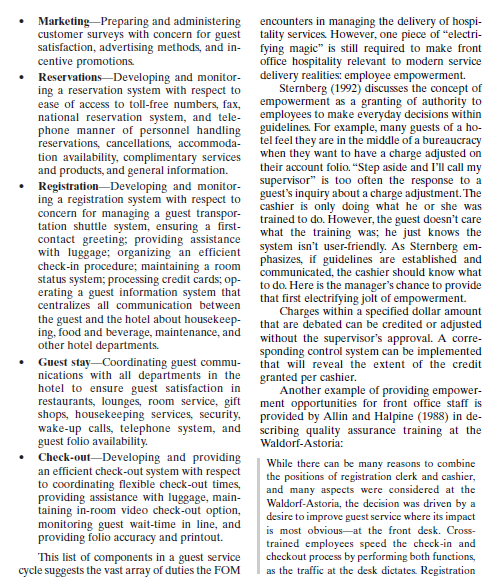
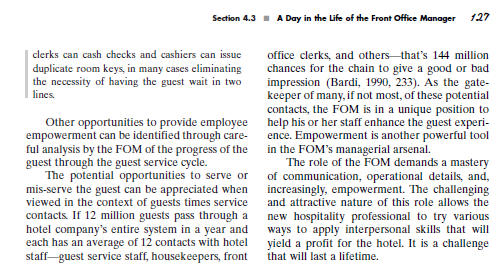
14.2 THE ELECTRIFYING JOB OF THE FRONT OFFICE MANAGER James A. Bardi corporate management concepts, to empower employees, and to refine exemplary commu- nication techniques Bardi (1990, 345-349) stated, "The front office manager must take an active role in gathering information of interest to guests and in developing procedures for the front of fice to use in disbursing this information." This information is also needed by various de- partments to assist in delivering and organiz- ing hospitality. This is a tall order for the FOM to fulfill, especially considering the total realm of potential information guests may re- quire and from what departments. Those ho- tel departmental areas and their sources of guest information are included below: The exciting atmosphere of a hotel lobby of ten intrigues students of hotel management People from all walks of life and corners of the world cross paths to discuss and share ideas. greet family and friends on special occasions, attend conferences to debate issues, or discuss business deals. Questions concerning arrivals. meeting times, rates, food and beverage ser- vices, directions, transportation services, or whereabouts of the management staff and guests create a commotion that seems over- whelming at times. Is someone in charge here? The preprofessional who sets as his or her ca- reer objective being the general manager of a hotel and hopes the required tenure as a front office manager (FOM) proceeds with haste will find the role challenging. If you begin your career in hotel management as a front desk clerk, bellperson, or cashier, you have a vast opportunity to explore just who is in charge. In a 1985 study, Rutherford discussed the important dimensions of the FOM's job, in- cluding communications, facilitation, and or- ganizational interface and technical minutia. Selected job functions reported in the re- search findings included communications with guests and employees, facilitating med ical emergencies, selling up, power failure procedures, walking guests due to overbook- ing, and design of computer systems for the front office, and organizational interface with the director of marketing, controller, food and beverage manager, and catering manager. These job skills and interactions require a person to prioritize and to resolve many is- sues, to make quick decisions based on sound Interdepartmental Communication Department Information Needed from Front Office Marketing and Guest history, reservations, first impressions, relay messages, and guest function information Housekeeping Room status, potential house count, security concerns, and requests for amenities and supplies Food and Relaying messages, accu- Beverage rate voucher informa- tion, posting of charges to guest accounts, pre- dicted house counts, and paid-outs Section 4.2 The Electrifying Job of the Front Office Manager 1.25 Banquet Controller Information on scheduled events, process of pay- ment of guest charges for scheduled events, preparation of daily function board and marquee, and a public communication post Daily summary of financial transactions, financial data for billing, and credit card ledgers Room status and guest requests for mainte- nance service Fire safety, emergency com- munication informa- tion, and investigation of guest security concerns Initial point of contact and screening for potential employees Maintenance Security Human Resources Communicates information to other de- partments-housekeeping, marketing and sales, banquets, food and beverage, plant engineering, and security. Resolves guest billing discrepancies and other complaints Prepares budget with general manager and controller Prepares forecasting sheet. Conducts business meetings to promote room sales Assists in check-in, check-out, reservation confirmations, updating reservation sys- tem. Interviews potential front office employ- ees Communicates with night auditor. Maintains front office equipment. Although this list shows only a few of the many duties performed in any one day in the life of an FOM, it provides the aspiring hospi- tality professional with an idea of the range of managerial activities. The FOM must stay in control of all activities that affect the delivery of hospitality to the guesta major function of a hotel's financial success If delivering hospitality to the guest is a major responsibility of the FOM, what are the components of this subsystem of the hotel op- eration? How does the front office and, sub- sequently, the FOM fit in? An answer to this question can be derived from reviewing the guest service cycle in a hotel (adapted from Albrecht and Zemke, 1985). If the FOM ana- lyzes the various guest-departmental contacts, he or she can move toward understanding how the front office fits into the efficient de- livery of the hotel's hospitality services. The potential departmental contacts in the cycle are: Thus the FOM must embrace the charge of becoming a proactive communicator and facilitator. This hotel executive must analyze and seek the pieces of information guests will probably need and figure out which depart- ments must interact to fulfill these needs Further inquiry into the role of the FOM can be accomplished by reviewing the ele- ments of a job analysis of this position. Bardi (1990, 49-50) presents a job analysis of an FOM's duties on a typical day. Reviews night audit report. Reviews incoming reservations for the day. Communicates information to employees on all shifts concerning reservations, room assignments, and room inventory Marketing-Preparing and administering customer surveys with concern for guest satisfaction, advertising methods, and in- centive promotions Reservations-Developing and monitor- ing a reservation system with respect to ease of access to toll-free numbers, fax, national reservation system, and tele- phone manner of personnel handling reservations, cancellations, accommoda- tion availability, complimentary services and products, and general information Registration-Developing and monitor- ing a registration system with respect to concern for managing a guest transpor- tation shuttle system, ensuring a first- contact greeting; providing assistance with luggage; organizing an efficient check-in procedure; maintaining a room status system, processing credit cards, op- erating a guest information system that centralizes all communication between the guest and the hotel about housekeep- ing, food and beverage, maintenance, and other hotel departments. Guest stay-Coordinating guest commu- nications with all departments in the hotel to ensure guest satisfaction in restaurants, lounges, room service, gift shops, housekeeping services, security, wake-up calls, telephone system, and guest folio availability. Check-out-Developing and providing an efficient check-out system with respect to coordinating flexible check-out times, providing assistance with luggage, main- taining in-room video check-out option, monitoring guest wait-time in line, and providing folio accuracy and printout. This list of components in a guest service cycle suggests the vast array of duties the FOM encounters in managing the delivery of hospi- tality services. However, one piece of electri- fying magic" is still required to make front office hospitality relevant to modern service delivery realities employee empowerment. Sternberg (1992) discusses the concept of empowerment as a granting of authority to employees to make everyday decisions within guidelines. For example, many guests of a ho- tel feel they are in the middle of a bureaucracy when they want to have a charge adjusted on their account folio. "Step aside and I'll call my supervisor" is too often the response to a guest's inquiry about a charge adjustment. The cashier is only doing what he or she was trained to do. However, the guest doesn't care what the training was, he just knows the system isn't user-friendly. As Sternberg em- phasizes, if guidelines are established and communicated, the cashier should know what to do. Here is the manager's chance to provide that first electrifying jolt of empowerment. Charges within a specified dollar amount that are debated can be credited or adjusted without the supervisor's approval. A corre- sponding control system can be implemented that will reveal the extent of the credit granted per cashier. Another example of providing empower- ment opportunities for front office staff is provided by Allin and Halpine (1988) in de- scribing quality assurance training at the Waldorf Astoria: While there can be many reasons to combine the positions of registration clerk and cashier, and many aspects were considered at the Waldorf Astoria, the decision was driven by a desire to improve guest service where its impact is most obviousat the front desk. Cross- trained employees speed the check-in and checkout process by performing both functions, as the traffic at the desk dictates. Registration Section 4.3 A Day in the Life of the Front Office Manager 1.27 clerks can cash checks and cashiers can issue duplicate room keys, in many cases eliminating the necessity of having the guest wait in two lines Other opportunities to provide employee empowerment can be identified through care- ful analysis by the FOM of the progress of the guest through the guest service cycle. The potential opportunities to serve or mis-serve the guest can be appreciated when viewed in the context of guests times service contacts. If 12 million guests pass through a hotel company's entire system in a year and each has an average of 12 contacts with hotel stafl-guest service staff, housekeepers, front office clerks, and others that's 144 million chances for the chain to give a good or bad impression (Bardi, 1990, 233). As the gate- keeper of many, if not most of these potential contacts, the FOM is in a unique position to help his or her staff enhance the guest experi- ence. Empowerment is another powerful tool in the FOM's managerial arsenal. The role of the FOM demands a mastery of communication, operational details, and, increasingly, empowerment. The challenging and attractive nature of this role allows the new hospitality professional to try various ways to apply interpersonal skills that will yield a profit for the hotel. It is a challenge that will last a lifetime









 Study Help