







Question: please read this book pages very carefully and write a summary what did you understand and your analysis please don't copy internet it's a request
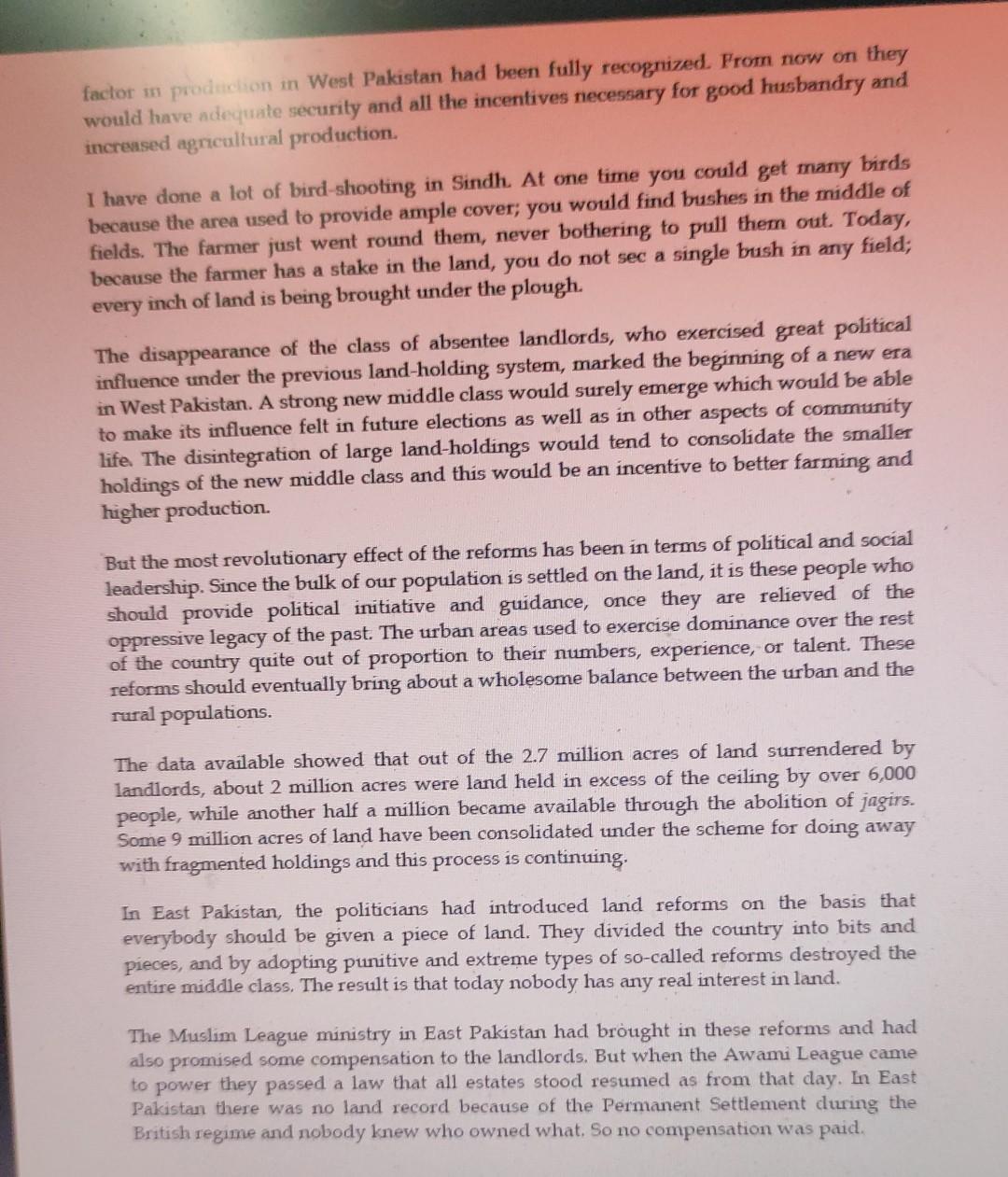
please read this book pages very carefully and write a summary what did you understand and your analysis please don't copy internet it's a request I gave you a vote please do it for me word limit- 1000-1200 thanks
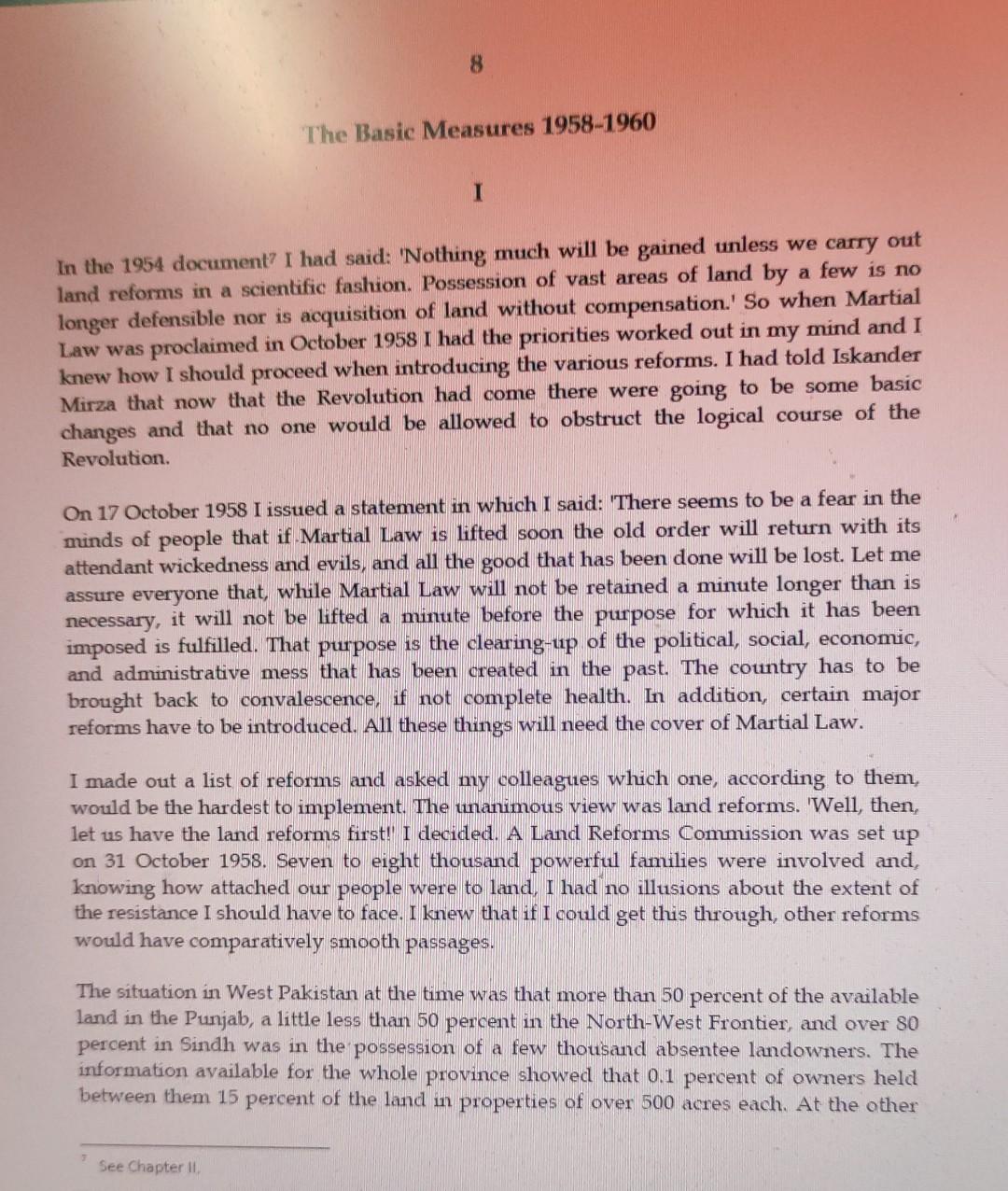
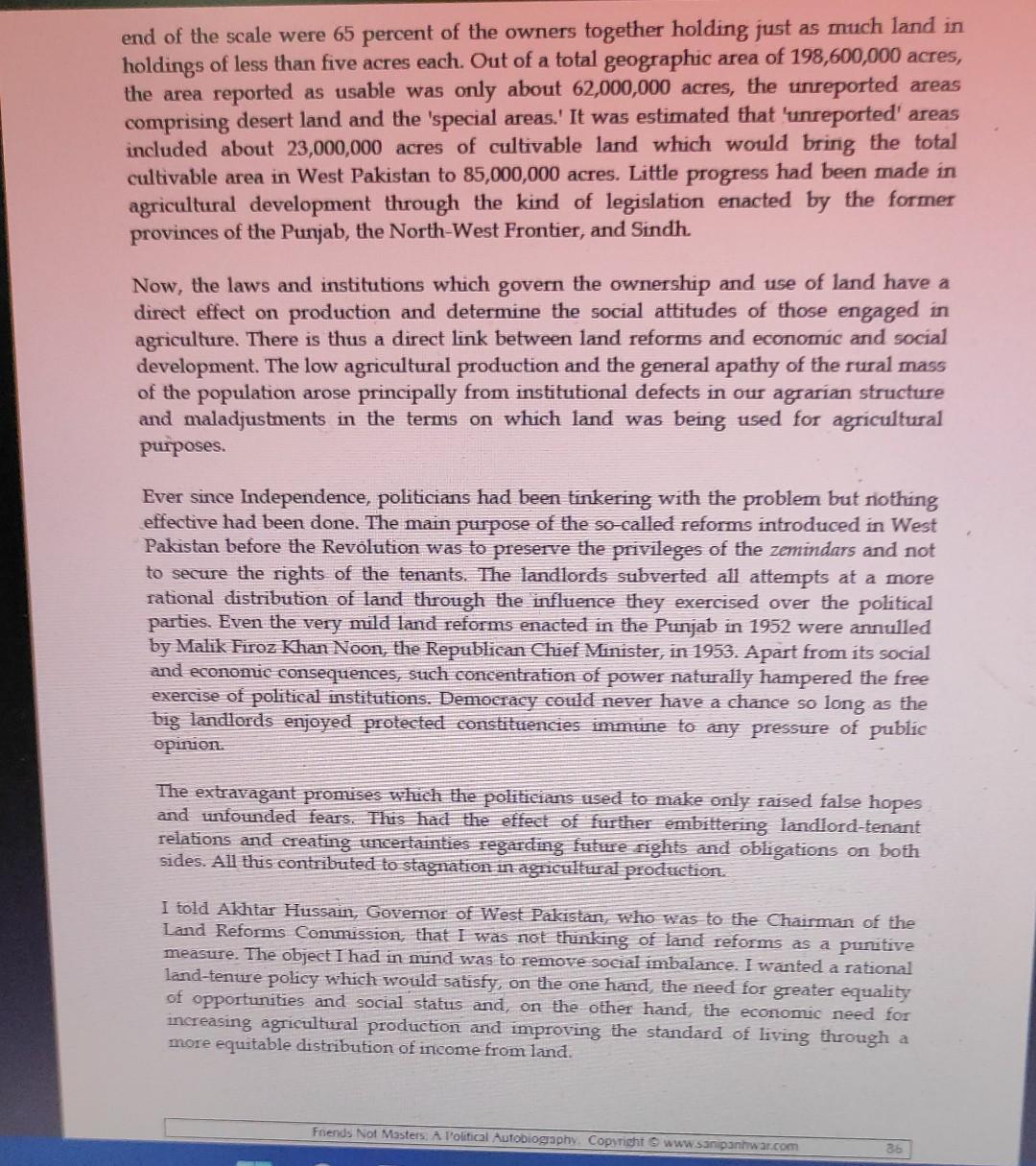
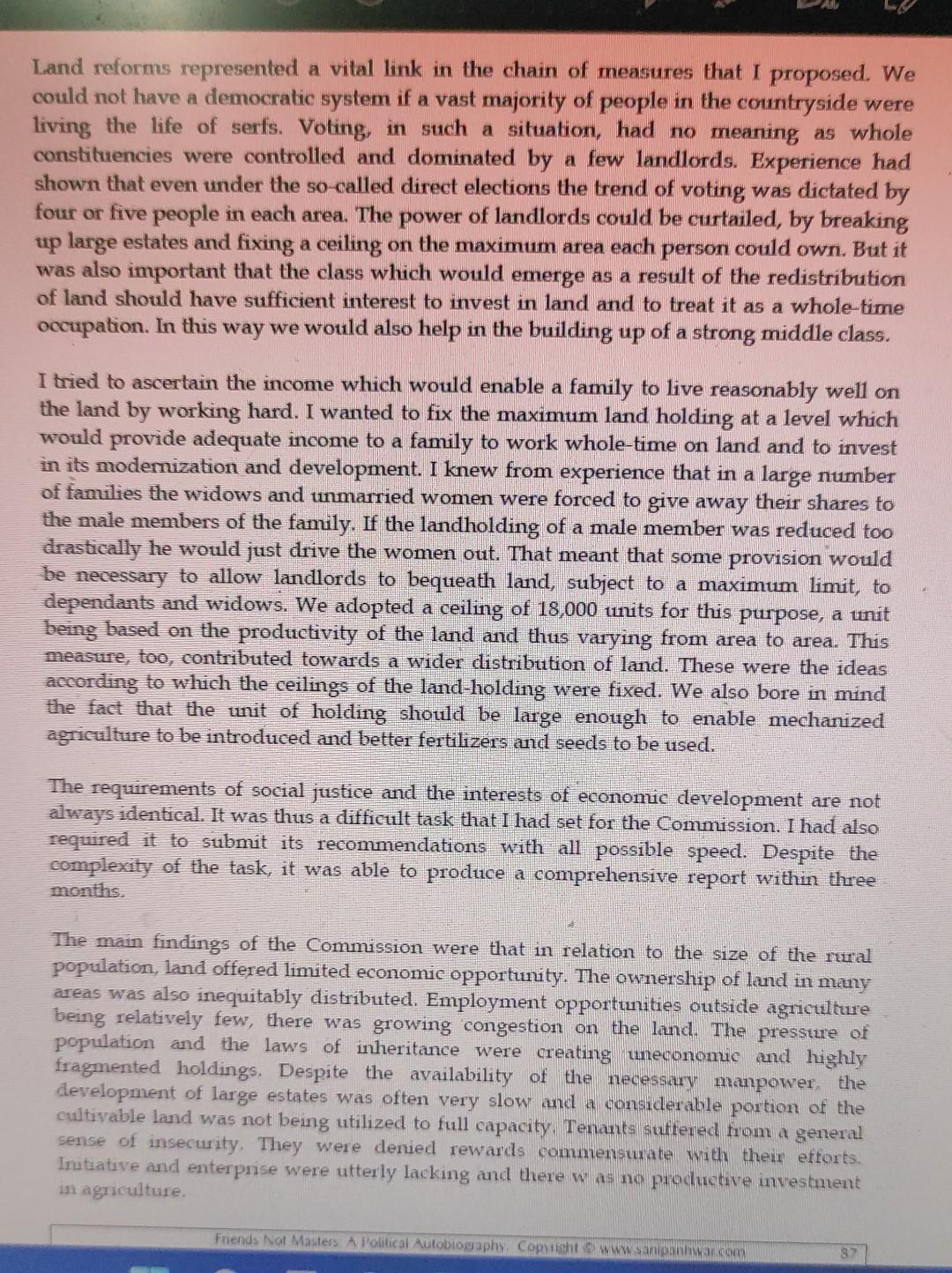
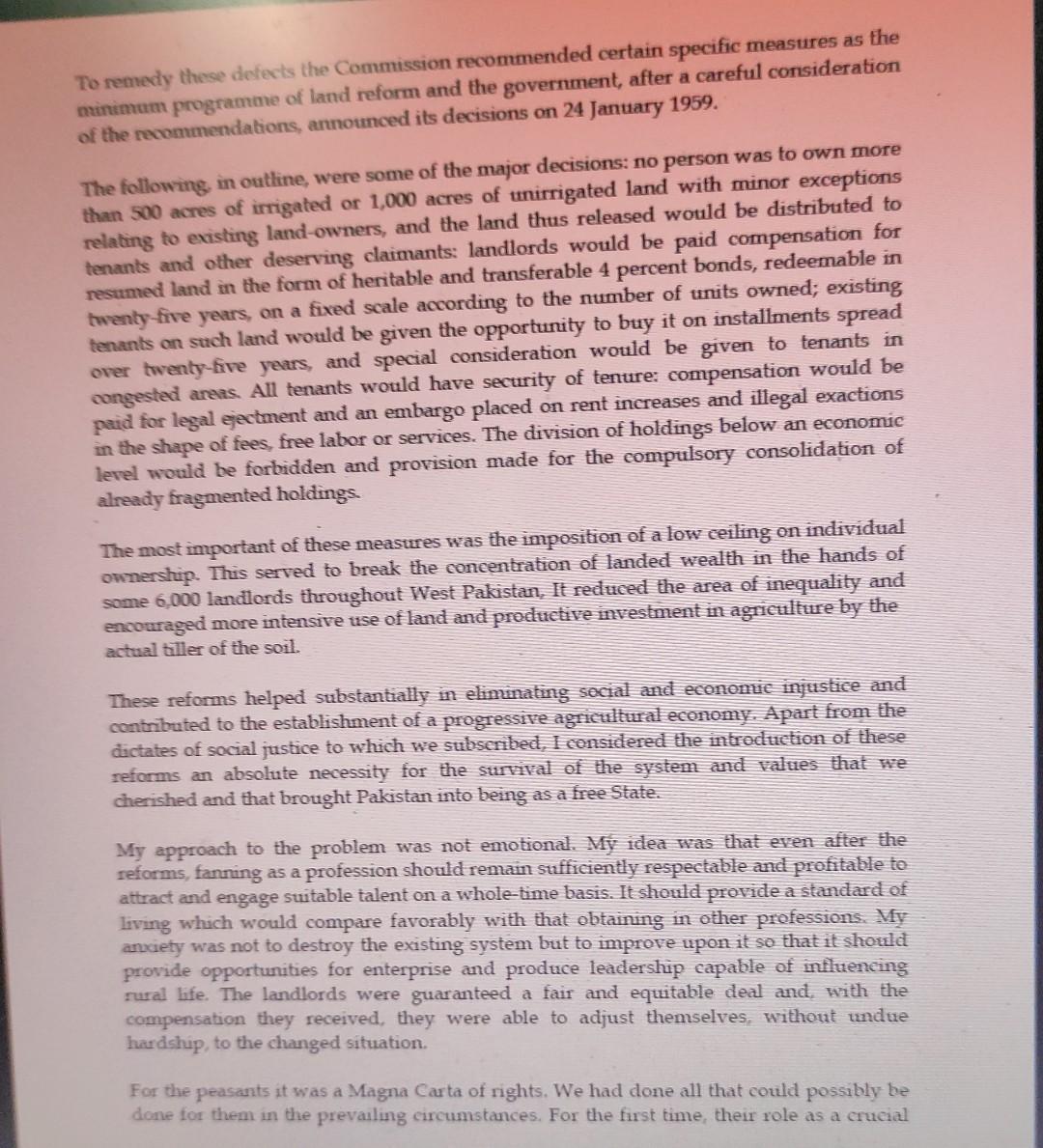
The Basic Measures 1958-1960 In the 1954 document? I had said: 'Nothing much will be gained unless we carry out land reforms in a scientific fashion. Possession of vast areas of land by a few is no longer defensible nor is acquisition of land without compensation.' So when Martial Law was proclaimed in October 1958 I had the priorities worked out in my mind and I knew how I should proceed when introducing the various reforms. I had told Iskander Mirza that now that the Revolution had come there were going to be some basic changes and that no one would be allowed to obstruct the logical course of the Revolution. On 17 October 1958 I issued a statement in which I said: "There seems to be a fear in the minds of people that if.Martial Law is lifted soon the old order will return with its attendant wickedness and evils, and all the good that has been done will be lost. Let me assure everyone that, while Martial Law will not be retained a minute longer than is necessary, it will not be lifted a minute before the purpose for which it has been imposed is fulfilled. That purpose is the clearing-up of the political, social, economic, and administrative mess that has been created in the past. The country has to be brought back to convalescence, if not complete health. In addition, certain major reforms have to be introduced. All these things will need the cover of Martial Law. I made out a list of reforms and asked my colleagues which one, according to them, would be the hardest to implement. The unanimous view was land reforms. 'Well, then, let us have the land reforms first!' I decided. A Land Reforms Commission was set up on 31 October 1958. Seven to eight thousand powerful families were involved and, knowing how attached our people were to land, I had no illusions about the extent of the resistance I should have to face. I knew that if I could get this through, other reforms would have comparatively smooth passages. The situation in West Pakistan at the time was that more than 50 percent of the available land in the Punjab, a little less than 50 percent in the North-West Frontier, and over 80 percent in Sindh was in the possession of a few thousand absentee landowners. The information available for the whole province showed that 0.1 percent of owners held between them 15 percent of the land in properties of over 500 acres each. At the other See Chapter II. end of the scale were 65 percent of the owners together holding just as much land in holdings of less than five acres each. Out of a total geographic area of 198,600,000 acres, the area reported as usable was only about 62,000,000 acres, the unreported areas comprising desert land and the 'special areas.' It was estimated that 'unreported' areas included about 23,000,000 acres of cultivable land which would bring the total cultivable area in West Pakistan to 85,000,000 acres. Little progress had been made in agricultural development through the kind of legislation enacted by the former provinces of the Punjab, the North-West Frontier, and Sindh. Now, the laws and institutions which govern the ownership and use of land have a direct effect on production and determine the social attitudes of those engaged in agriculture. There is thus a direct link between land reforms and economic and social development. The low agricultural production and the general apathy of the rural mass of the population arose principally from institutional defects in our agrarian structure and maladjustments in the terms on which land was being used for agricultural purposes. Ever since Independence, politicians had been tinkering with the problem but riothing effective had been done. The main purpose of the so-called reforms introduced in West Pakistan before the Revolution was to preserve the privileges of the zemindars and not to secure the rights of the tenants. The landlords subverted all attempts at a more rational distribution of land through the influence they exercised over the political parties, Even the very mild land reforms enacted in the Punjab in 1952 were annulled by Malik Firoz Khan Noon, the Republican Chief Minister, in 1953. Apart from its social and economic consequences, such concentration of power naturally hampered the free exercise of political institutions. Demoeracy could never have a chance so long as the big landiords enjoyed protected constituencies immine to any pressure of public opinion. The extravagant promises which the politicians used to make only raised false hopes and unfounded fears. This had the effect of further embittering landlord-tenant relations and ereating uncertainties regarding future-rights and obligations on both sides. All this contributed to stagnation in agricultural production. I told Akhtar Hussain, Governor of West Pakistan, who was to the Chairman of the Land Reforms Commission, that I was not thinking of land reforms as a punitive measure. The object I had in mind was to remove social imbalance. I wanted a rational land-tenure policy which would satisfy, on the one hand, the need for greater equality of opportunities and social status and, on the other hand, the economic need for increasing agricultural productron and improving the standard of living through a more equitable distribution of income from land. Frends Nof Masters. A Volitical Autobiographv. Copurighit 9 wwwanpantwarcom 36 Land reforms represented a vital link in the chain of measures that I proposed. We could not have a democratic system if a vast majority of people in the countryside were living the life of serfs. Voting, in such a situation, had no meaning as whole constituencies were controlled and dominated by a few landlords. Experience had shown that even under the so-called direct elections the trend of voting was dictated by four or five people in each area. The power of landlords could be curtailed, by breaking up large estates and fixing a ceiling on the maximum area each person could own. But it was also important that the class which would emerge as a result of the redistribution of land should have sufficient interest to invest in land and to treat it as a whole-time occupation. In this way we would also help in the building up of a strong middle class. I tried to ascertain the income which would enable a family to live reasonably well on the land by working hard. I wanted to fix the maximum land holding at a level which would provide adequate income to a family to work whole-time on land and to invest in its modemization and development. I knew from experience that in a large number of families the widows and unmarried women were forced to give away their shares to the male members of the family. If the landholding of a male member was reduced too drastically he would just drive the women out. That meant that some provision would be necessary to allow landlords to bequeath land, subject to a maximum limit, to dependants and widows. We adopted a ceiling of 18,000 units for this purpose, a unit being based on the productivity of the land and thus varying from area to area. This measure, too, contributed towards a wider distribution of land. These were the ideas according to which the ceilings of the land-holding were fixed. We also bore in mind the fact that the unit of holding should be large enough to enable mechanized agriculture to be introduced and better fertilizers and seeds to be used. The requirements of social justice and the interests of economic development are not always identical. It was thus a difficult task that I had set for the Commission. I had also required it to submit its recommendations with all possible speed. Despite the complexity of the task, it was able to produce a comprehensive report within three months. The main findings of the Commission were that in relation to the size of the rural population, land offered limited economic opportunity. The ownership of land in many areas was also inequitably distributed. Employment opportunities outside agriculture being relatively few, there was growing congestion on the land. The pressure of population and the laws of inheritance were creating uneconomic and highly fragmented holdings. Despite the availability of the necessary manpower, the development of large estates was often very slow and a considerable portion of the cultivable land was not being utilized to full capacity. Tenants suffered from a general sense of insecurity. They were denied rewards commensurate with their efforts. Initiative and enterprise were utterly lacking and there w as no procluctive investment in agriculture. To remedy these defects the Commission recommended certain specific measures as the minimum programme of land reform and the government, after a careful consideration of the recommendations, anmounced its decisions on 24 January 1959. The following, in outline, were some of the major decisions: no person was to own more than 500 acres of irrigated or 1,000 acres of unirrigated land with minor exceptions relating to existing land-owners, and the land thus released would be distributed to tenants and other deserving claimants: landlords would be paid compensation for resumed land in the form of heritable and transferable 4 percent bonds, redeemable in twenty-five years, on a fixed scale according to the number of units owned; existing tenants on such land would be given the opportunity to buy it on installments spread over twenty-five years, and special consideration would be given to tenants in congested areas. All tenants would have security of tenure: compensation would be paid for legal ejectment and an embargo placed on rent increases and illegal exactions in the shape of fees, free labor or services. The division of holdings below an economic level would be forbidden and provision made for the compulsory consolidation of already fragmented holdings. The most important of these measures was the imposition of a low ceiling on individual ownership. This served to break the concentration of landed wealth in the hands of some 6,000 landlords throughout West Pakistan, It reduced the area of inequality and encouraged more intensive use of land and productive investment in agriculture by the actual tiller of the soil. These reforms helped substantially in eliminating social and economic injustice and contributed to the establishment of a progressive agricultural economy. Apart from the dictates of social justice to which we subseribed, I considered the introduction of these reforms an absolute necessity for the survival of the system and values that we cherished and that brought Pakistan into being as a free State. My approach to the problem was not emotional. My idea was that even after the reforms, fanning as a profession should remain sufficiently respectable and profitable to attract and engage suitable talent on a whole-time basis. It shoutd provide a standard of living which would compare favorably with that obtaining in other professions. My anviety was not to destroy the existing system but to improve upon it so that it should provide opportunities for enterprise and produce leadership capable of influencing rural life. The landlords were guaranteed a fair and equitable deal and, with the compensation they received, they were able to adjust themselves, without undue hardship, to the changed situation. For the peasants it was a Magna Carta of rights. We had done all that could possibly be done for them in the prevailing circumstances. For the first time, their role as a crucial factor m prodiuchon in West Pakistan had been fully recogrized. From now on they would have ndryuate security and all the incentives necessary for good husbandry and increased agreultural production. I have done a lot of bird-shooting in Sindh. At one time you could get many birds because the area used to provide ample cover; you would find bushes in the middle of fields. The farmer just went round them, never bothering to pull them out. Today, because the farmer has a stake in the land, you do not sec a single bush in any field; every inch of land is being brought under the plough. The disappearance of the class of absentee landlords, who exercised great political influence under the previous land-holding system, marked the beginning of a new era in West Pakistan. A strong new middle class would surely emerge which would be able to make its influence felt in future elections as well as in other aspects of community life. The disintegration of large land-holdings would tend to consolidate the smaller holdings of the new middle class and this would be an incentive to better farming and higher production. But the most revolutionary effect of the reforms has been in terms of political and social leadership. Since the bulk of our population is settled on the land, it is these people who should provide political initiative and guidance, once they are relieved of the oppressive legacy of the past. The urban areas used to exercise dominance over the rest of the country quite out of proportion to their numbers, experience, or talent. These reforms should eventually bring about a wholesome balance between the urban and the rural populations. The data available showed that out of the 2.7 million acres of land surrendered by landlords, about 2 million acres were land held in excess of the ceiling by over 6,000 people, while another half a million became available through the abolition of jagirs. Some 9 million acres of land have been consolidated under the scheme for doing away with fragmented holdings and this process is continuing. In East Pakistan, the politicians had introduced land reforms on the basis that everybody should be given a piece of land. They divided the country into bits and pieces, and by adopting punitive and extreme types of so-called reforms destroyed the entire middle class. The result is that today nobody has any real interest in land. The Muslim League ministry in East Pakistan had brought in these reforms and had also promised some compensation to the landlords. But when the Awami League came to power they passed a law that all estates stood resumed as from that day. In East Pakistan there was no land record because of the Permanent Settlement during the British regime and nobody knew who owned what. So no compensation was paidStep by Step Solution
There are 3 Steps involved in it
1 Expert Approved Answer
Step: 1 Unlock

Question Has Been Solved by an Expert!
Get step-by-step solutions from verified subject matter experts
Step: 2 Unlock
Step: 3 Unlock
 Study Help