







Question: Please type out answer and answer fully. 1. What were the strengths of the Mot culture in the early days of operation? To what extent
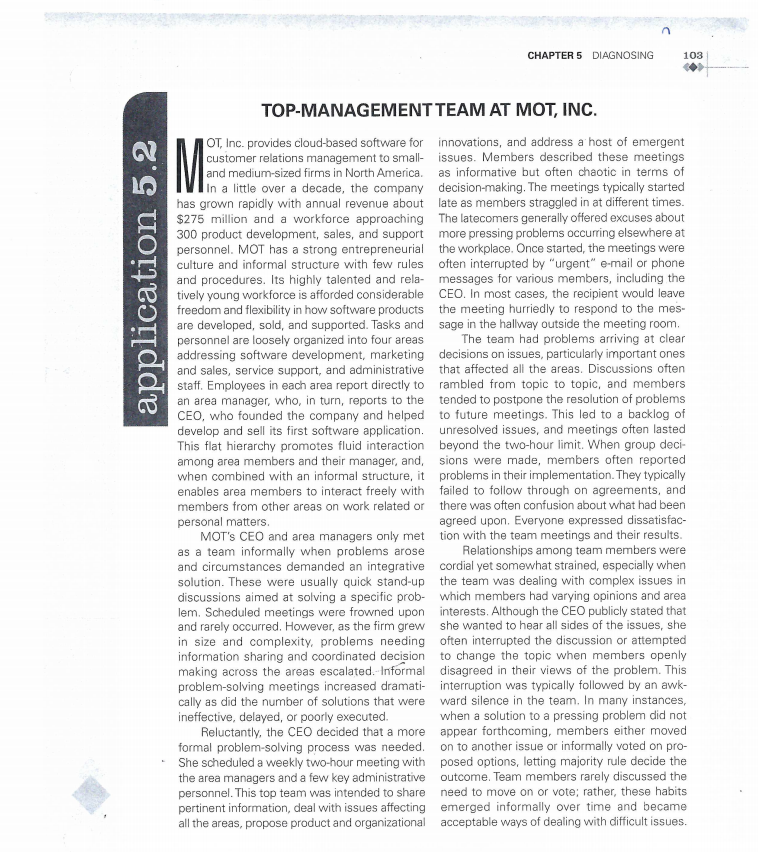 Please type out answer and answer fully.
1. What were the strengths of the Mot culture in the early days of operation? To what extent do these strengths support innovation?
2.How did company growth influence senior management's strategy and operating structure?
3.Using articles from The Innovator's Cookbook evaluate the current level of team members engagement, motivation and creativity.
4. What advice would you offer senior management?
CHAPTER 5 DIAGNOSING 103 TOP-MANAGEMENT TEAM AT MOT, INC. IM application 5.2 OT, Inc. provides cloud-based software for innovations, and address a host of emergent customer relations management to small issues. Members described these meetings and medium-sized firms in North America. as informative but often chaotic in terms of in a little over a decade, the company decision-making. The meetings typically started has grown rapidly with annual revenue about late as members straggled in at different times. $275 million and a workforce approaching The latecomers generally offered excuses about 300 product development, sales, and support more pressing problems occurring elsewhere at personnel. MOT has a strong entrepreneurial the workplace. Once started, the meetings were culture and informal structure with few rules often interrupted by "urgent" e-mail or phone and procedures. Its highly talented and rela messages for various members, including the tively young workforce is afforded considerable CEO. In most cases, the recipient would leave freedom and flexibility in how software products the meeting hurriedly to respond to the mes- are developed, sold, and supported. Tasks and sage in the hallway outside the meeting room personnel are loosely organized into four areas The team had problems arriving at clear addressing software development, marketing decisions on issues, particularly important ones and sales, service support, and administrative that affected all the areas. Discussions often staff. Employees in each area report directly to rambled from topic to topic, and members an area manager, who, in turn, reports to the tended to postpone the resolution of problems CEO, who founded the company and helped to future meetings. This led to a backlog of develop and sell its first software application. unresolved issues, and meetings often lasted This flat hierarchy promotes fluid interaction beyond the two-hour limit. When group deci among area members and their manager, and, sions were made, members often reported when combined with an informal structure, it problems in their implementation. They typically enables area members to interact freely with failed to follow through on agreements, and members from other areas on work related or there was often confusion about what had been personal matters agreed upon. Everyone expressed dissatisfac- MOT'S CEO and area managers only met tion with the team meetings and their results. as a team informally when problems arose Relationships among team members were and circumstances demanded an integrative cordial yet somewhat strained, especially when solution. These were usually quick stand-up the team was dealing with complex issues in discussions aimed at solving a specific prob- which members had varying opinions and area lem. Scheduled meetings were frowned upon interests. Although the CEO publicly stated that and rarely occurred. However, as the firm grew she wanted to hear all sides of the issues, she in size and complexity, problems needing often interrupted the discussion or attempted information sharing and coordinated decision to change the topic when members openly making across the areas escalated. Informal disagreed in their views of the problem. This problem-solving meetings increased dramati- interruption was typically followed by an awk- cally as did the number of solutions that were ward silence in the team. In many instances, ineffective, delayed, or poorly executed. when a solution to a pressing problem did not Reluctantly, the CEO decided that a more appear forthcoming, members either moved formal problem-solving process was needed. on to another issue or informally voted on pro- She scheduled a weekly two-hour meeting with posed options, letting majority rule decide the the area managers and a few key administrative outcome. Team members rarely discussed the personnel. This top team was intended to share need to move on or vote; rather, these habits pertinent information, deal with issues affecting emerged informally over time and became all the areas, propose product and organizational acceptable ways of dealing with difficult issuesStep by Step Solution
There are 3 Steps involved in it
1 Expert Approved Answer
Step: 1 Unlock

Question Has Been Solved by an Expert!
Get step-by-step solutions from verified subject matter experts
Step: 2 Unlock
Step: 3 Unlock
 Study Help