





Question: Please use excel to do this question , and it's all the information and all the file that need to this question. Data Case: IBM

Please use excel to do this question , and it's all the information and all the file that need to this question.
Please use excel to do this question , and it'sPlease use excel to do this question , and it's
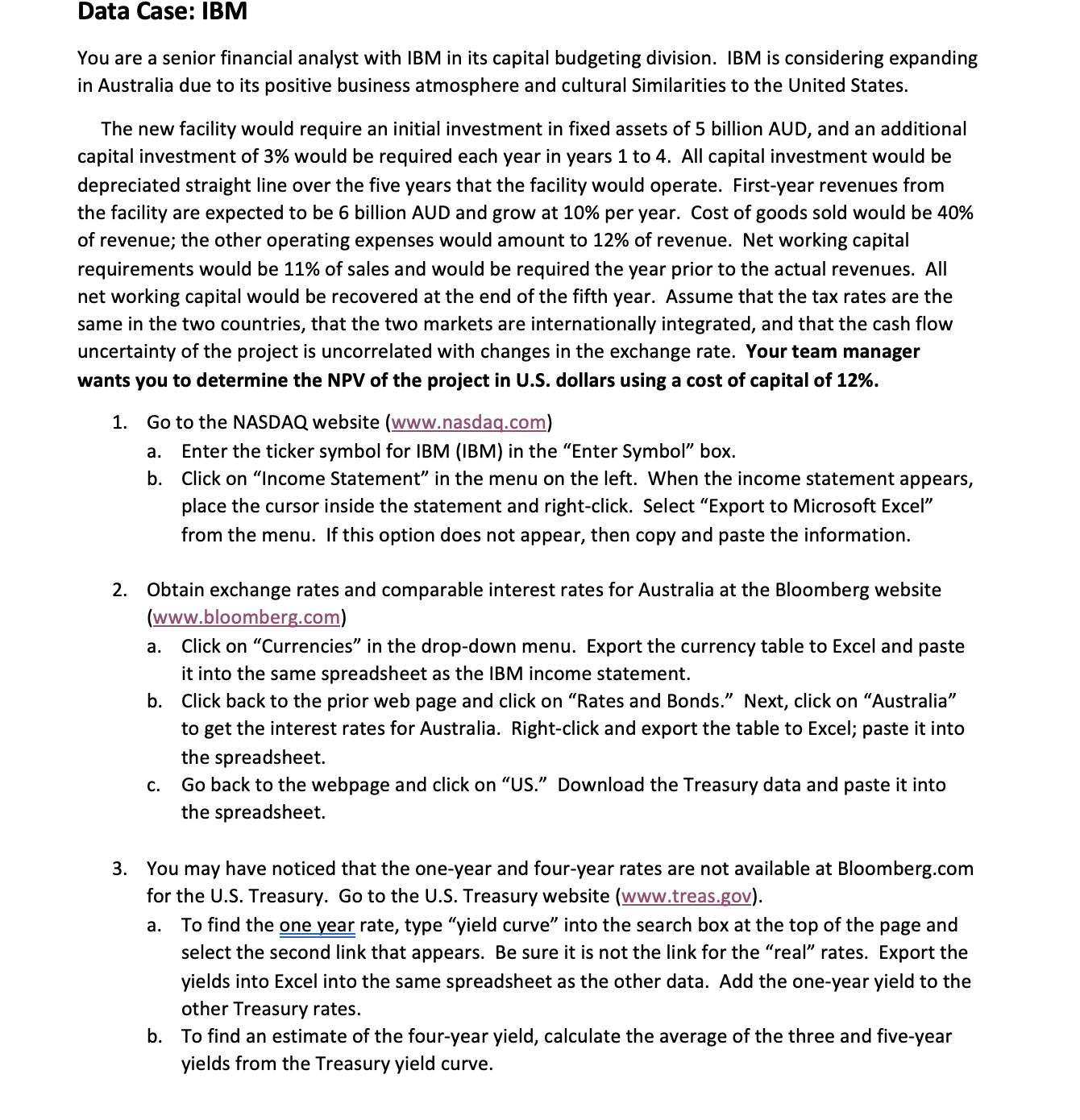
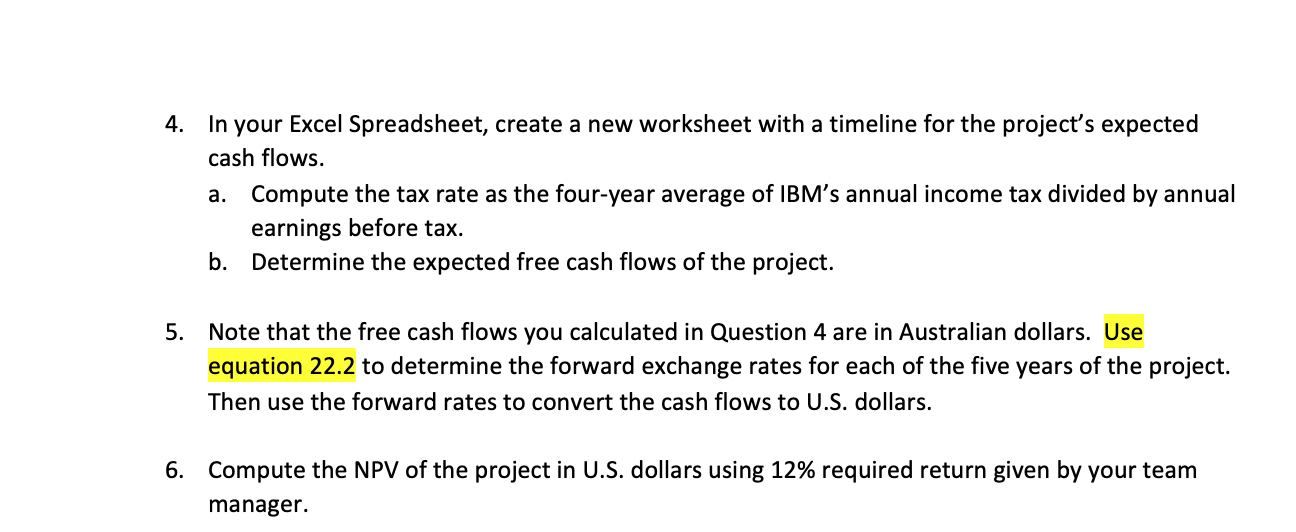
Data Case: IBM You are a senior financial analyst with IBM in its capital budgeting division. IBM is considering expanding in Australia clue to its positive business atmosphere and cultural Similarities to the United States. The new facility would require an initial investment in fixed assets of 5 billion AUD, and an additional capital investment of 3% would be required each year in years 1 to 4. All capital investment would be depreciated straight line over the ve years that the facility would operate. First-year revenues from the facility are expected to be 6 billion AUD and grow at 10% per year. Cost of goods sold would be 40% of revenue; the other operating expenses would amount to 12% of revenue. Net working capital requirements would be 11% of sales and would be required the year prior to the actual revenues. All net working capital would be recovered at the end of the fifth year. Assume that the tax rates are the same in the two countries, that the two markets are internationally integrated, and that the cash flow uncertainty of the project is uncorrelated with changes in the exchange rate. Your team manager wants you to determine the NPV of the project in U.S. dollars using a cost of capital of 12%. 1. Go to the NASDAQ website (www.nasdag.com} a. Enter the ticker symbol for IBM (IBM) in the "Enter Symbol\" box. b. Click on "Income Statement\" in the menu on the left. When the income statement appears, place the cursor inside the statement and right-click. Select \"Export to Microsoft Excel\" from the menu. If this option does not appear, then copy and paste the information. 2. Obtain exchange rates and comparable interest rates for Australia at the Bloomberg website (www.bloomberg.com) a. Click on "Currencies\" in the drop-down menu. Export the currency table to Excel and paste it into the same spreadsheet as the IBM income statement. b. Click back to the prior web page and click on "Rates and Bonds.\" Next, click on "Australia" to get the interest rates for Australia. Right-click and export the table to Excel; paste it into the spreadsheet. c. Go back to the webpage and click on \"US.\" Download the Treasury data and paste it into the spreadsheet. 3. You may have noticed that the one-year and four-year rates are not available at Bloomberg.com for the US. Treasury. Go to the US. Treasury website (www.treas.gov). a. To find the one year rate, type "yield curve\" into the search box at the top of the page and select the second link that appears. Be sure it is not the link for the \"real\" rates. Export the yields into Excel into the same spreadsheet as the other data. Add the one-year yield to the other Treasury rates. b. To find an estimate of the four-year yield, calculate the average of the three and five-year yields from the Treasury yield curve. 4. In your Excel Spreadsheet, create a new worksheet with a timeline for the project's expected cash flows. a. Compute the tax rate as the four-year average of IBM's annual income tax divided by annual earnings before tax. b. Determine the expected free cash flows of the project. Note that the free cash flows you calculated in Question 4 are in Australian dollars. Use equation 22.2 to determine the forward exchange rates for each of the ve years of the project. Then use the forward rates to convert the cash flows to U.S. dollars. Compute the NPV of the project in U.S. dollars using 12% required return given by your team manager

Step by Step Solution

There are 3 Steps involved in it

1 Expert Approved Answer
Step: 1 Unlock blur-text-image

Question Has Been Solved by an Expert!

Get step-by-step solutions from verified subject matter experts

Step: 2 Unlock
Step: 3 Unlock

Students Have Also Explored These Related Finance Questions!