







Question: Please use Java Scientists performing DNA sequence alignment often desire a more parametrized way of aligning two strings than simply computing a longest common subse-
Please use Java
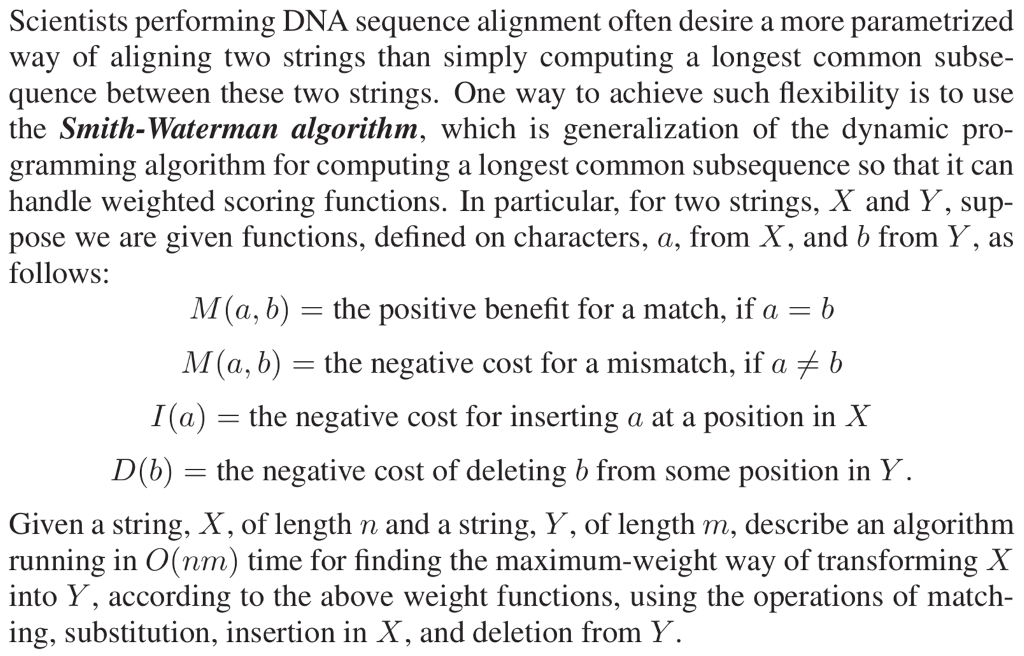
Scientists performing DNA sequence alignment often desire a more parametrized way of aligning two strings than simply computing a longest common subse- quence between these two strings. One way to achieve such flexibility is to use the Smith-Waterman algorithm, which is generalization of the dynamic pro- gramming algorithm for computing a longest common subsequence so that it can handle weighted scoring functions. In particular, for two strings, X and Y, sup.- pose we are given functions, defined on characters, a, from X, and b from Y, as follows: M(a,b) - the positive benefit for a match, if a -b M(a, b) the negative cost for a mismatch, if a b (a) the negative cost for inserting a at a position in X 1 D(b) the negative cost of deleting b from some position in Y Given a string, X, of length n and a string, Y, of length m, describe an algorithm running in O(nm) time for finding the maximum-weight way of transforming X into Y, according to the above weight functions, using the operations of match- ing, substitution, insertion in X, and deletion from Y Scientists performing DNA sequence alignment often desire a more parametrized way of aligning two strings than simply computing a longest common subse- quence between these two strings. One way to achieve such flexibility is to use the Smith-Waterman algorithm, which is generalization of the dynamic pro- gramming algorithm for computing a longest common subsequence so that it can handle weighted scoring functions. In particular, for two strings, X and Y, sup.- pose we are given functions, defined on characters, a, from X, and b from Y, as follows: M(a,b) - the positive benefit for a match, if a -b M(a, b) the negative cost for a mismatch, if a b (a) the negative cost for inserting a at a position in X 1 D(b) the negative cost of deleting b from some position in Y Given a string, X, of length n and a string, Y, of length m, describe an algorithm running in O(nm) time for finding the maximum-weight way of transforming X into Y, according to the above weight functions, using the operations of match- ing, substitution, insertion in X, and deletion from Y
Step by Step Solution
There are 3 Steps involved in it

Get step-by-step solutions from verified subject matter experts
 Study Help