



Question: PLEASE USE MATLAB in the portions that require it! I will make sure to give you a thumbs up:) Now, we will turn our attention
PLEASE USE MATLAB in the portions that require it! I will make sure to give you a thumbs up:)
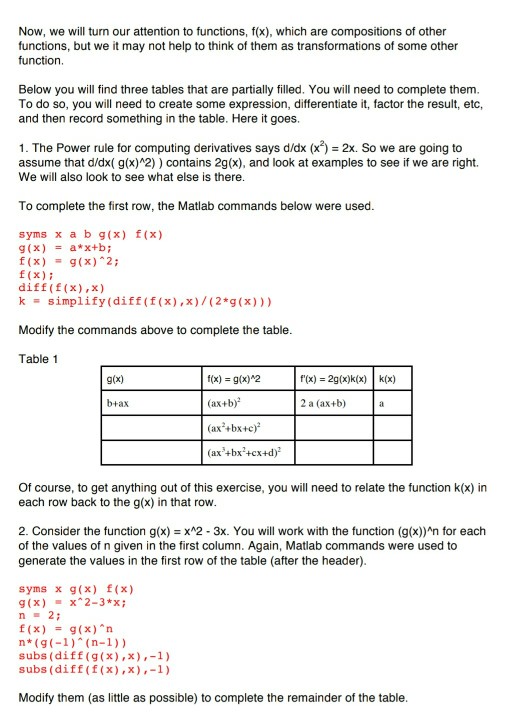
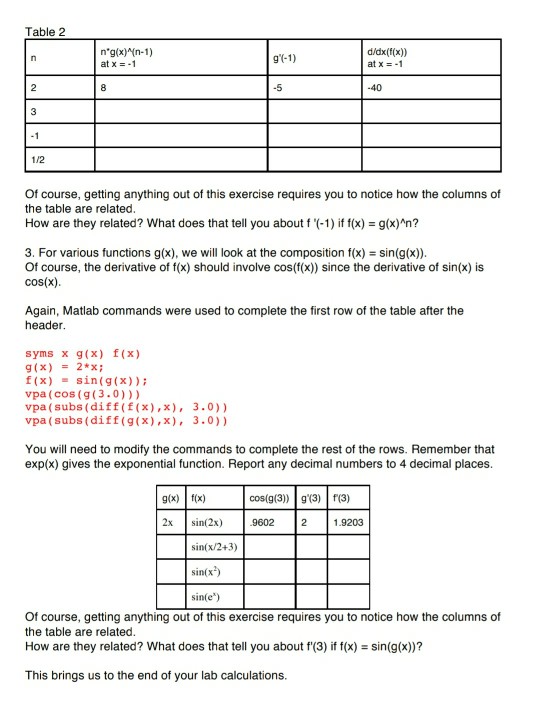
Now, we will turn our attention to functions, f(x), which are compositions of other functions, but we it may not help to think of them as transformations of some other function. Below you will find three tables that are partially filled. You will need to complete them To do so, you will need to create some expression, differentiate it, factor the result, etc, and then record something in the table. Here it goes. 1. The Power rule for computing derivatives says d/dx (x)-2x. So we are going to assume that d/dx( g(x)2)) contains 2g(x), and look at examples to see if we are right. We will also look to see what else is there To complete the first row, the Matlab commands below were used syms x a b g(x) f(x) g(x) a*x+b ; f(x) = g(x)^2; f (x)i diff (f (x) , x) k = simplify ( diff(f(x),x)/(2*g(x))) Modify the commands above to complete the table Table 1 g(x) f(x) = g(x)"2 f'(x) = 2g(x)k(x) k(x) b+ax (ax+b) 2 a (ax+b) (ax+bx+cx+d) Of course, to get anything out of this exercise, you will need to relate the function k(x) in each row back to the g(x) in that row 2. Consider the function g(x) = x^2-3x. You will work with the function (g(x))^n for each of the values of n given in the first column. Again, Matlab commands were used to generate the values in the first row of the table (after the header) syms x g(x) f(x) g(x)x 2-3*x; f(x) = g(x)^n subs(diff(g(x),x),-1) subs (diff (f (x),x),-1) Modify them (as little as possible) to complete the remainder of the table
Step by Step Solution
There are 3 Steps involved in it

Get step-by-step solutions from verified subject matter experts