







Question: 1. Simulate a fair coin toss over 1000 trials Plot the frequency of heads and the frequency of tails per trial. b. Plot the
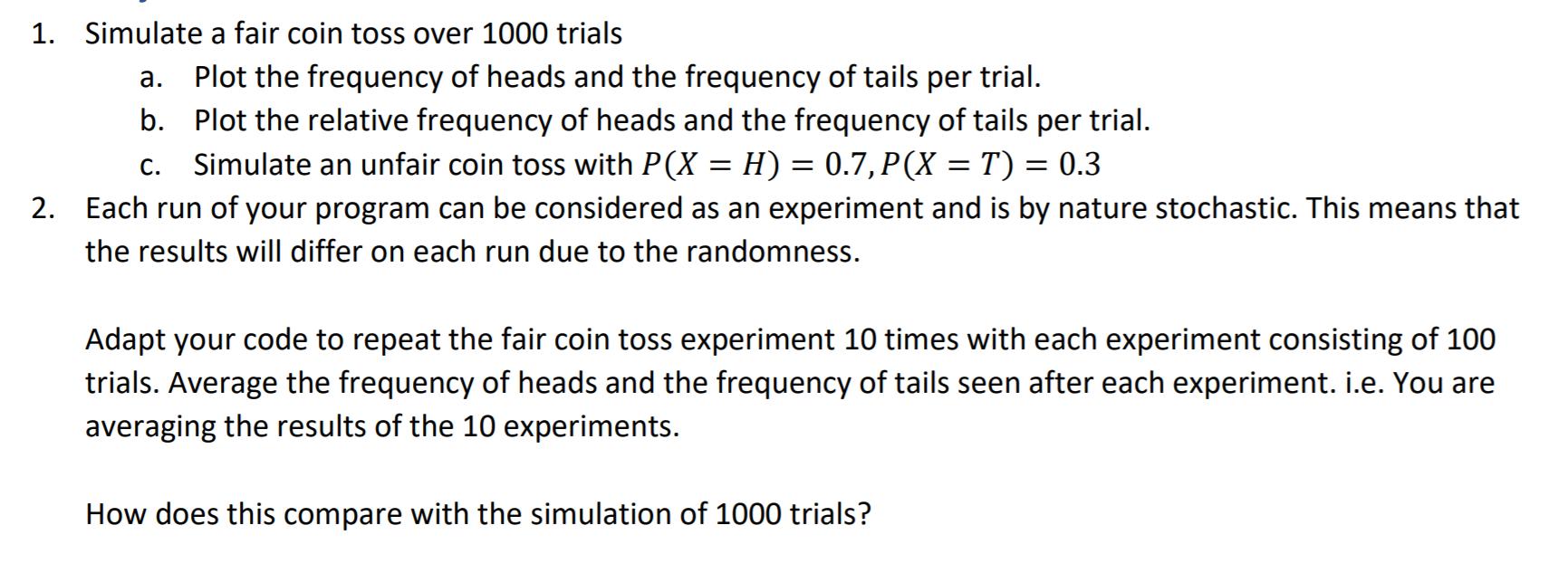
1. Simulate a fair coin toss over 1000 trials Plot the frequency of heads and the frequency of tails per trial. b. Plot the relative frequency of heads and the frequency of tails per trial. c. Simulate an unfair coin toss with P(X = H) = 0.7, P(X = T) = 0.3 . 2. Each run of your program can be considered as an experiment and is by nature stochastic. This means that the results will differ on each run due to the randomness. Adapt your code to repeat the fair coin toss experiment 10 times with each experiment consisting of 100 trials. Average the frequency of heads and the frequency of tails seen after each experiment. i.e. You are averaging the results of the 10 experiments. How does this compare with the simulation of 1000 trials? 1. Simulate a fair coin toss over 1000 trials Plot the frequency of heads and the frequency of tails per trial. b. Plot the relative frequency of heads and the frequency of tails per trial. c. Simulate an unfair coin toss with P(X = H) = 0.7, P(X = T) = 0.3 . 2. Each run of your program can be considered as an experiment and is by nature stochastic. This means that the results will differ on each run due to the randomness. Adapt your code to repeat the fair coin toss experiment 10 times with each experiment consisting of 100 trials. Average the frequency of heads and the frequency of tails seen after each experiment. i.e. You are averaging the results of the 10 experiments. How does this compare with the simulation of 1000 trials? 1. Simulate a fair coin toss over 1000 trials Plot the frequency of heads and the frequency of tails per trial. b. Plot the relative frequency of heads and the frequency of tails per trial. c. Simulate an unfair coin toss with P(X = H) = 0.7, P(X = T) = 0.3 . 2. Each run of your program can be considered as an experiment and is by nature stochastic. This means that the results will differ on each run due to the randomness. Adapt your code to repeat the fair coin toss experiment 10 times with each experiment consisting of 100 trials. Average the frequency of heads and the frequency of tails seen after each experiment. i.e. You are averaging the results of the 10 experiments. How does this compare with the simulation of 1000 trials?
Step by Step Solution
3.35 Rating (155 Votes )
There are 3 Steps involved in it
To solve this problem you would typically use a programming language like Python Heres a stepbystep approach Step 1 Simulate a Fair Coin Toss over 100... View full answer

Get step-by-step solutions from verified subject matter experts
 Study Help