







Question: Please use MATLAB to solve this problem 5. (25 points) The Reynolds # for a fluid flowing in a pipe is given by the equation:
Please use MATLAB to solve this problem
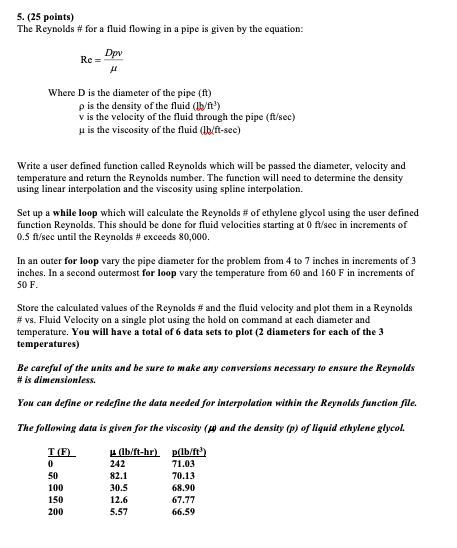
5. (25 points) The Reynolds # for a fluid flowing in a pipe is given by the equation: Dpv Re Where D is the diameter of the pipe (f) p is the density of the fluid (lt) v is the velocity of the fluid through the pipe (ft/sec) u is the viscosity of the fluid (lb/ft-sec) Write a user defined function called Reynolds which will be passed the diameter, velocity and temperature and return the Reynolds number. The function will need to determine the density using linear interpolation and the viscosity using spline interpolation. Set up a while loop which will calculate the Reynolds # of ethylene glycol using the user defined function Reynolds. This should be done for fluid velocities starting at O ft/sec in increments of 0.5 ft/sec until the Reynolds # exceeds 80,000. In an outer for loop vary the pipe diameter for the problem from 4 to 7 inches in increments of 3 inches. In a second outermost for loop vary the temperature from 60 and 160 F in increments of SO F. Store the calculated values of the Reynolds # and the fluid velocity and plot them in a Reynolds # vs. Fluid Velocity on a single plot using the hold on command at each diameter and temperature. You will have a total of 6 data sets to plot (2 diameters for each of the 3 temperatures) Be careful of the units and be sure to make any conversions necessary to ensure the Reynolds # is dimensionless. You can define or redefine the data needed for interpolation within the Reynolds function file. . The following data is given for the viscosity (W) and the density (p) of liquid ethylene glycol. T(F) (lb/ft-hr) P(lb/ft!) 242 71.03 82.1 70.13 0 50 100 150 200 30.5 12.6 5.57 68.90 67.77 66.59
Step by Step Solution
There are 3 Steps involved in it

Get step-by-step solutions from verified subject matter experts
 Study Help