







Question: Problem #1 (10 points) Modeling liquid flow through a pipe involves a number of interrelated calculations based on the size of the system and the
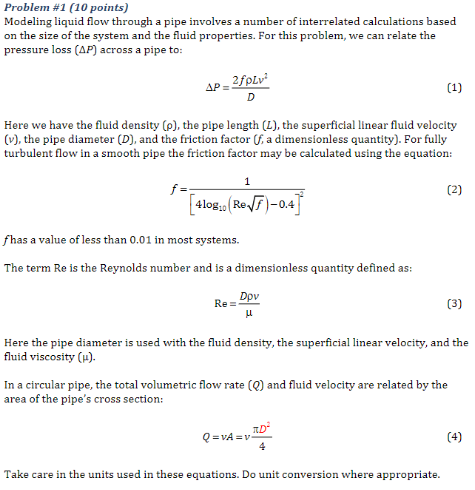
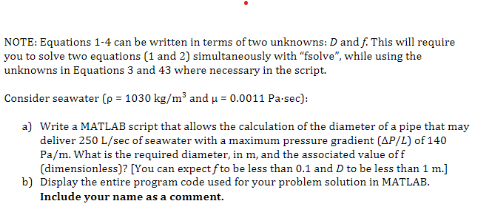
Problem #1 (10 points) Modeling liquid flow through a pipe involves a number of interrelated calculations based on the size of the system and the fluid properties. For this problem, we can relate the pressure loss (AP) across a pipe to: AP=2fp.v2 (1) D Here we have the fluid density (e), the pipe length (L), the superficial linear fluid velocity (v), the pipe diameter (D), and the friction factor (f, a dimensionless quantity). For fully turbulent flow in a smooth pipe the friction factor may be calculated using the equation: 1 f= (2) [4109:0(Re/F)-0.41 fhas a value of less than 0.01 in most systems. The term Re is the Reynolds number and is a dimensionless quantity defined as: Dpv Re= u (3) Here the pipe diameter is used with the fluid density, the superficial linear velocity, and the fluid viscosity (1) In a circular pipe, the total volumetric flow rate () and fluid velocity are related by the area of the pipe's cross section: Q = VAEV AD (4) Take care in the units used in these equations. Do unit conversion where appropriate. NOTE: Equations 1-4 can be written in terms of two unknowns: D and f. This will require you to solve two equations (1 and 2) simultaneously with "fsolve", while using the unknowns in Equations 3 and 43 where necessary in the script. Consider seawater (p = 1030 kg/m and u = 0.0011 Pa.sec): a) Write a MATLAB script that allows the calculation of the diameter of a pipe that may deliver 250 L/sec of seawater with a maximum pressure gradient (AP/L) of 140 Pa/m. What is the required diameter, in m, and the associated value off (dimensionless)? [You can expect fto be less than 0.1 and D to be less than 1 m.] b) Display the entire program code used for your problem solution in MATLAB. Include your name as a comment
Step by Step Solution
There are 3 Steps involved in it

Get step-by-step solutions from verified subject matter experts
 Study Help