





Question: Please use Program R studio and show code, I would like to compare mine for bugs. Data is from the book Introductory Econometrics A modern
Please use Program R studio and show code, IPlease use Program R studio and show code, I would like to compare mine for bugs. Data is from the book Introductory Econometrics A modern approach 7th edition by Jeffery M. Wooldridge.

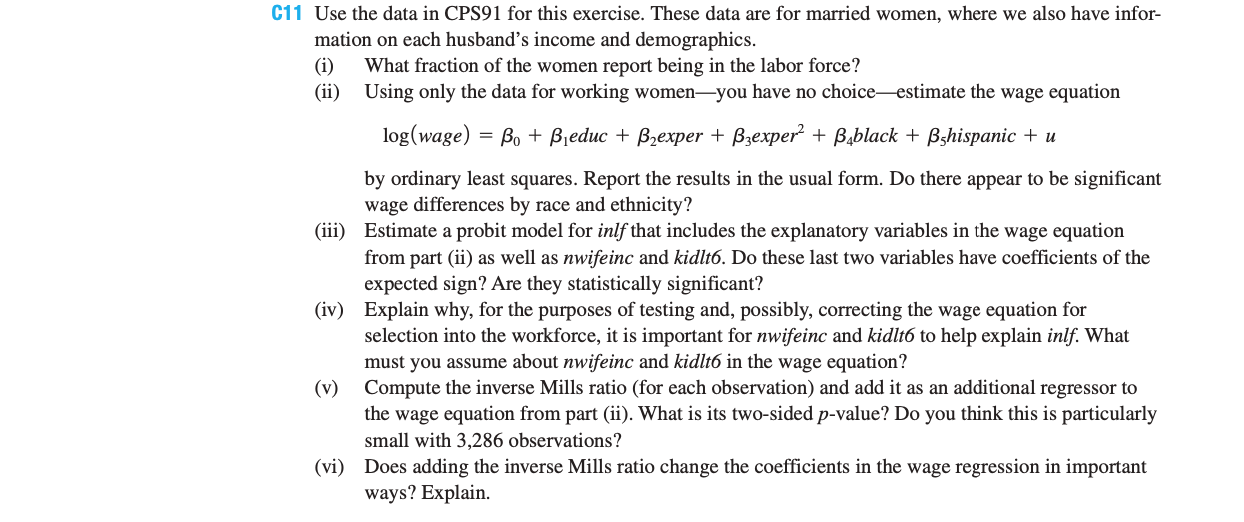
C11 Use the data in CPS91 for this exercise. These data are for married women, where we also have infor- mation on each husband's income and demographics. (i) What fraction of the women report being in the labor force? (ii) Using only the data for working womenyou have no choiceestimate the wage equation log(wage) = Bo + Bieduc + B2exper + Bzexper2 + B black + Bshispanic + u by ordinary least squares. Report the results in the usual form. Do there appear to be significant wage differences by race and ethnicity? (iii) Estimate a probit model for inlf that includes the explanatory variables in the wage equation from part (ii) as well as nwifeinc and kidlto. Do these last two variables have coefficients of the expected sign? Are they statistically significant? (iv) Explain why, for the purposes of testing and, possibly, correcting the wage equation for selection into the workforce, it is important for nwifeinc and kidlt6 to help explain inlf. What must you assume about nwifeinc and kidlto in the wage equation? Compute the inverse Mills ratio (for each observation) and add it as an additional regressor to the wage equation from part (ii). What is its two-sided p-value? Do you think this is particularly small with 3,286 observations? (vi) Does adding the inverse Mills ratio change the coefficients in the wage regression in important ways? Explain. (v) C11 Use the data in CPS91 for this exercise. These data are for married women, where we also have infor- mation on each husband's income and demographics. (i) What fraction of the women report being in the labor force? (ii) Using only the data for working womenyou have no choiceestimate the wage equation log(wage) = Bo + Bieduc + B2exper + Bzexper2 + B black + Bshispanic + u by ordinary least squares. Report the results in the usual form. Do there appear to be significant wage differences by race and ethnicity? (iii) Estimate a probit model for inlf that includes the explanatory variables in the wage equation from part (ii) as well as nwifeinc and kidlto. Do these last two variables have coefficients of the expected sign? Are they statistically significant? (iv) Explain why, for the purposes of testing and, possibly, correcting the wage equation for selection into the workforce, it is important for nwifeinc and kidlt6 to help explain inlf. What must you assume about nwifeinc and kidlto in the wage equation? Compute the inverse Mills ratio (for each observation) and add it as an additional regressor to the wage equation from part (ii). What is its two-sided p-value? Do you think this is particularly small with 3,286 observations? (vi) Does adding the inverse Mills ratio change the coefficients in the wage regression in important ways? Explain. (v)

Step by Step Solution

There are 3 Steps involved in it

1 Expert Approved Answer
Step: 1 Unlock blur-text-image

Question Has Been Solved by an Expert!

Get step-by-step solutions from verified subject matter experts

Step: 2 Unlock
Step: 3 Unlock

Students Have Also Explored These Related General Management Questions!