







Question: Please use Python 2.4. Write a routine for estimating the condition number of a matrix A. You may use either the 1-norm or the -norm
Please use Python
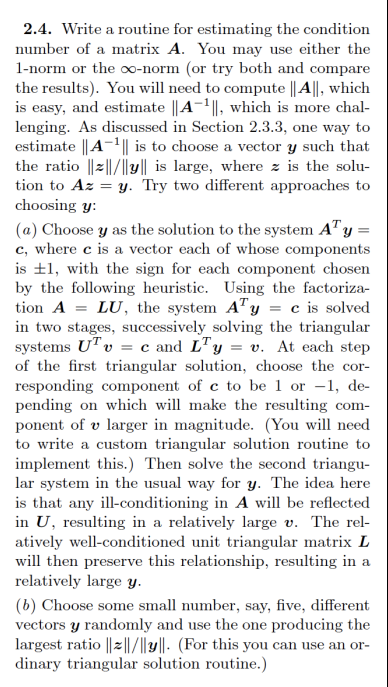
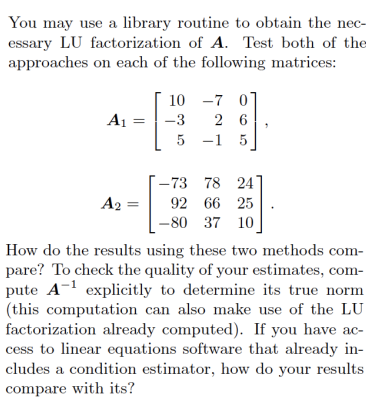
2.4. Write a routine for estimating the condition number of a matrix A. You may use either the 1-norm or the -norm (or try both and compare the results). You will need to compute A, which is easy, and estimate A1, which is more challenging. As discussed in Section 2.3.3, one way to estimate A1 is to choose a vector y such that the ratio z/y is large, where z is the solution to Az=y. Try two different approaches to choosing y : (a) Choose y as the solution to the system ATy= c, where c is a vector each of whose components is \pm 1 , with the sign for each component chosen by the following heuristic. Using the factorization A=LU, the system ATy=c is solved in two stages, successively solving the triangular systems UTv=c and LTy=v. At each step of the first triangular solution, choose the corresponding component of c to be 1 or -1 , depending on which will make the resulting component of v larger in magnitude. (You will need to write a custom triangular solution routine to implement this.) Then solve the second triangular system in the usual way for y. The idea here is that any ill-conditioning in A will be reflected in U, resulting in a relatively large v. The relatively well-conditioned unit triangular matrix L will then preserve this relationship, resulting in a relatively large y. (b) Choose some small number, say, five, different vectors y randomly and use the one producing the largest ratio z/y. (For this you can use an ordinary triangular solution routine.) You may use a library routine to obtain the necessary LU factorization of A. Test both of the approaches on each of the following matrices: A1=1035721065,A2=739280786637242510. How do the results using these two methods compare? To check the quality of your estimates, compute A1 explicitly to determine its true norm (this computation can also make use of the LU factorization already computed). If you have access to linear equations software that already includes a condition estimator, how do your results compare with its
Step by Step Solution
There are 3 Steps involved in it

Get step-by-step solutions from verified subject matter experts
 Study Help