







Question: please use python and # to explain what you are doing. please be aware there are hidden test all these photos are apart of the
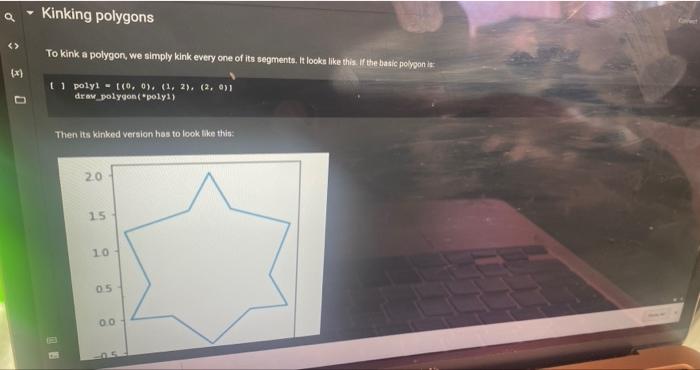
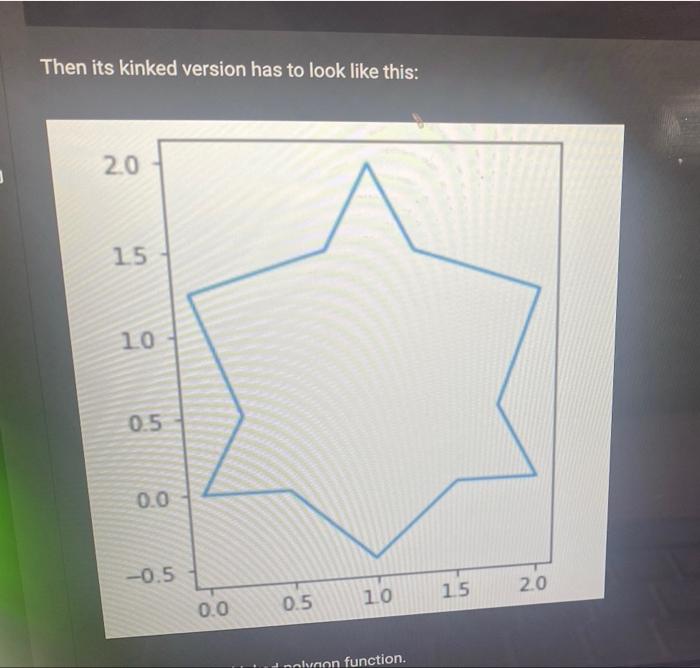
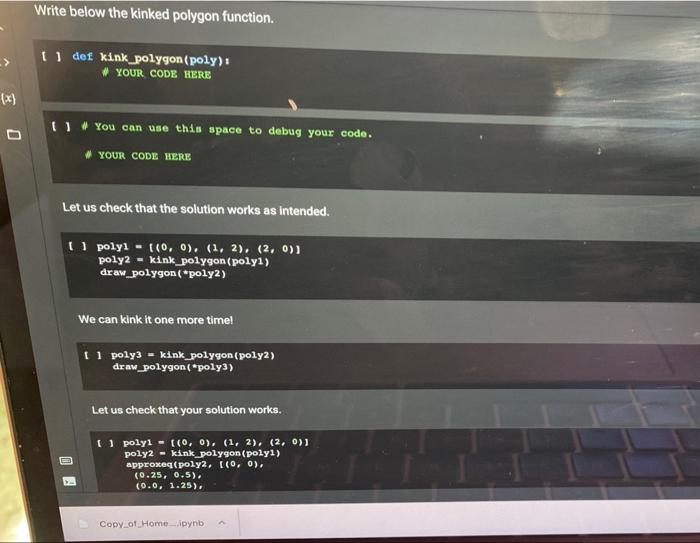
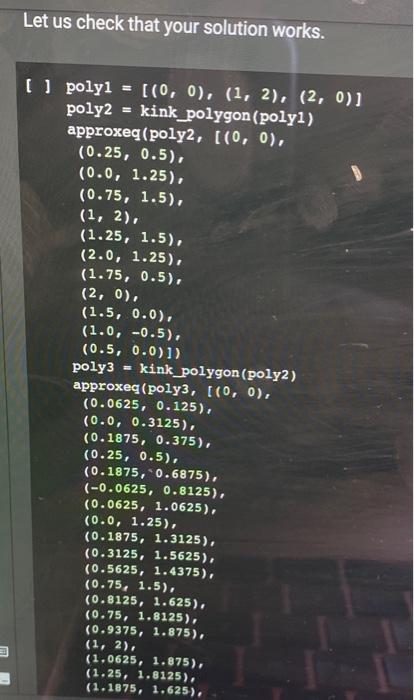
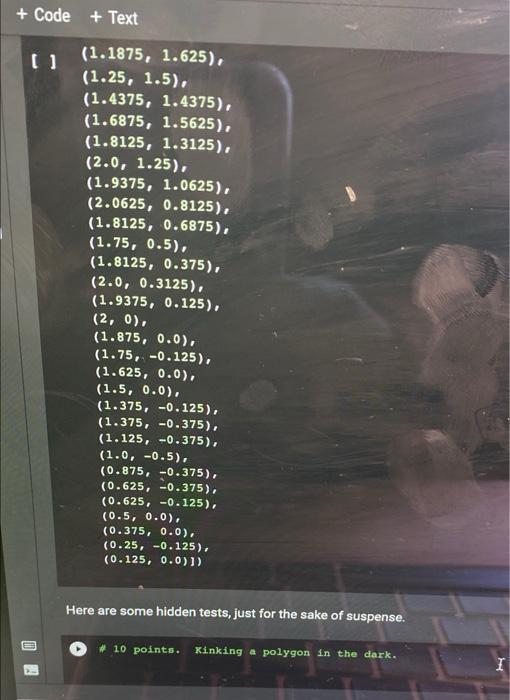
o Kinking polygons x) To kink a polygon, we simply klink every one of its segments. It looks like this. If the basic polypon is polyl - to... (1, 2), (2. oyi draw_polygon( poly) o Then its kinked version has to look like this: 20 15 10 05 00 Then its kinked version has to look like this: 20 15 10 0.5 0.0 -0.5 1.5 2.0 10 0.5 0.0 on function. Write below the kinked polygon function. U def kink_polygon (poly) YOUR CODE HERE (x) 0 0 0 You can use this space to debug your code. YOUR CODE HERE Let us check that the solution works as intended. u polyi - f(0, 0), (1, 2), (2, 0) poly2 - kink_polygon (polyi) draw_polygon(*poly) We can kink it one more time! poly3 - kink_polygon (poly) draw_polygon( *poly3) Let us check that your solution works. # D A polyl-((0, 0), (1, 2), (2, 0)) poly2 - kink polygon (polyi) approxeq(poly2. f(0, 0). (0.25, 0.5). (0.0, 1.25). Copy of Home_ipynb Let us check that your solution works. U polyi = [(0, 0), (1, 2), (2, 0)) poly2 = kink_polygon (polyl) approxeg(poly2, [(0, 0), (0.25, 0.5), (0.0, 1.25), (0.75, 1.5), (1, 2), (1.25, 1.5), (2.0, 1.25), (1.75, 0.5), (2, 0), (1.5, 0.0), (1.0, -0.5), (0.5, 0.01) poly3 kink_polygon (poly2) approxeg (poly3, [(0, 0), (0.0625, 0.125), (0.0, 0.3125), (0.1875, 0.375), (0.25, 0.5), (0.1875, 0.6875), (-0.0625, 0.8125), (0.0625, 1.0625), (0.0, 1.25), (0.1875, 1.3125), (0.3125, 1.5625), (0.5625, 1.4375), (0.75, 1.5), (0.8125, 1.625), (0.75, 1.8125), (0.9375, 1.875), (1, 2), (1.0625, 1.875), (1.25, 1.8125), (1.1875, 1.625), + Code + Text (1.1875, 1.625), (1.25, 1.5), (1.4375, 1.4375), (1.6875, 1.5625), (1.8125, 1.3125), (2.0, 1.25), (1.9375, 1.0625), (2.0625, 0.8125), (1.8125, 0.6875), (1.75, 0.5), (1.8125, 0.375), (2.0, 0.3125), (1.9375, 0.125), (2, 0), (1.875, 0.0), (1.75, -0.125), (1.625, 0.0), (1.5, 0.0), (1.375, -0.125), (1.375, -0.375), (1.125, -0.375), (1.0, -0.5), (0.875, -0.375), (0.625, -0.375), (0.625, -0.125), (0.5, 0.0), (0.375, 0.0), (0.25, -0.125). (0.125, 0.0))) Here are some hidden tests, just for the sake of suspense. 10 points. Kinking a polygon in the dark
Step by Step Solution
There are 3 Steps involved in it

Get step-by-step solutions from verified subject matter experts
 Study Help