







Question: Please use the Answer sheet A quality inspector took five samples, each with four observations (n = 4), of the length of time for glue
Please use the Answer sheet 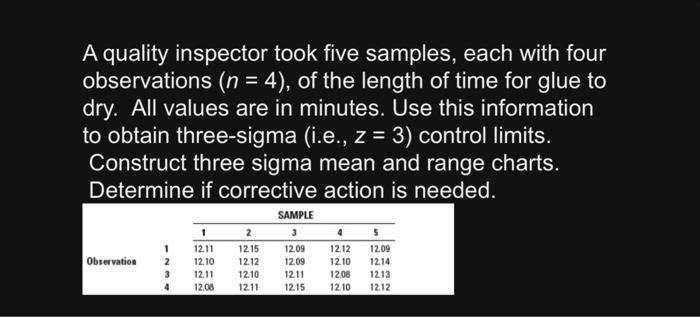
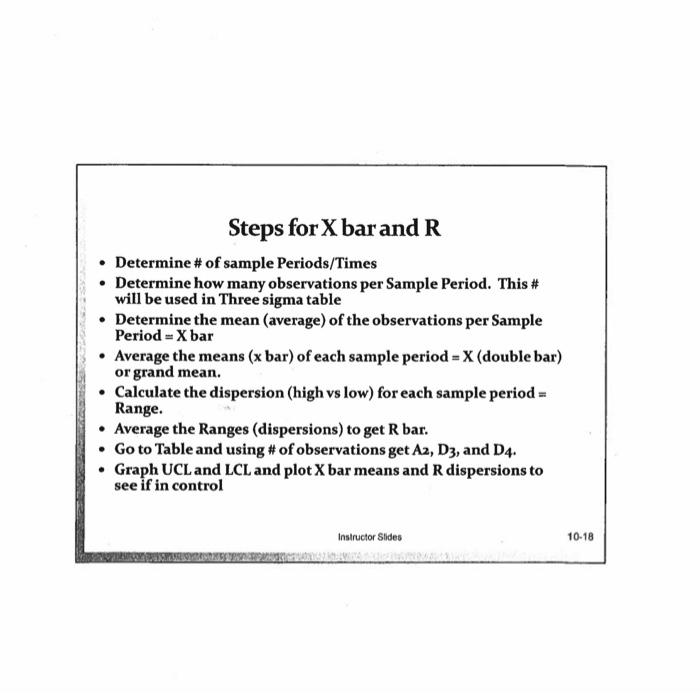
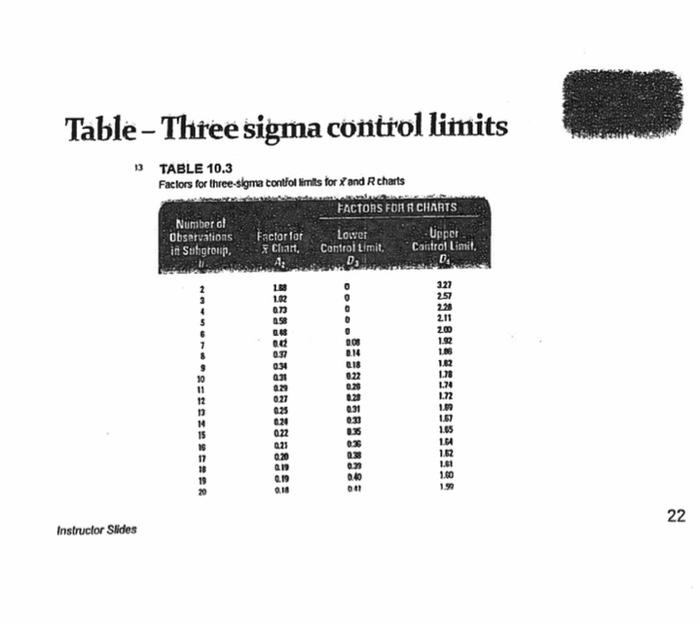
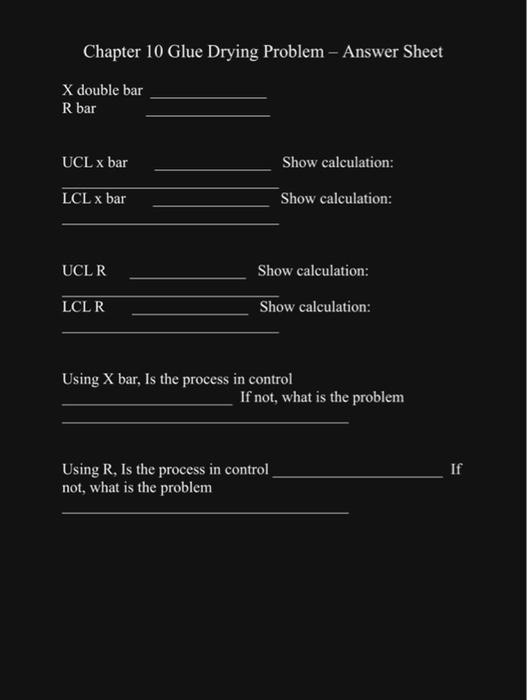
A quality inspector took five samples, each with four observations (n = 4), of the length of time for glue to dry. All values are in minutes. Use this information to obtain three-sigma (i.e., z = 3) control limits. Construct three sigma mean and range charts. Determine if corrective action is needed. 1 Observation 2 3 4 1 12.11 12.10 12.11 12.08 2 12.15 12.12 12.10 12.11 SAMPLE 3 12.09 12.09 12.11 12.15 4 5 12.12 12.09 12.10 12.14 12.08 12.13 12.10 12.12 Steps for X bar and R Determine # of sample Periods/Times Determine how many observations per Sample Period. This # will be used in Three sigma table Determine the mean (average) of the observations per Sample Period = X bar Average the means (x bar) of each sample period = X (double bar) or grand mean. Calculate the dispersion (high vs low) for each sample period= Range. Average the Ranges (dispersions) to get R bar. . Go to Table and using # of observations get Az, D3, and D4. Graph UCL and LCL and plot X bar means and R dispersions to see if in control NESTING Instructor Slides AUTOKLGERINGSTER IN MALUSO 10-18 Table-Three sigma control limits 13 TABLE 10.3 Factors for three-sigma control limits for and R charts Instructor Slides Number of Observations in Sungrolip, REFRENRERES 10 12 13 14 16 Factor for Chart, 1.02 0.73 0.58 0.48 0.42 0.37 0.34 0.31 0.29 0.27 0.25 0.20 0.22 0.21 0.20 0.19 0.19 0.18 FACTORS FOR R CHARTS Lower Upper Control Limit, Control Limit, DawSPIDER D 200 0.14 0.18 0.22 0.20 0.28 0.31 0.33 0.35 0.36 0.39 0.39 0.40 041 327 2.57 2.28 2.11 2.00 1.92 1.06 1.82 1.78 1.74 1.72 1.09 1.67 1.05 1.54 1.62 1.61 1.00 1.50 22 Chapter 10 Glue Drying Problem - Answer Sheet X double bar R bar UCL x bar LCL x bar UCL R LCL R Show calculation: Show calculation: Show calculation: Show calculation: Using X bar, Is the process in control Using R, Is the process in control not, what is the problem If not, what is the problem If Step by Step Solution
There are 3 Steps involved in it
1 Expert Approved Answer
Step: 1 Unlock

Question Has Been Solved by an Expert!
Get step-by-step solutions from verified subject matter experts
Step: 2 Unlock
Step: 3 Unlock
 Study Help