Question: please write a summary (at least 4 sentences) explaining Zinssers main points in this section of the book. Then, find one or two quotes that
please write a summary (at least 4 sentences) explaining Zinssers main points in this section of the book. Then, find one or two quotes that stood out to you as particularly important writing advice and directly transcribe them into your response. Follow your quote(s) with an explanation of what you think it means and how you plan to apply this advice to your own writing. Your answer should be specific and detailed, and you should demonstrate that you have closely read the material. thank you!
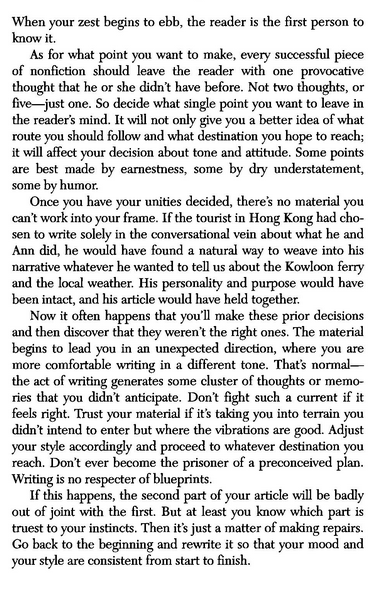
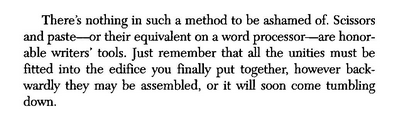
Unity You learn to write by writing. It's a truism, but what makes it a truism is that it's true. The only way to learn to write is to force yourself to produce a certain number of words on a regular basis. If you went to work for a newspaper that required you to write two or three articles every day, you would be a better writer after six months. You wouldn't necessarily be writing wellyour style might still be full of clutter and clichs. But you would be exercising your powers of putting the English lan- guage on paper, gaining confidence and identifying the most common problems. All writing is ultimately a question of solving a problem. It may be a problem of where to obtain the facts or how to orga- nize the material. It may be a problem of approach or attitude, tone or style. Whatever it is, it has to be confronted and solved. Sometimes you will despair of finding the right solution-or any solution. You'll think, "If I live to be ninety I'll never get out of this mess." I've often thought it myself. But when I finally do solve the problem it's because I'm like a surgeon removing his 500th appendix; I've been there before. Unity is the anchor of good writing. So, first, get your uni- ties straight. Unity not only keeps the reader from straggling off in all directions; it satisfies the readers' subconscious need for order and reassures them that all is well at the helm. There- fore choose from among the many variables and stick to your choice. One choice is unity of pronoun. Are you going to write in the first person, as a participant, or in the third person, as an observer? Or even in the second person, that darling of sportswriters hung up on Hemingway? ("You knew this had to be the most spine-tingling clash of giants you'd ever seen from a pressbox seat, and you weren't just some green kid who was still wet behind the ears.") Unity of tense is another choice. Most people write mainly in the past tense ("I went up to Boston the other day"), but some people write agreeably in the present ("I'm sitting in the dining car of the Yankee Limited and we're pulling into Boston). What is not agreeable is to switch back and forth. I'm not saying you can't use more than one tense; the whole purpose of tenses is to enable a writer to deal with time in its various gradations, from the past to the hypothetical future ("When I telephoned my mother from the Boston station, I realized that if I had written to tell her I would be coming she would have waited for me). But you must choose the tense in which you are principally going to address the reader, no matter how many glances you may take backward or forward along the way. Another choice is unity of mood. You might want to talk to the reader in the casual voice that The New Yorker has strenu- ously refined. Or you might want to approach the reader with a certain formality to describe a serious event or to present a set of important facts. Both tones are acceptable. In fact, any tone is acceptable. But don't mix two or three. Such fatal mixtures are common in writers who haven't learned control. Travel writing is a conspicuous example. My wife, Ann, and I had always wanted to visit Hong Kong," the writer begins, his blood astir with reminiscence, and one day last spring we found ourselves looking at an airline poster and I said, "Let's go!" The kids were grown up," he continues, and he proceeds to describe in genial detail how he and his wife stopped off in Hawaii and had such a comical time changing their money at the Hong Kong airport and finding their hotel. Fine. He is a real person taking us along on a real trip, and we can identify with him and Ann. Suddenly he turns into a travel brochure. "Hong Kong affords many fascinating experiences to the curious sightseer," he writes. "One can ride the picturesque ferry from Kowloon and gawk at the myriad sampans as they scuttle across the teem- ing harbor, or take a day's trip to browse in the alleys of fabled Macao with its colorful history as a den of smuggling and intrigue. You will want to take the quaint funicular that climbs..." Then we get back to him and Ann and their efforts to eat at Chinese restaurants, and again all is well. Everyone is interested in food, and we are being told about a personal adventure. Then suddenly the writer is a guidebook: "To enter Hong Kong it is necessary to have a valid passport, but no visa is required. You should definitely be immunized against hepatitis and you would also be well advised to consult your physician with regard to a possible inoculation for typhoid. The climate in Hong Kong is seasonable except in July and August when... Our writer is gone, and so is Ann, and so--very soon-are we. It's not that the scuttling sampans and the hepatitis shots shouldn't be included. What annoys us is that the writer never decided what kind of article he wanted to write or how he wanted to approach us. He comes at us in many guises, depending on what kind of material he is trying to purvey. Instead of controlling his material, his material is controlling him. That wouldn't happen if he took time to establish certain unities. Therefore ask yourself some basic questions before you start. For example: "In what capacity am I going to address the reader?" (Reporter? Provider of information? Average man or woman?) "What pronoun and tense am I going to use?" "What style?" (Impersonal reportorial? Personal but formal? Personal and casual?) "What attitude am I going to take toward the mate- rial?" (Involved? Detached? Judgmental? Ironic? Amused?) "How much do I want to cover?" "What one point do I want to make?" The last two questions are especially important. Most nonfic- tion writers have a definitiveness complex. They feel that they are under some obligation to the subject, to their honor, to the gods of writing to make their article the last word. It's a com- mendable impulse, but there is no last word. What you think is definitive today will turn undefinitive by tonight, and writers who doggedly pursue every last fact will find themselves pursu- ing the rainbow and never settling down to write. Nobody can write a book or an article "about something. Tolstoy couldn't write a book about war and peace, or Melville a book about whaling. They made certain reductive decisions about time and place and about individual characters in that time and place- one man pursuing one whale. Every writing project must be reduced before you start to write. Therefore think small. Decide what comer of your subject you're going to bite off, and be content to cover it well and stop. Often you'll find that along the way you've managed to say almost everything you wanted to say about the entire sub- ject. This is also a matter of energy and morale. An unwieldy writing task is a drain on your enthusiasm. Enthusiasm is the force that keeps you going and keeps the reader in your grip. When your zest begins to ebb, the reader is the first person to know it As for what point you want to make, every successful piece of nonfiction should leave the reader with one provocative thought that he or she didn't have before. Not two thoughts, or fivejust one. So decide what single point you want to leave in the reader's mind. It will not only give you a better idea of what route you should follow and what destination you hope to reach; it will affect your decision about tone and attitude. Some points are best made by earnestness, some by dry understatement, some by humor. Once you have your unities decided, there's no material you can't work into your frame. If the tourist in Hong Kong had cho- sen to write solely in the conversational vein about what he and Ann did, he would have found a natural way to weave into his narrative whatever he wanted to tell us about the Kowloon ferry and the local weather. His personality and purpose would have been intact, and his article would have held together. Now it often happens that you'll make these prior decisions and then discover that they weren't the right ones. The material begins to lead you in an unexpected direction, where you are more comfortable writing in a different tone. That's normal the act of writing generates some cluster of thoughts or memo- ries that you didn't anticipate. Don't fight such a current if it feels right . Trust your material if it's taking you into terrain you didn't intend to enter but where the vibrations are good. Adjust your style accordingly and proceed to whatever destination you reach. Don't ever become the prisoner of a preconceived plan. Writing is no respecter of blueprints. If this happens, the second part of your article will be badly out of joint with the first. But at least you know which part is truest to your instincts. Then it's just a matter of making repairs. Go back to the beginning and rewrite it so that your mood and your style are consistent from start to finish. There's nothing in such a method to be ashamed of. Scissors and paste or their equivalent on a word processorare honor- able writers' tools. Just remember that all the unities must be fitted into the edifice you finally put together, however back- wardly they may be assembled, or it will soon come tumbling down









 Study Help