







Question: please write a summary (at least 4 sentences) explaining Zinsser's main points in this section of the book. Then, find one or two quotes that
please write a summary (at least 4 sentences) explaining Zinsser's main points in this section of the book. Then, find one or two quotes that stood out to you as particularly important writing advice and directly transcribe them into your response. Follow your quote(s) with an explanation of what you think it means and how you plan to apply this advice to your own writing. Your answer should be specific and detailed, and you should demonstrate that you have closely read the material. thank you! 
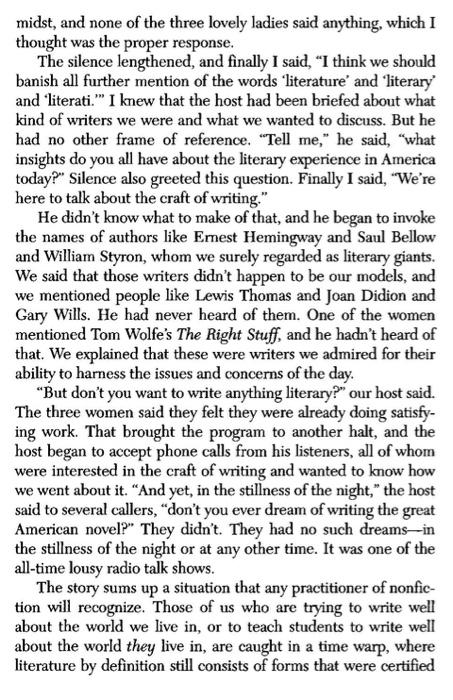
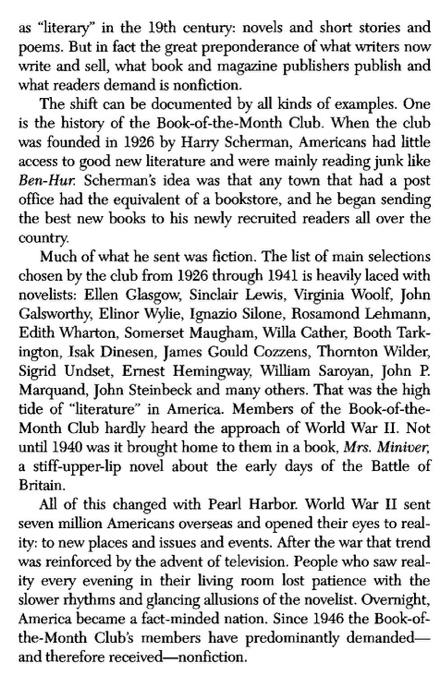
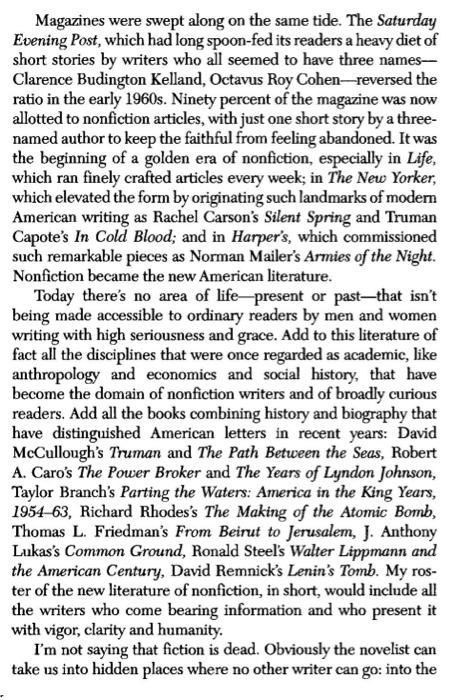
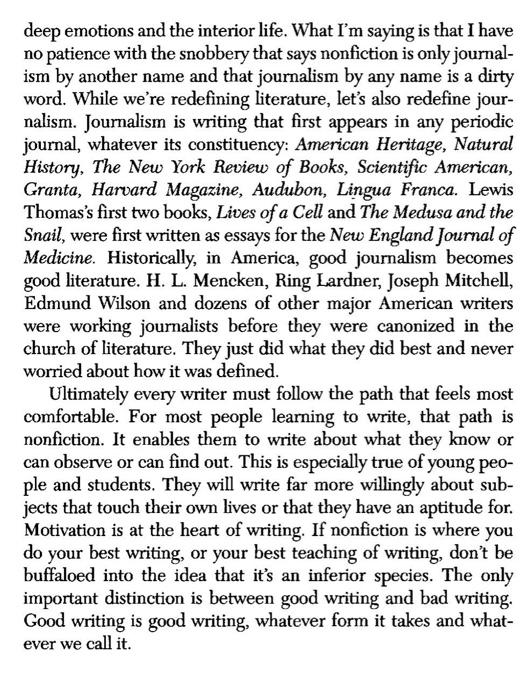
Nonfiction as Literature One weekend a few years ago I went to Buffalo to talk at a writ- ers' conference that had been organized by a group of women writers in that city. The women were serious about their craft, and the books and articles they had written were solid and use- ful. They asked me if I would take part in a radio talk show ear- lier in the week to publicize the conference--they would be with the host in the studio and I would be on a telephone hookup from my apartment in New York. The appointed evening arrived, and my phone rang, and the host came on and greeted me with the strenuous joviality of his trade. He said he had three lovely ladies in the studio with him and he was eager to find out what we all thought of the present state of literature and what advice we had for all his listeners who were members of the literati and had literary ambitions themselves. This hearty introduction dropped like a stone in our midst, and none of the three lovely ladies said anything, which I thought was the proper response. The silence lengthened, and finally I said, I think we should banish all further mention of the words 'literature and literary and literati."" I knew that the host had been briefed about what kind of writers we were and what we wanted to discuss. But he had no other frame of reference. "Tell me," he said, "what insights do you all have about the literary experience in America today?" Silence also greeted this question. Finally I said, "We're here to talk about the craft of writing." He didn't know what to make of that, and he began to invoke the names of authors like Emest Hemingway and Saul Bellow and William Styron, whom we surely regarded as literary giants. We said that those writers didn't happen to be our models, and we mentioned people like Lewis Thomas and Joan Didion and Gary Wills. He had never heard of them. One of the women mentioned Tom Wolfe's The Right Stuff, and he hadn't heard of that. We explained that these were writers we admired for their ability to harness the issues and concerns of the day. But don't you want to write anything literary?" our host said. The three women said they felt they were already doing satisfy- ing work. That brought the program to another halt, and the host began to accept phone calls from his listeners, all of whom were interested in the craft of writing and wanted to know how we went about it. And yet in the stillness of the night," the host said to several callers, don't you ever dream of writing the great American novel? They didn't. They had no such dreams-in the stillness of the night or at any other time. It was one of the all-time lousy radio talk shows. The story sums up a situation that any practitioner of nonfic- tion will recognize. Those of us who are trying to write well about the world we live in, or to teach students to write well about the world they live in, are caught in a time warp, where literature by definition still consists of forms that were certified as "literary in the 19th century: novels and short stories and poems. But in fact the great preponderance of what writers now write and sell, what book and magazine publishers publish and what readers demand is nonfiction. The shift can be documented by all kinds of examples. One is the history of the Book-of-the-Month Club. When the club was founded in 1926 by Harry Scherman, Americans had little access to good new literature and were mainly reading junk like Ben-Hur. Scherman's idea was that any town that had a post office had the equivalent of a bookstore, and he began sending the best new books to his newly recruited readers all over the country Much of what he sent was fiction. The list of main selections chosen by the club from 1926 through 1941 is heavily laced with novelists: Ellen Glasgow, Sinclair Lewis, Virginia Woolf, John Galsworthy, Elinor Wylie, Ignazio Silone, Rosamond Lehmann, Edith Wharton, Somerset Maugham, Willa Cather, Booth Tark- ington, Isak Dinesen, James Gould Cozzens, Thornton Wilder, Sigrid Undset, Emest Hemingway, William Saroyan, John P. Marquand, John Steinbeck and many others. That was the high tide of "literature" in America. Members of the Book-of-the- Month Club hardly heard the approach of World War II. Not until 1940 was it brought home to them in a book, Mrs. Miniver, a stiff-upper-lip novel about the early days of the Battle of Britain. All of this changed with Pearl Harbor. World War II sent seven million Americans overseas and opened their eyes to real- ity: to new places and issues and events. After the war that trend was reinforced by the advent of television. People who saw real- ity every evening in their living room lost patience with the slower rhythms and glancing allusions of the novelist. Overnight, America became a fact-minded nation. Since 1946 the Book-of- the-Month Club's members have predominantly demanded- and therefore received-nonfiction. Magazines were swept along on the same tide. The Saturday Evening Post, which had long spoon-fed its readers a heavy diet of short stories by writers who all seemed to have three names- Clarence Budington Kelland, Octavus Roy Cohen-reversed the ratio in the early 1960s. Ninety percent of the magazine was now allotted to nonfiction articles, with just one short story by a three- named author to keep the faithful from feeling abandoned. It was the beginning of a golden era of nonfiction, especially in Life, which ran finely crafted articles every week; in The New Yorker, which elevated the form by originating such landmarks of modem American writing as Rachel Carson's Silent Spring and Truman Capote's In Cold Blood; and in Harper's, which commissioned such remarkable pieces as Norman Mailer's Armies of the Night. Nonfiction became the new American literature. Today there's no area of life-present or pastthat isn't being made accessible to ordinary readers by men and women writing with high seriousness and grace. Add to this literature of fact all the disciplines that were once regarded as academic, like anthropology and economics and social history, that have become the domain of nonfiction writers and of broadly curious readers. Add all the books combining history and biography that have distinguished American letters in recent years: David McCullough's Truman and The Path Between the Seas, Robert A. Caro's The Power Broker and The Years of Lyndon Johnson, Taylor Branch's Parting the Waters: America in the King Years, 1954-63, Richard Rhodes's The Making of the Atomic Bomb, Thomas L. Friedman's From Beirut to Jerusalem, J. Anthony Lukas's Common Ground, Ronald Steel's Walter Lippmann and the American Century, David Remnick's Lenin's Tomb. My ros- ter of the new literature of nonfiction, in short, would include all the writers who come bearing information and who present it with vigor, clarity and humanity. I'm not saying that fiction is dead. Obviously the novelist can take us into hidden places where no other writer can go into the deep emotions and the interior life. What I'm saying is that I have no patience with the snobbery that says nonfiction is only journal- ism by another name and that journalism by any name is a dirty word. While we're redefining literature, let's also redefine jour- nalism. Journalism is writing that first appears in any periodic journal, whatever its constituency: American Heritage, Natural History, The New York Review of Books, Scientific American, Granta, Harvard Magazine, Audubon, Lingua Franca. Lewis Thomas's first two books, Lives of a Cell and The Medusa and the Snail, were first written as essays for the New England Journal of Medicine. Historically, in America, good journalism becomes good literature. H. L. Mencken, Ring Lardner, Joseph Mitchell, Edmund Wilson and dozens of other major American writers were working journalists before they were canonized in the church of literature. They just did what they did best and never worried about how it was defined. Ultimately every writer must follow the path that feels most comfortable. For most people learning to write, that path is nonfiction. It enables them to write about what they know or can observe or can find out. This is especially true of young peo- ple and students. They will write far more willingly about sub- jects that touch their own lives or that they have an aptitude for. Motivation is at the heart of writing. If nonfiction is where you do your best writing, or your best teaching of writing, don't be buffaloed into the idea that it's an inferior species. The only important distinction is between good writing and bad writing. Good writing is good writing, whatever form it takes and what- ever we call it Step by Step Solution
There are 3 Steps involved in it
1 Expert Approved Answer
Step: 1 Unlock

Question Has Been Solved by an Expert!
Get step-by-step solutions from verified subject matter experts
Step: 2 Unlock
Step: 3 Unlock
 Study Help